
Breast cyst treatment is often not needed at all. A simple breast cyst is a harmless, fluid-filled sac, and many shrink or disappear on their own. If a cyst is painful, large or unclear on ultrasound, a doctor can drain it with a fine needle in a few minutes. Surgery is rarely needed and is reserved for cysts that keep coming back, contain blood, or show solid areas on imaging.
A lump that appears suddenly, sometimes overnight, can be alarming. The good news is that cysts are among the most common and least worrying causes of a breast lump. This guide explains what a breast cyst is, how doctors confirm it, every treatment option from watchful waiting to drainage, how to ease cyst pain, what aftercare involves, and how to plan breast cyst treatment in Dhaka.
Most breast cysts are benign and need no treatment. Breast cyst treatment ranges from monitoring and simple pain relief to needle drainage (aspiration), with surgery kept for a small number of unusual or recurring cysts.
What Is a Breast Cyst?
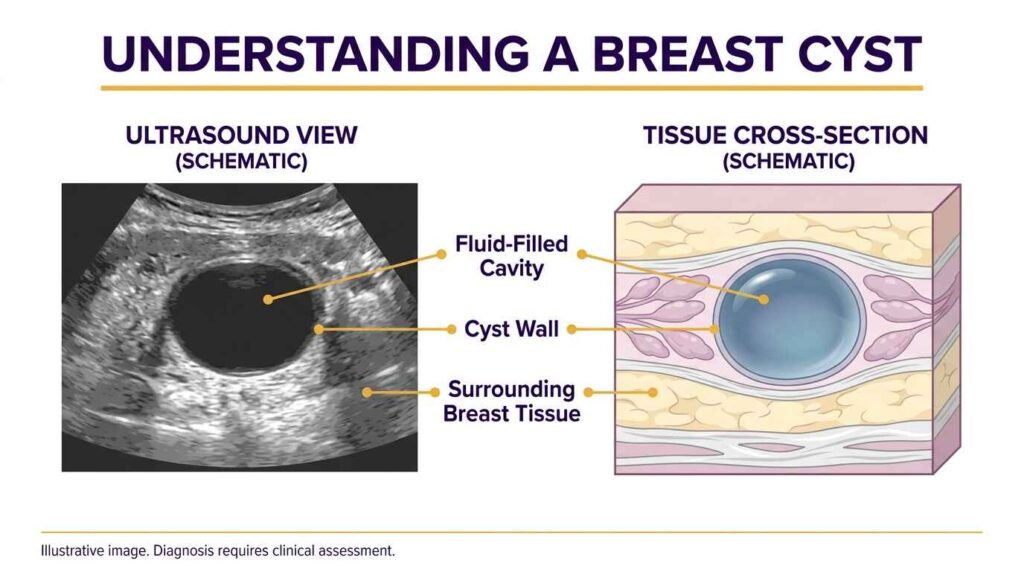
A breast cyst is a round or oval sac filled with fluid that forms inside breast tissue. It is benign, which means it is not cancer. Many people describe it as feeling like a grape or a water-filled balloon: smooth, movable and sometimes tender.
A few facts put cysts in perspective:
- They are most common between the ages of 30 and 50, and new cysts usually stop forming about a year after menopause, according to a StatPearls review on NCBI.
- About 7% of women develop a cyst large enough to feel at some point.
- A cyst can be smaller than a pea or several centimetres wide, and one or both breasts can have more than one.
- Women taking hormone therapy after menopause may continue to develop cysts.
Why do breast cysts form?
Cysts form when fluid collects in the milk glands. Monthly changes in oestrogen and progesterone appear to drive this, which is why cysts often appear, enlarge or feel sore just before a period and settle afterwards. They are not caused by wearing a bra, an injury or anything you ate.
Common symptoms
- A smooth, round lump with clear edges that moves under the skin
- Tenderness or a dull ache in the area
- A lump that grows or becomes sore before a period and shrinks after it
- Occasionally, nipple discharge that is clear, yellow, straw-coloured or dark brown
Types of breast cysts and what they mean for treatment
| Type | How it looks on ultrasound | Usual approach |
|---|---|---|
| Simple cyst | Thin wall, clear fluid, no solid parts | Benign; no treatment unless it is painful |
| Complicated cyst | Contains debris or thicker fluid but no solid part | Usually a short-interval follow-up scan or aspiration |
| Complex cyst | Thick wall, internal divisions or a solid component | Needs a biopsy to rule out cancer |
Cysts are often part of fibrocystic breast changes, a very common pattern of lumpy, sometimes tender breast tissue. To compare a cyst with other lumps, read our guide on when to see a doctor for a breast lump.
How Is a Breast Cyst Diagnosed Before Treatment?
Safe breast cyst treatment starts with knowing that the lump really is a cyst. A cyst and a solid lump can feel alike, so a doctor uses a short, step-by-step assessment:
- History and examination. The doctor asks when you noticed the lump, whether it changes with your cycle and about family history, then examines both breasts and armpits.
- Breast ultrasound. This is the key test. The Mayo Clinic notes that ultrasound is better than a mammogram at telling a fluid-filled cyst from a solid lump. It is painless and uses no radiation.
- Mammogram when appropriate. For women around 40 and older, a mammogram may be added to check the rest of the breast tissue.
- Fine-needle aspiration when needed. If the lump is painful or unclear, a thin needle draws out the fluid. This confirms the diagnosis and often treats the cyst at the same time.
If no fluid comes out, or the scan shows a solid area, the doctor may recommend a core needle biopsy to check the tissue.
What Is the Treatment for Breast Cysts?
A simple, painless breast cyst needs no treatment. A painful or large cyst can be drained with a fine needle. Surgery is rarely needed and is kept for cysts that keep returning, contain blood or have a solid part.
Breast cyst treatment depends on the cyst type, its size, your symptoms and your age. Here are the main options.
1. Watchful waiting (breast cyst treatment without surgery)
For a confirmed simple cyst that does not bother you, monitoring is the standard benign breast cyst treatment. Many cysts shrink or vanish within a few menstrual cycles. Your doctor may suggest a follow-up check and will ask you to report a cyst that grows, hardens or causes skin changes.
2. Fine-needle aspiration (drainage)
Aspiration is the most common active breast cyst treatment. The doctor, usually guided by ultrasound, passes a thin needle into the cyst and draws out the fluid. The lump typically disappears straight away and pain eases quickly.
What the fluid shows guides the next step:
- Clear, yellow or greenish fluid with the lump gone: usually no further tests are needed.
- Bloody fluid, or a lump that remains: the fluid goes for laboratory testing and the area is assessed further.
- No fluid at all: the lump may be solid and may need a core needle biopsy.
Cysts can refill, so a repeat drainage is sometimes needed. Large breast cyst treatment usually follows this route, because drainage gives fast relief from pressure and discomfort.
3. Treatment for breast cyst pain
If a cyst is tender, these steps can help while it settles:
- Wear a well-fitting, supportive bra, including at night if needed.
- Apply a warm or cold compress for 10 to 15 minutes.
- Take a simple pain reliever, such as paracetamol, after checking with your doctor.
- Try cutting down on caffeine for a few weeks. Evidence is limited, but some women notice less tenderness.
Hormonal treatment is occasionally considered for women with severe, recurring symptoms, but it has side effects and is decided case by case. Breast pain can also have other causes, explained in our article on breast pain causes.
4. Surgical removal
Surgical excision removes the whole cyst through a small cut and sends it for laboratory testing. It is uncommon and considered when a cyst returns again and again, the fluid is bloody, or imaging shows a solid component.
Comparing breast cyst treatment options
| Option | Best suited for | Main benefit | Main limitation |
|---|---|---|---|
| Watchful waiting | Small, simple, painless cysts | No procedure | The cyst may stay for a while |
| Fine-needle aspiration | Painful, large or unclear cysts | Quick relief and a diagnosis in one visit | The cyst can refill |
| Pain self-care | Tender cysts awaiting change | Simple and done at home | Eases symptoms only |
| Surgical excision | Recurring, bloody or complex cysts | Complete removal and full pathology | Small scar and longer recovery |
Do Breast Cysts Require Surgery?
Rarely. Most breast cysts never need an operation. The Mayo Clinic and StatPearls both describe surgery as an option for a small group of cysts:
- A cyst that keeps refilling after repeated drainage
- Bloody fluid on aspiration
- A solid part inside the cyst, or a lump that remains after drainage
- A biopsy result that does not fully explain the imaging findings
Complicated breast cyst treatment
A complicated cyst contains debris or thicker fluid but no solid part. It is very likely to be benign. Complicated breast cyst treatment usually means either a follow-up ultrasound after a few months or aspiration to confirm it. A complex cyst with a solid area is different and needs a biopsy.
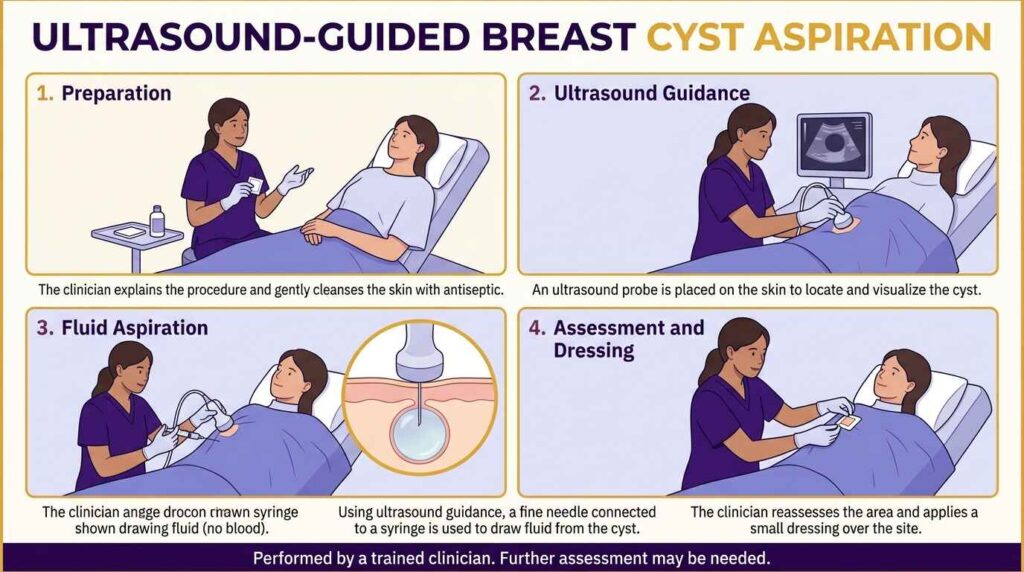
What happens during breast cyst aspiration?
- You lie down and the skin is cleaned. A local anaesthetic may be used.
- Using ultrasound, the doctor guides a fine needle into the cyst.
- The fluid is drawn into a syringe, usually within a few minutes.
- The doctor checks that the lump has gone and decides whether the fluid needs testing.
- A small plaster is applied and you go home the same day.
Is breast cyst removal painful?
Aspiration usually feels like a quick pinch, similar to a blood test, and the relief of pressure often outweighs the brief discomfort. Surgical removal is done under local or general anaesthesia, so you should not feel pain during it. Mild soreness afterwards is common and usually settles within a few days.
Breast cyst removal aftercare
- Keep the puncture site or wound clean and dry for 24 hours, or as advised.
- Wear a supportive bra to reduce movement and soreness.
- Use a cold pack and simple pain relief for minor bruising.
- After surgery, avoid heavy lifting and strenuous exercise until your surgeon confirms healing.
- Attend your follow-up to review any laboratory results.
Contact your doctor if you notice increasing redness, warmth, fever, pus, or a lump that quickly returns.
Breast Cyst Treatment Cost in Dhaka
There is no single fixed breast cyst treatment cost in Dhaka, because the total depends on what you actually need. For many women, the bill is simply a consultation and an ultrasound.
The main cost items are:
- Consultation and follow-up visits
- Breast ultrasound and a mammogram if advised
- Fine-needle aspiration, with or without ultrasound guidance
- Laboratory testing of the fluid, if needed
- Core needle biopsy, only if a solid area is found
- Surgery, anaesthesia and hospital charges, in the rare cases that need it
Breast cyst aspiration cost in Dhaka is usually far lower than surgery, as it is a short outpatient procedure. Before any procedure, ask for a written, itemised estimate and check whether imaging and laboratory fees are included. For current consultation fees, contact the chamber directly, as fees can change.
Breast Cyst Treatment in Dhaka with a Female Breast Surgeon
Many women put off a breast check because they feel uncomfortable being examined by a male doctor. Seeing a female surgeon in Dhaka can make it easier to speak openly and get assessed early.
Dr. Reshma Aziz is a female breast and colorectal surgeon who has provided medical and surgical care since 1996. Her qualifications and surgical training include breast surgery training at IPGMR (1998), a Diploma in Clinical Ultrasonography (2000) and an MS in Paediatric Surgery from the University of Dhaka (2003). She is registered with the Bangladesh Medical and Dental Council under number A-24611, which you can check through her official BMDC registration record.
During a breast surgery consultation in Dhaka, she reviews your history and examination, arranges the right scan, and explains whether monitoring, drainage or further tests suit you, before any decision is made.
- Breast cyst treatment in Mohammadpur, Dhaka: Dhaka Lab, 1/20 Humayun Road, College Gate. Saturday, Tuesday and Thursday, 11:30 AM to 1:30 PM.
- Gulshan chamber: Cure Medical Center & Hospital, House 15, Road 42, Gulshan-2. Saturday and Tuesday, 4:00 PM to 6:00 PM.
Confirm your serial on the appointment and visiting hours page before travelling. Patients outside Dhaka can start with a telemedicine consultation to review existing scan reports.
When Should You See a Doctor Quickly?
Book an early appointment if a breast lump:
- Feels hard, fixed or irregular rather than smooth and movable
- Stays after your period or keeps growing
- Comes back quickly after drainage
- Is red, hot and painful, especially with fever, which can signal infection or a breast abscess
- Comes with skin dimpling, a newly inverted nipple or bloody nipple discharge
- Appears after menopause, particularly if you are not on hormone therapy
These signs do not automatically mean cancer, but they need prompt assessment. Learn more in our guide to breast cancer symptoms. A lump that feels solid rather than fluid-filled may also be a fibroadenoma, covered in our fibroadenoma treatment guide.
Key Takeaways
- A breast cyst is a benign, fluid-filled sac, most common between ages 30 and 50.
- Ultrasound is the main test to confirm a cyst.
- Simple, painless cysts usually need no treatment.
- Painful or large cysts can be drained with a fine needle in one short visit.
- Surgery is rare and kept for recurring, bloody or complex cysts.
- Costs in Dhaka depend on the tests and procedures you need, so ask for an itemised estimate.
Frequently Asked Questions
Can a breast cyst go away on its own?
Yes. Many simple cysts shrink or disappear within a few menstrual cycles without any treatment. New cysts usually stop forming about a year after menopause unless you take hormone therapy.
Can a breast cyst turn into cancer?
A simple breast cyst does not turn into cancer and does not raise your breast cancer risk. Cancer inside a cyst is very rare and is usually linked to a complex cyst with a solid part, which is why unclear cysts are biopsied.
Will a breast cyst come back after drainage?
Some do. Most simple cysts disappear after aspiration, but a cyst can refill or a new one can form elsewhere. A cyst that refills quickly should be checked again, sometimes with a biopsy.
Can I drain a breast cyst at home?
No. Squeezing or puncturing a cyst at home can cause infection and bleeding, and it skips the checks that confirm the lump is a cyst. Drainage should be done by a doctor, ideally with ultrasound guidance.
Does caffeine cause breast cysts?
There is no proof that caffeine causes cysts. Some women find that cutting down on tea, coffee and soft drinks eases breast tenderness, so it is a reasonable thing to try.
Which doctor should I see for a breast cyst in Dhaka?
A breast surgeon is the right specialist, as she can examine you, arrange imaging and explain every breast cyst treatment option. Many women prefer a female breast surgeon for comfort and privacy.
Get Peace of Mind About Your Breast Lump
The right breast cyst treatment is often reassurance and a simple plan, not an operation. A short consultation and an ultrasound can usually tell you exactly what the lump is and whether it needs anything at all.
If you have noticed a new or painful breast lump, book an appointment with Dr. Reshma Aziz for a private assessment in Mohammadpur or Gulshan. Call +88-01948-444999 or message +88-01775-731935 on WhatsApp.