

Breast abscess treatment usually means draining the pus and taking antibiotics. A breast abscess is a collection of pus inside the breast, most often in breastfeeding mothers after mastitis. A doctor confirms it with ultrasound, then drains it with a fine needle or, for larger or complicated abscesses, through a small cut. Most mothers can keep breastfeeding during treatment.
The first weeks after birth are tiring enough without a painful, hot, swollen breast. Many new mothers in Dhaka are told to “just wait and see,” or worry that they must stop feeding their baby. This guide explains how a blocked duct, mastitis, and a breast abscess differ, the warning signs at each stage, every treatment option, recovery and aftercare, and what to expect from breast abscess treatment in Dhaka.
A blocked duct and early mastitis often settle with rest, regular feeding and simple pain relief. A breast abscess will not clear on its own. Breast abscess treatment needs drainage plus antibiotics, and it works best when started early.
Blocked Duct, Mastitis or Breast Abscess: What Is the Difference?
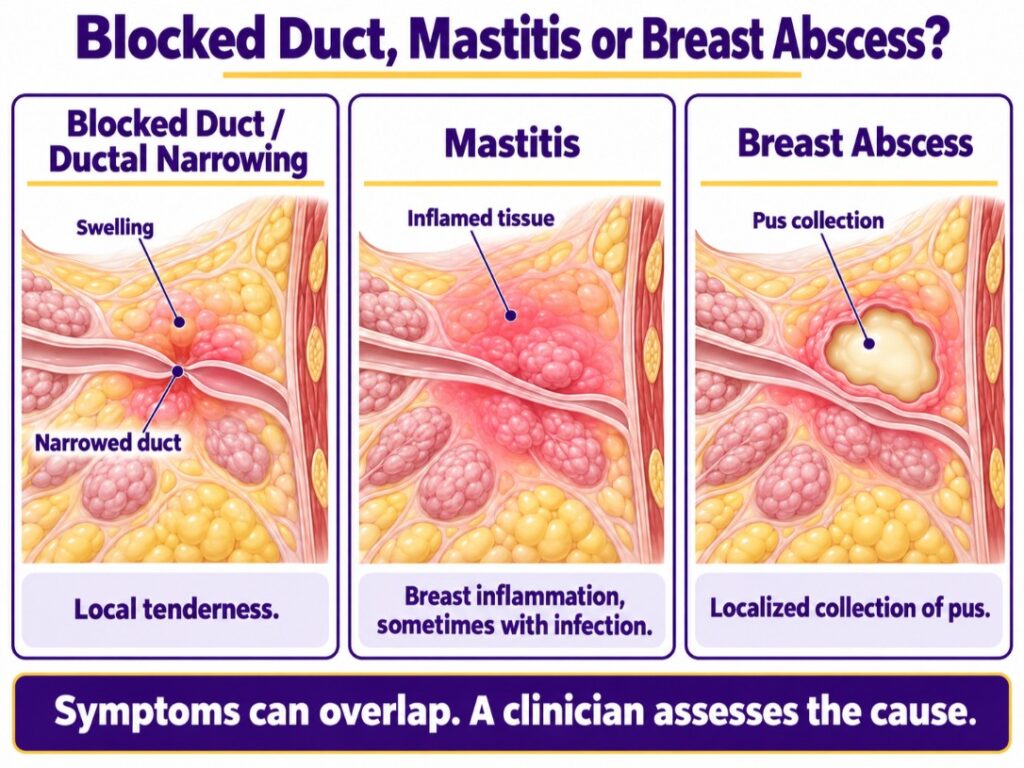
These three problems sit on one spectrum. Milk that is not draining well can cause a blocked duct, inflammation can turn into mastitis, and untreated or slow-to-settle infection can form an abscess.
- Blocked (plugged) duct: A tender, firm lump where milk is not flowing freely. You usually feel well otherwise.
- Mastitis: Inflammation of breast tissue, often with infection. The NHS describes a hot, swollen, painful area, sometimes wedge-shaped, with flu-like symptoms such as fever, chills and tiredness.
- Breast abscess: A walled-off pocket of pus. It feels like a tense, very tender lump that may soften in the centre, and it does not go away with feeding or antibiotics alone.
| Feature | Blocked duct | Mastitis | Breast abscess |
|---|---|---|---|
| Lump | Small, tender | Hard, wedge-shaped area | Tense, swollen, may feel fluid-filled |
| Skin | Normal or slightly pink | Red, hot | Red, shiny, sometimes thinning |
| Fever | Rare | Common | Common, may persist |
| Usual treatment | Feeding, rest, cold packs | Self-care, antibiotics if not improving | Drainage plus antibiotics |
Why does a breast abscess form?
Bacteria, most often Staphylococcus aureus from the skin, enter through a cracked nipple or a milk duct. If milk stays trapped and inflammation is not controlled, the body walls off the infection into a pocket of pus. Common triggers include:
- Cracked or sore nipples from poor latch
- Long gaps between feeds or a sudden switch to formula
- A tight bra or pressure from a sling strap
- Mastitis that was treated late or with an incomplete antibiotic course
- Smoking and diabetes, which slow healing
Abscesses can also occur in women who are not breastfeeding. These non-lactational abscesses often sit near the nipple, tend to recur, and are more common in smokers.
Breast abscess symptoms and treatment timing
Watch for these signs that mastitis may have become an abscess:
- A lump that stays or grows after 48 hours of antibiotics
- A swelling that feels soft or “boggy” in the middle
- Fever that does not settle
- Pus from the nipple or the skin
- Skin that looks shiny, purple or thin over the lump
Early breast abscess treatment is simpler and gentler, so do not wait for the lump to burst.
How Is a Breast Abscess Diagnosed?
A breast abscess is diagnosed with a clinical examination and a breast ultrasound. The steps are usually:
- History. The doctor asks how old your baby is, how feeding is going, when the pain started and what medicines you have taken.
- Examination. Both breasts and armpits are checked for a lump, redness, warmth and swollen glands.
- Breast ultrasound. This shows whether there is a pocket of pus, how big it is and whether it has more than one chamber. It is painless and safe while breastfeeding.
- Pus sample. Fluid drawn during drainage can be sent for culture so the antibiotic can be matched to the bacteria.
If an abscess keeps coming back, or a red, swollen breast does not improve with full treatment, the doctor may recommend a biopsy. The Mayo Clinic notes that rare conditions such as inflammatory breast cancer can look like mastitis, so persistent symptoms always need a second look. Learn more about warning signs in our guide to breast cancer symptoms.
What Are the Breast Abscess Treatment Options?
The main breast abscess treatment is drainage of the pus plus antibiotics. Small abscesses are usually drained with an ultrasound-guided needle. Large, multi-chambered abscesses, or those with thinning skin, may need a small surgical cut.
1. Antibiotics for breast abscess treatment
Antibiotics treat the surrounding infection, but on their own they rarely clear a formed abscess, because medicine cannot reach the centre of a pus pocket well. Your doctor will choose an antibiotic that is safe while breastfeeding. For mastitis, the Mayo Clinic notes that a course of about 10 days is common. Always finish the full course, even when you feel better.
2. Needle aspiration (breast abscess treatment without surgery)
Needle aspiration breast abscess treatment is now the first choice for many abscesses. Under local anaesthetic, the doctor uses ultrasound to guide a needle into the pocket and draws out the pus. A 2023 review in the Journal of Medical Radiation Sciences describes it as the recommended minimally invasive option for abscesses under about 3 to 5 cm, with better cosmetic results, faster healing, a shorter hospital stay and easier breastfeeding than surgery.
The trade-off is that aspiration may need to be repeated every few days until the pocket stays empty. Small breast abscess treatment almost always starts here.
3. Incision and drainage
For a large or multi-chambered abscess, or one where the skin over it is thin or breaking down, the surgeon makes a small cut, drains the pus and washes out the cavity. The wound may be left to heal from the inside out, sometimes with a light dressing or pack that is changed during follow-up. It is done under local or general anaesthesia, and most patients go home the same day.
Comparing breast abscess treatment options
| Option | Best suited for | Benefits | Limitations |
|---|---|---|---|
| Antibiotics alone | Mastitis without a pus collection | Simple, taken at home | Rarely clears a formed abscess |
| Needle aspiration | Small or medium, single-pocket abscesses | No cut, small mark, quicker healing | May need repeat visits |
| Incision and drainage | Large, multi-chambered abscesses or thin, damaged skin | Drains everything at once | Wound care and a visible scar |
Postpartum breast abscess treatment and feeding support
Postpartum breast abscess treatment works best when feeding problems are fixed at the same time. Ask for help with your baby’s latch and positioning, since a shallow latch is a common cause of cracked nipples and poor drainage. The NHS advises against stopping breastfeeding suddenly, because full breasts make inflammation worse.

Can You Breastfeed During Breast Abscess Treatment?
In most cases, yes. Continuing to feed or express keeps milk moving and helps the breast heal. Your baby can usually feed from the unaffected breast as normal. On the affected side:
- Feed as usual if the drainage site is well away from the nipple and areola.
- If the wound is close to the nipple, or feeding is too painful, express milk by hand or pump from that side until it heals.
- Offer the affected side often enough that it does not become overfull.
Your doctor will choose medicines that are compatible with breastfeeding. The NHS notes that a very small amount of antibiotic may reach breast milk and can make a baby a little unsettled, but it is not harmful.
Breast Abscess Drainage Recovery Time
Breast abscess drainage recovery time depends on the method and the size of the abscess:
- After needle aspiration: Pain and fever often ease within 1 to 3 days. Follow-up scans check whether more drainage is needed.
- After incision and drainage: The wound heals from the inside out and often takes a few weeks to close fully, with regular dressing checks.
- Return to normal routine: Most mothers manage light daily activities within days, depending on pain and wound care.
Breast Abscess Drainage Aftercare
Good aftercare speeds healing and lowers the chance of the abscess coming back:
- Finish the full antibiotic course.
- Keep the dressing clean and dry, and change it as your doctor advises.
- Use paracetamol or ibuprofen for pain if your doctor agrees. Avoid aspirin while breastfeeding.
- Apply a cold compress for about 10 minutes at a time to ease swelling.
- Wear a soft, supportive bra without underwire, and avoid tight straps.
- Do not massage the area hard or squeeze the lump.
- Attend every follow-up visit and scan.
Contact your doctor promptly if fever returns, redness spreads, pain worsens, or the swelling refills.

Breast Abscess Treatment Cost in Dhaka
There is no single fixed breast abscess treatment cost in Dhaka. The total depends on how early the abscess is caught and which method it needs. The main cost items are:
- Consultation and follow-up visits
- Breast ultrasound, sometimes repeated to check progress
- Needle aspiration, which may need more than one session
- Pus culture and laboratory tests
- Antibiotics and pain relief
- Incision and drainage, anaesthesia, dressings and hospital charges, if surgery is needed
Breast abscess drainage cost in Dhaka is usually lower with needle aspiration than with surgical drainage, because aspiration is a short outpatient procedure. Treating mastitis early is the best way to avoid an abscess and its costs. Ask for a written, itemised estimate before any procedure, and contact the chamber directly for current consultation fees.
Breast Abscess Treatment in Dhaka with a Female Breast Surgeon
Many new mothers delay a breast examination because they feel uncomfortable seeing a male doctor, especially while breastfeeding. A female surgeon in Dhaka can make it easier to speak openly and be examined early.
Dr. Reshma Aziz is a female breast and colorectal surgeon who has provided medical and surgical care since 1996. Her qualifications and surgical training include breast surgery training at IPGMR (1998), a Diploma in Clinical Ultrasonography (2000) and an MS in Paediatric Surgery from the University of Dhaka (2003). She is registered with the Bangladesh Medical and Dental Council under number A-24611, which you can check through her official BMDC registration record.
Her practice also offers antenatal and postnatal breast care. During a breast surgery consultation in Dhaka, she examines you, arranges an ultrasound and explains whether self-care, antibiotics or drainage suits you.
- Breast abscess treatment in Mohammadpur, Dhaka: Dhaka Lab, 1/20 Humayun Road, College Gate. Saturday, Tuesday and Thursday, 11:30 AM to 1:30 PM.
- Breast abscess treatment in Gulshan, Dhaka: Cure Medical Center & Hospital, House 15, Road 42, Gulshan-2. Saturday and Tuesday, 4:00 PM to 6:00 PM.
Confirm your serial on the appointment and visiting hours page before travelling. A breast abscess needs an in-person examination, but a telemedicine consultation can help you decide how urgently to come in.
When Should a New Mother See a Doctor Urgently?
Seek same-day care if you have:
- A high fever, shivering or feeling very unwell
- Redness that spreads quickly across the breast
- No improvement 48 hours after starting antibiotics
- A lump that keeps growing, or pus leaking from the skin or nipple
- A red, swollen breast while you are not breastfeeding
How to Prevent Blocked Ducts and Breast Abscess
- Feed often and let your baby finish the first breast before switching.
- Get help early with latch if your nipples crack or bleed.
- Avoid long gaps between feeds and do not stop breastfeeding suddenly.
- Choose loose, comfortable bras and avoid pressure from straps.
- Treat a tender lump or flu-like symptoms promptly, rather than waiting.
Key Takeaways
- Blocked duct, mastitis and abscess are stages of one problem.
- An abscess is confirmed by ultrasound and needs drainage plus antibiotics.
- Needle aspiration is the first choice for most small abscesses.
- Most mothers can keep breastfeeding during treatment.
Frequently Asked Questions
Can a breast abscess heal without drainage?
Rarely. Antibiotics alone seldom clear a formed pus pocket. Drainage, usually by needle, is what allows it to heal.
Is breast abscess drainage painful?
Local anaesthetic numbs the skin, so most women feel pressure rather than sharp pain. Soreness afterwards usually eases within a few days.
Will a breast abscess come back?
It can, especially if feeding problems continue or the antibiotic course is not finished. Non-lactational abscesses in smokers recur more often.
Is pus in breast milk harmful to my baby?
Your doctor will advise on the affected side. In most cases, feeding from the unaffected breast continues normally, and milk from the affected side can be expressed until the wound heals.
Get Prompt, Private Care
A painful, swollen breast is not something new mothers should simply endure. Early assessment often means a simpler breast abscess treatment and a faster return to comfortable feeding.
Book an appointment with Dr. Reshma Aziz for a private assessment in Mohammadpur or Gulshan. Call +88-01948-444999 or message +88-01775-731935 on WhatsApp.