
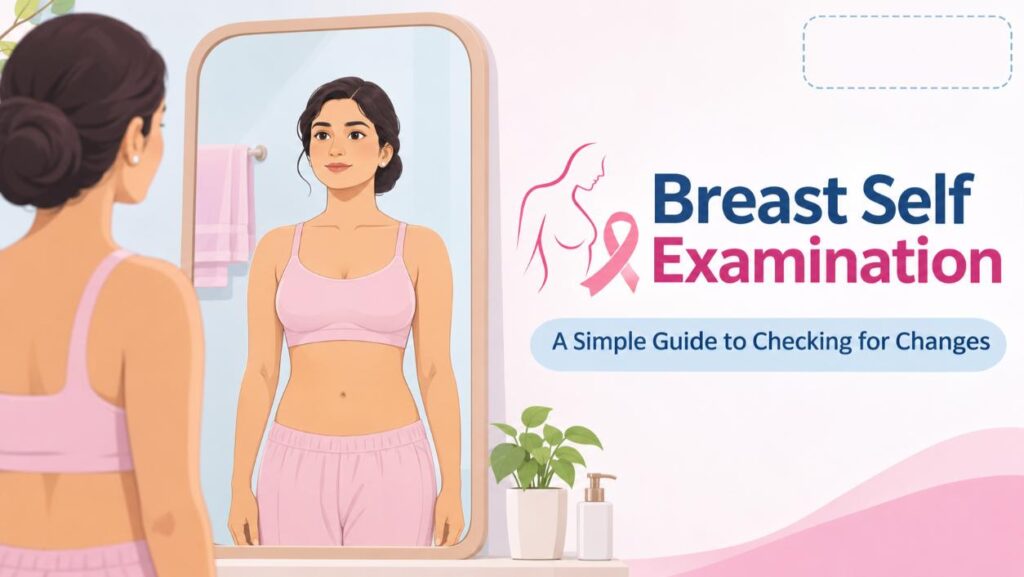
Noticing a change in your breast can be unsettling, especially when you are not sure what is normal for your body. A regular breast self-examination helps you learn how your breasts usually look and feel, so a new change is easier to spot.
A breast self examination is a simple home check in which you look at and feel your breasts and armpits for changes. Do it once a month, ideally a few days to a week after your period ends. It does not replace a clinical breast examination or a mammogram, and any new lump or change should be checked by a doctor.
This guide covers the exact steps, the best time to check, what an abnormal lump may feel like, and when to book an assessment in Dhaka.
What Is Breast Self Examination?
A breast self examination (BSE) is a structured way of checking your own breasts by sight and touch. The goal is not to diagnose anything. The goal is to know your normal, so you can report a change early.
Doctors now often use the term breast self-awareness, which simply means being familiar with how your breasts look and feel across the month and through life stages such as pregnancy and menopause.
Why Breast Self Examination Still Matters
According to the World Health Organization breast cancer fact sheet, early diagnosis depends on women recognising warning signs and seeking medical advice promptly. The WHO also notes that breast cancer deaths fall when the disease is found and treated early, and that most breast lumps are not cancer.
It is fair to be clear about the evidence. The American Cancer Society stopped recommending formal monthly self-exams as a screening tool for women at average risk, because studies did not show a clear survival benefit when women were also having regular screening. Many specialists still teach the steps, because a methodical check is a practical way to build breast awareness.
Benefits of a regular self-check
- Helps you recognise your normal breast texture
- Encourages earlier reporting of new changes
- Costs nothing and takes about 10 minutes
Limitations to keep in mind
- Cannot detect cancers that are too small or deep to feel
- Cannot tell a harmless lump from a harmful one
- Is not a substitute for a doctor’s examination or imaging
Breast Self Examination Best Time: When Should You Check?
The best time for a breast self examination after menstruation is a few days to a week after your period ends, when your breasts are least likely to be swollen or tender.
Before a period, hormones often make breasts tender and lumpy, especially near the armpit, which can make normal tissue feel suspicious. Our guide to breast pain before your period explains this in more detail.
| Life stage | When to do breast self examination |
|---|---|
| Regular periods | A few days to a week after your period ends |
| Irregular periods | One fixed date each month |
| After menopause | The same date every month, such as the 1st |
| Pregnancy | Once a month, knowing breasts naturally enlarge and change |
| Breastfeeding | After feeding or pumping, when breasts are less full |
Consistency matters more than the exact day, because it lets you compare like with like.
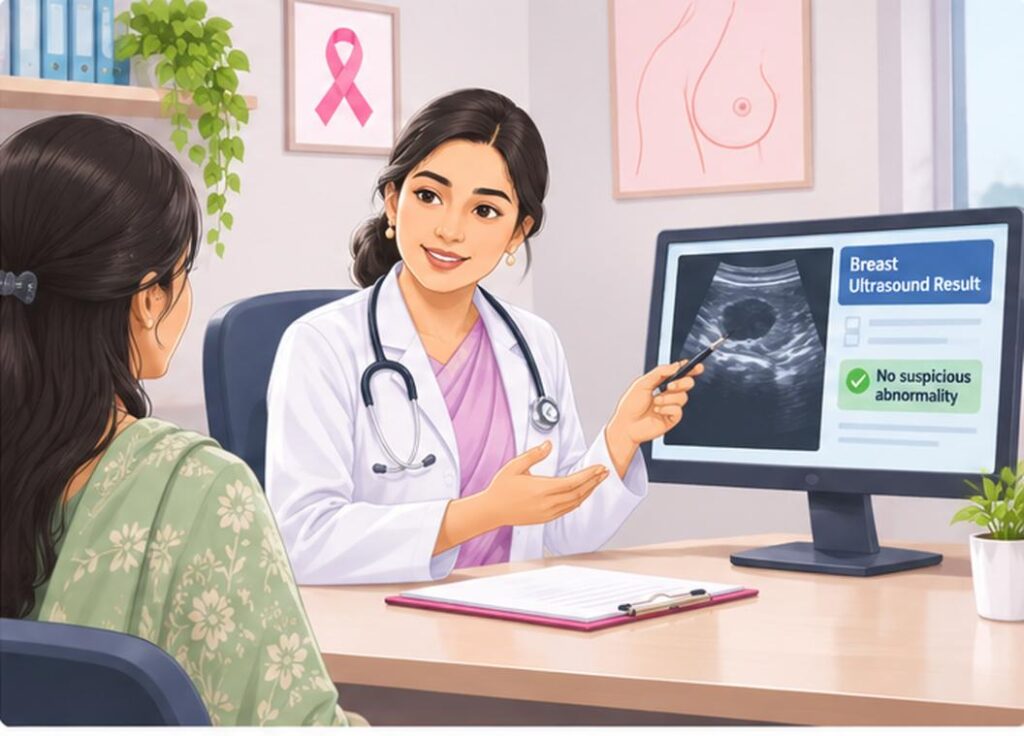
Breast Self-Examination Steps: How to Do It at Home
Set aside about 10 minutes in a private, well-lit room and follow these steps in order.
Step 1: Look in the Mirror With Arms Down
Stand facing a mirror with your arms relaxed at your sides. Look for:
- A change in size, shape, or outline of either breast
- Dimpling, puckering, or skin that looks like orange peel
- Redness, rash, or scaling on the skin or nipple
- A nipple that has newly turned inward or changed position
One breast is often slightly larger than the other. What matters is a change from your usual appearance.
Step 2: Raise Your Arms and Look Again
Lift both arms above your head and check for the same changes. Then press your hands firmly on your hips to tighten the chest muscles and look once more. These positions can reveal dimpling that stays hidden when you are relaxed.
Step 3: Check the Nipples
Look for any fluid on the nipple or inside your bra, such as clear, milky, yellow, or blood-stained discharge. You do not need to squeeze the nipple. Learn more about nipple discharge causes and warning signs.
Step 4: Feel Your Breasts While Lying Down
Lying down spreads breast tissue evenly, which makes it easier to feel.
- Lie on your back with a pillow under your right shoulder and your right arm behind your head.
- Use the flat pads of the three middle fingers of your left hand, not the fingertips.
- Move in small, coin-sized circles.
- Use three levels of pressure at each spot: light for the skin, medium for the middle tissue, and firm for the deep tissue near the ribs.
- Follow an up-and-down pattern from the collarbone to the bra line and from the armpit to the breastbone.
- Switch sides and repeat on the left breast with your right hand.
Step 5: Repeat Standing or in the Shower
Wet, soapy skin makes it easier for many women to feel the tissue. Repeat the same circles while standing, paying close attention to the armpit and the area up to the collarbone.
Step 6: Write Down What You Notice
Keep a short note on your phone with the date and any areas that felt lumpy. Over a few months, this record makes new changes much easier to spot.
For an illustrated version of these steps, see Memorial Sloan Kettering Cancer Center’s patient guide to breast self-awareness and self-exams.
What Does a Breast Lump Feel Like During a Self Exam?
Normal breast tissue often feels slightly lumpy or rope-like, especially in the upper outer area near the armpit. A firm ridge along the lower curve of the breast is also normal.
| Often normal | Should be checked by a doctor |
|---|---|
| Lumpiness that feels similar on both sides | A new lump that feels different from the surrounding tissue |
| Tenderness that settles after a period | A lump that stays after your next period |
| A firm ridge under the lower curve of the breast | A hard, irregular, or fixed lump that does not move easily |
| General lumpiness you have always had | Thickening in one area or a lump in the armpit |
Some benign lumps have typical features. A fibroadenoma is often smooth, rubbery, and moves under the fingers. A breast cyst may feel soft or firm and can be tender. Even so, touch alone cannot confirm what a lump is. Our guide to the types of breast lumps explains the common causes.
Breast Self Examination Abnormal Findings to Report
See a doctor if your breast self examination shows any of the following:
- A new lump or thickening in the breast or armpit
- A change in breast size or shape that is new for you
- Dimpling, puckering, or orange-peel skin
- A nipple that has newly turned inward
- A rash, crusting, or sore on the nipple that does not heal
- Discharge that is bloody or comes from one breast without squeezing
- Swelling around the collarbone or armpit
- Pain in one specific spot that does not go away
Breast pain on its own is rarely caused by cancer, but persistent pain still deserves attention. Read when breast pain needs a doctor and review the main breast cancer symptoms so you know what to watch for.
Seek care the same day if a breast becomes red, hot, swollen, and painful, especially with fever. This can signal an infection or abscess that needs prompt treatment.
Breast Self Exam vs Mammogram vs Clinical Breast Examination
These three methods work together, and none replaces the others.
| Feature | Breast self examination | Clinical breast examination | Mammogram |
|---|---|---|---|
| Who does it | You, at home | A trained doctor | A radiology team |
| How it works | Looking and feeling | A systematic hands-on examination | A low-dose breast X-ray |
| Main strength | Knowing your normal | Trained hands and clinical judgement | Can show changes too small to feel |
| Main limitation | Cannot identify the cause of a lump | Cannot see inside the tissue | Less clear in dense breast tissue |
Ultrasound is often added for younger women with dense breasts. When to start routine mammograms depends on age and personal risk, so ask your doctor.
Found a Lump After Breast Self Examination? What to Do Next
Most breast lumps are benign, so try not to panic. Still, do not wait months to see whether it disappears.
- Note the details: where the lump is, its approximate size, and whether it hurts.
- Book an assessment: a doctor can tell you whether a recheck after your next period is reasonable.
- Bring your notes: include your cycle dates, family history, and current medicines.
- Expect a step-by-step evaluation: usually a clinical breast examination, imaging such as ultrasound or mammogram, and sometimes a needle biopsy.
If being examined feels uncomfortable, seeing a female doctor in Dhaka can make the first visit easier. If you have found a breast lump after self examination in Dhaka, a breast surgery consultation in Dhaka can give you a clear diagnosis and a plan, whether that means reassurance, monitoring, or treatment.
Health Education Regarding Breast Self Examination: Common Mistakes
Avoid these errors to make each check more useful:
- Using fingertips instead of finger pads: fingertips miss deeper tissue.
- Pressing too lightly: use all three pressure levels.
- Skipping the armpit and collarbone: breast tissue extends into both areas.
- Checking the week before a period: normal swelling can cause false alarms.
- Assuming no family history means no risk: the WHO notes that most women diagnosed with breast cancer have no known family history.
Men can also develop breast cancer, although it is uncommon. Any man who notices a lump behind the nipple should have it examined.
Key Takeaways
- A breast self examination helps you learn what is normal for your body.
- Check a few days to a week after your period, or on a fixed date after menopause.
- Most breast lumps are not cancer, but every new lump needs a doctor’s assessment.
- Self-checks support, but never replace, clinical examination and imaging.
Frequently Asked Questions
How often should I do a breast self examination?
Once a month is enough. Checking much more often can make gradual changes harder to notice.
At what age should I start breast self examination?
Many breast health organisations encourage women to become familiar with their breasts from their early twenties and to continue throughout life.
Is breast self examination enough to detect breast cancer?
No. Some cancers are too small or deep to feel, so self-checks should be combined with clinical breast examinations and any screening your doctor recommends.
Is it normal for my breasts to feel lumpy?
Yes. Many women have naturally lumpy breast tissue. The key is noticing a new lump or an area that feels different from the rest.
Where can I see a breast self examination doctor in Dhaka?
You can book a breast screening consultation in Dhaka with Dr. Reshma Aziz at Dhaka Lab, Mohammadpur, or Cure Medical Center & Hospital, Gulshan.
Conclusion: Make Breast Awareness a Monthly Habit
A breast self examination takes only a few minutes each month. Keep a short record, act promptly on any change, and remember that most findings turn out to be harmless.
If you have noticed a lump, nipple change, or persistent breast pain, consult Dr. Reshma Aziz for an individual assessment. Book an appointment to discuss your symptoms and options in a private, respectful setting.
About Dr. Reshma Aziz
Dr. Reshma Aziz is a female breast and colorectal surgeon in Dhaka. She completed her MBBS at Dow Medical College, her MS in Paediatric Surgery at the University of Dhaka, and breast surgery training at the Institute of Post Graduate Medical Research (IPGMR), and she holds a Diploma in Clinical Ultrasonography. Patients can verify her BMDC registration (A-24611) and review her full qualifications and surgical training.
Chambers:
- Dhaka Lab, Mohammadpur: Saturday, Tuesday, Thursday, 11:30 AM to 1:30 PM
- Cure Medical Center & Hospital, Gulshan: Saturday, Tuesday, 4:00 PM to 6:00 PM
Phone: +88-019-48-444-999 | WhatsApp: +88-017-75-73-19-35 (please confirm the schedule before visiting)
This article is for general health education and does not replace a personal medical consultation.