
Fibroadenoma treatment usually begins with confirming the diagnosis, not with surgery. Once a breast examination, ultrasound and, when needed, a core needle biopsy show that a lump is a simple fibroadenoma, many women can safely monitor it. Removal is considered when the lump is large, grows quickly, causes pain, changes the shape of the breast, or when test results are unclear.
Finding a breast lump is frightening, even when someone says it is “probably nothing.” This guide explains what a fibroadenoma is, how doctors confirm it, every realistic treatment option, what recovery involves, and how to plan fibroadenoma treatment in Dhaka.
A fibroadenoma is a common, non-cancerous breast lump. Fibroadenoma treatment ranges from simple monitoring to removal, depending on your age, the lump’s size and growth, your symptoms, your test results and your own preference.
What Is a Fibroadenoma?
A fibroadenoma is a solid, benign breast tumour made of glandular tissue and supporting fibrous tissue. It usually feels smooth, firm or rubbery and slides easily under the fingers, which is why doctors sometimes call it a “breast mouse.”
- It is most common between the ages of 14 and 35, although it can appear at any age.
- An estimated 10% of women worldwide develop one at some point, according to a StatPearls review on NCBI.
- It responds to oestrogen and progesterone, so it may grow in pregnancy and often shrinks after menopause.
- Some women have more than one.
Types of fibroadenoma and why the type matters
| Type | What it means | Effect on treatment |
|---|---|---|
| Simple | The most common form, with uniform tissue | Often suitable for monitoring |
| Complex | Contains extra changes such as cysts or calcifications | Slightly higher future breast cancer risk, so closer follow-up or removal may be advised |
| Juvenile | Occurs in adolescents and can grow quickly | Monitoring or surgery, depending on growth |
| Giant | Usually larger than 5 cm | Surgical removal is standard |
A fibroadenoma is not caused by tight bras, food or minor knocks to the breast. To understand other causes of a new lump, read our guide on when to see a doctor for a breast lump.
How Is a Fibroadenoma Diagnosed Before Treatment?
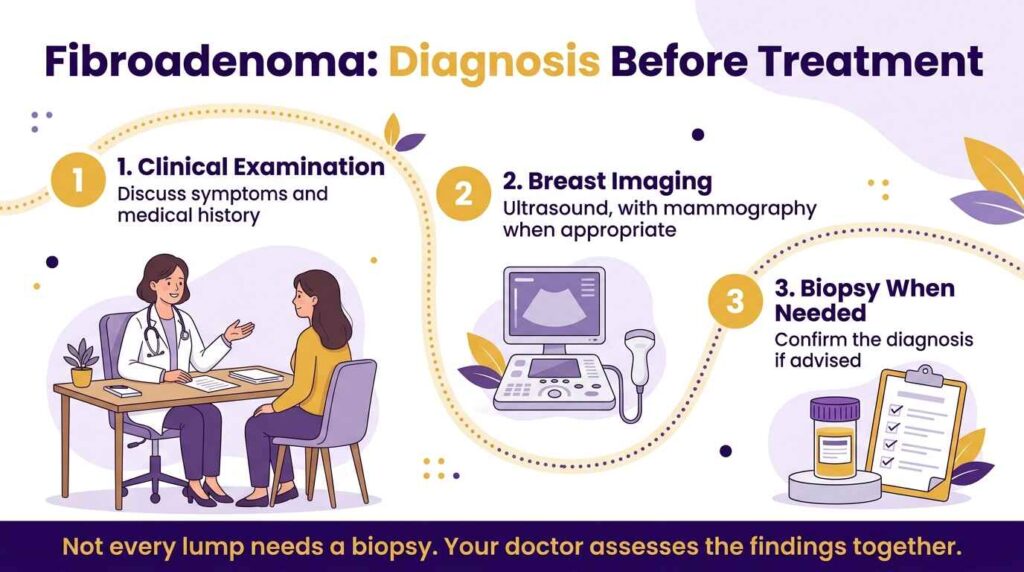
Safe fibroadenoma treatment depends on an accurate diagnosis. Cysts, phyllodes tumours and, rarely, cancers can feel similar, so specialists use “triple assessment”:
- Clinical examination. The doctor asks when you noticed the lump, whether it changes with your cycle, and about family history, then examines both breasts and armpits.
- Imaging. Ultrasound is the main test for women under 30, as it shows whether a lump is solid or fluid-filled without radiation. A mammogram may be added for older women, as the Mayo Clinic explains.
- Biopsy when needed. A core needle biopsy takes small tissue samples under ultrasound guidance so a pathologist can confirm the diagnosis.
Not every young woman with a typical-looking lump needs a biopsy. The decision depends on age, imaging features and whether all findings agree.
What Are the Fibroadenoma Treatment Options?
There are four main fibroadenoma treatment options. Your doctor will explain which are suitable and available for you.
1. Active monitoring (fibroadenoma treatment without surgery)
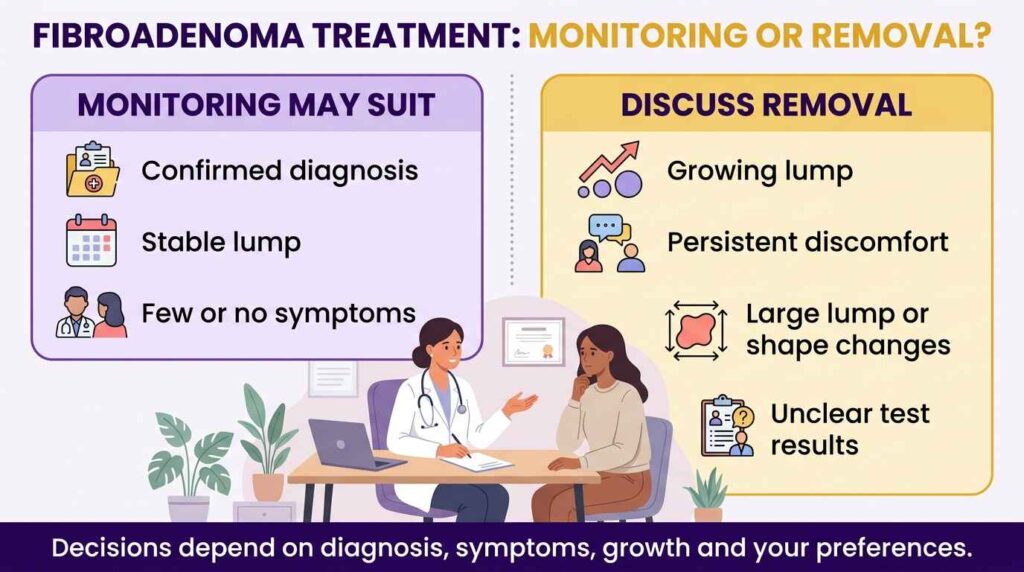
For a small, confirmed, symptom-free fibroadenoma, monitoring is often the best first choice. It is a planned approach, not neglect:
- Recording the lump’s size and appearance on ultrasound
- A follow-up visit or scan at an interval your doctor sets
- Reporting any growth, pain or new symptoms between visits
The UK’s National Institute for Health and Care Excellence (NICE) notes that most simple fibroadenomas do not grow, and some disappear over time.
2. Surgical excision
The surgeon removes the whole lump through a small cut, often placed along the areola edge or a natural skin crease to limit the visible scar. The tissue goes to a laboratory for a final diagnosis. This is the most widely available method in Bangladesh and the standard approach for giant fibroadenomas and phyllodes tumours.
3. Vacuum-assisted excision
An ultrasound-guided needle removes the lump in small pieces through a tiny skin opening. NICE recognises it for symptomatic fibroadenomas under local or general anaesthesia. It suits selected smaller lumps and needs specialised equipment.
4. Cryoablation and other ablation methods
Cryoablation freezes and destroys a biopsy-confirmed fibroadenoma with a thin probe; radiofrequency ablation uses heat. The tissue stays in place, not every lump qualifies, and availability is limited, including in Dhaka.
Comparing fibroadenoma treatment options
| Option | Best suited for | Main advantage | Main limitation |
|---|---|---|---|
| Active monitoring | Small, stable, confirmed lumps | No operation or scar | Needs regular follow-up |
| Surgical excision | Large, growing, painful or uncertain lumps | Complete removal and final pathology | Scar and anaesthesia |
| Vacuum-assisted excision | Selected smaller lumps | Very small skin opening | Limited availability and size limits |
| Cryoablation | Selected confirmed lumps | No cut for removal | Rarely available; lump is not removed |
Can medicine or home remedies dissolve a fibroadenoma?
No. No tablet, herbal product, cream or diet has been proven to dissolve a fibroadenoma. Relying on such products can delay a proper diagnosis.
Should a Fibroadenoma Be Removed?
Not always. A confirmed simple fibroadenoma can usually stay in place. Removal is generally advised when the lump is larger than about 2 cm, grows quickly, causes symptoms, shows complex features, recurs, or causes significant anxiety.
These indications come from a clinical review in the British Journal of Hospital Medicine and the StatPearls review. Size is not the whole story; your age, growth rate and preference also shape the fibroadenoma treatment plan.
Fibroadenoma monitoring vs surgery
| Monitoring | Surgery | |
|---|---|---|
| Pros | No scar, no anaesthesia, no recovery time | Lump gone, final diagnosis confirmed |
| Cons | Follow-up visits; the lump stays | Small scar, possible shape change, recovery time |
| Good fit if | Lump is small, stable and typical | Lump is large, growing, painful or unclear |
Painful fibroadenoma treatment
Most fibroadenomas are painless, though some feel tender before a period. A supportive bra and simple pain relief advised by your doctor often help. Persistent pain that affects daily life is a valid reason to discuss removal. Pain can also have other causes, explained in our article on breast pain causes.
Juvenile fibroadenoma treatment
In teenagers, a fibroadenoma can grow quickly. Juvenile fibroadenoma treatment aims to protect the developing breast: a stable lump is usually observed, while a rapidly enlarging or giant lump is removed with care to preserve normal tissue.
Fibroadenoma during pregnancy
Hormones can make an existing fibroadenoma grow during pregnancy or breastfeeding. Any change should be checked, usually with ultrasound. Surgery is generally postponed unless the lump is concerning.
Fibroadenoma Surgery Recovery Time: What to Expect
Removal is usually a short day-care procedure, and many patients go home the same day. Recovery depends on lump size, incision and anaesthesia type.
- First 1 to 2 days: Mild soreness, bruising and swelling, eased by a supportive bra and prescribed pain relief.
- First week: Most people return to light activities and desk work within a few days.
- Following weeks: Heavy lifting and strenuous exercise resume once your surgeon confirms healing.
- Pathology review: Attend follow-up to discuss the final laboratory report.
Contact your surgical team if you notice spreading redness, fever, worsening pain, wound discharge or sudden breast swelling.
Fibroadenoma Treatment Cost in Dhaka
There is no single fixed fibroadenoma treatment cost in Dhaka. The total depends on:
- Consultation and follow-up visits
- Ultrasound or mammogram
- Core needle biopsy and pathology, if needed
- Procedure type and the size or number of lumps
- Anaesthesia, hospital and theatre charges
- Histopathology of the removed lump and medicines
If monitoring suits you, the main cost is consultation and periodic ultrasound. Fibroadenoma removal surgery cost in Dhaka is higher because it adds theatre, anaesthesia and pathology charges. Ask for a written, itemised estimate before agreeing to surgery. For current consultation fees, contact the chamber directly, as fees can change.
Fibroadenoma Treatment in Dhaka with a Female Breast Surgeon
Many women delay a breast examination because they feel uncomfortable seeing a male doctor. Choosing a female surgeon in Dhaka can make it easier to speak openly and get checked early.
Dr. Reshma Aziz is a female breast and colorectal surgeon who has provided medical and surgical care since 1996. Her qualifications and surgical training include breast surgery training at IPGMR (1998), a Diploma in Clinical Ultrasonography (2000) and an MS in Paediatric Surgery from the University of Dhaka (2003). She is registered with the Bangladesh Medical and Dental Council under number A-24611, which you can check through her official BMDC registration record.
During a breast surgery consultation in Dhaka, she reviews your history and examination, arranges the right investigations and explains whether monitoring or removal suits you, before any decision is made.
- Fibroadenoma treatment in Mohammadpur, Dhaka: Dhaka Lab, 1/20 Humayun Road, College Gate. Saturday, Tuesday and Thursday, 11:30 AM to 1:30 PM.
- Fibroadenoma treatment in Gulshan, Dhaka: Cure Medical Center & Hospital, House 15, Road 42, Gulshan-2. Saturday and Tuesday, 4:00 PM to 6:00 PM.
Confirm your serial on the appointment and visiting hours page before travelling. Patients outside Dhaka can ask about a telemedicine consultation to review existing reports first.
When Should You See a Doctor Urgently?
Book an early appointment if a breast lump:
- Grows noticeably over weeks
- Feels hard, fixed or irregular
- Comes with skin dimpling, puckering or redness
- Is accompanied by bloody nipple discharge or a newly inverted nipple
- Appears with a lump in the armpit
- Develops after menopause
These signs do not automatically mean cancer, but they need prompt assessment. Learn more in our guide to breast cancer symptoms.
Key Takeaways
- A fibroadenoma is a common, benign breast lump, most often found between ages 14 and 35.
- Diagnosis uses examination, imaging and biopsy when needed.
- Many confirmed fibroadenomas can be monitored without surgery.
- Removal is considered for lumps over about 2 cm, rapid growth, symptoms or unclear results.
- No medicine or home remedy reliably dissolves a fibroadenoma.
- Costs in Dhaka vary, so ask for an itemised estimate.
Frequently Asked Questions
Can a fibroadenoma go away without treatment?
Yes, sometimes. Some fibroadenomas shrink or disappear over months or years, especially in younger women and after menopause. Others stay the same size for life. Both outcomes are normal for a confirmed fibroadenoma.
Can a fibroadenoma turn into breast cancer?
A simple fibroadenoma very rarely involves cancer and does not meaningfully raise breast cancer risk. A complex fibroadenoma carries a slightly higher future risk, which is why accurate diagnosis and follow-up matter.
Will a fibroadenoma come back after removal?
A completely removed fibroadenoma does not grow back in the same place. A new one can form elsewhere in the breast, so any new lump should be checked.
Is fibroadenoma removal painful?
The procedure is done under local or general anaesthesia, so you should not feel pain during it. Mild soreness afterwards is common and usually settles with prescribed pain relief.
Does a fibroadenoma affect breastfeeding?
Most fibroadenomas do not prevent breastfeeding. A lump may enlarge during pregnancy or breastfeeding and should be checked if it changes.
Get Clear Answers About Your Breast Lump
The right fibroadenoma treatment is the one that fits your diagnosis, your symptoms and your peace of mind. For many women, that means careful monitoring; for others, removal is the better path. You do not have to decide alone.
If you have noticed a new, growing or uncomfortable breast lump, book an appointment with Dr. Reshma Aziz for a private assessment in Mohammadpur or Gulshan. Call +88-01948-444999 or message +88-01775-731935 on WhatsApp.