
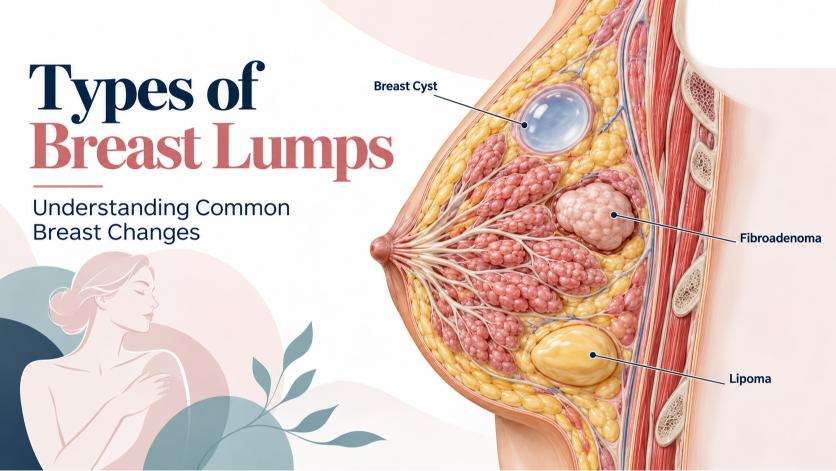
Most types of breast lumps are benign, which means they are not cancer. The most common are fibrocystic changes, fluid-filled cysts, and fibroadenomas, followed by fat necrosis, lipomas, intraductal papillomas and infections such as an abscess. A lump that is smooth, round, movable and changes with your cycle is usually harmless. A lump that is hard, fixed, irregular and painless is more concerning. Because the two can overlap, every new lump should be examined and scanned rather than judged by touch alone.
Finding a lump is frightening, and searching online often makes it worse. This guide explains the different types of breast lumps in plain language, how they feel, how they look on ultrasound and mammogram, how benign lumps differ from cancer, and when to see a specialist.
Most breast lumps are not cancer. Even so, the only way to know what a lump is, is a clinical examination plus imaging and, when needed, a biopsy.
What Are the Most Common Types of Breast Lumps?
The most common types of breast lumps are fibrocystic breast changes, breast cysts and fibroadenomas. All three are benign.
The National Cancer Institute lists many benign breast conditions and notes that most are not linked to a higher risk of breast cancer. Here are the different types of breast lumps doctors see most often.
1. Fibrocystic breast changes
This is lumpy, rope-like or “cobblestone” breast tissue, often in the upper outer area near the armpit. It is very common between the ages of about 20 and 50, tends to feel sorer before a period, and usually affects both breasts. It is a normal variation, not a disease.
2. Breast cysts
A cyst is a fluid-filled sac. It feels smooth, round and slightly squashy, like a grape, and can appear quickly. Cysts are most common between 30 and 50 and may become tender before a period. Read more in our breast cyst treatment guide.
3. Fibroadenomas
A fibroadenoma is a solid, benign growth of glandular and fibrous tissue. It feels firm, smooth and rubbery and slides easily under the fingers. It is most common in women under 30. Learn more in our fibroadenoma treatment guide.
Other types of benign lumps in the breast
- Fat necrosis: A firm, sometimes irregular lump that forms where fatty tissue has been damaged, often after an injury, surgery or radiotherapy. It can mimic cancer, so it is usually checked with imaging.
- Lipoma: A soft, slow-growing lump of fat that moves under the skin.
- Intraductal papilloma: A small, wart-like growth inside a milk duct, often near the nipple, sometimes with bloody or clear discharge.
- Breast abscess: A painful, hot, swollen lump filled with pus, most common during breastfeeding.
- Phyllodes tumour: A rare, often fast-growing lump. Most are benign, but some can be borderline or cancerous, so they are removed.
- Galactocele: A milk-filled cyst seen during or after breastfeeding.
Normal Breast Lumps and Bumps
Not all types of breast lumps are true “masses”. Healthy breasts naturally contain glands, ducts, fat and connective tissue, so some lumpiness is normal. Common normal breast lumps and bumps include:
- Glandular tissue: Firmer, granular areas, especially in the upper outer breast
- Premenstrual swelling: Tissue that feels fuller and lumpier the week before a period, then softens
- The ridge under the breast: A firm band of tissue along the lower curve, called the inframammary ridge
- Montgomery glands: Small raised bumps on the areola that are normal oil glands
- Rib edges: In slim women, a rib can feel like a hard lump under the breast
The key difference is change. A normal lumpy area feels similar in both breasts and changes with your cycle. A new, distinct lump that feels different from the rest of the breast, or that stays after your period, should be examined.
What Type of Breast Lump Is Painful?
Painful lumps are more often benign. The types of breast lumps that commonly hurt are:
- Cysts, especially when they appear suddenly or before a period
- Fibrocystic changes, which feel sore and swollen before menstruation
- Abscesses and mastitis, which are hot, red and very tender, often with fever
- Fat necrosis, which can be tender in the early weeks after an injury
Pain does not rule out cancer, though. A painful lump that stays after your period should still be checked. Our article on breast pain causes explains other reasons the breast may hurt.
Shapes of breast lumps
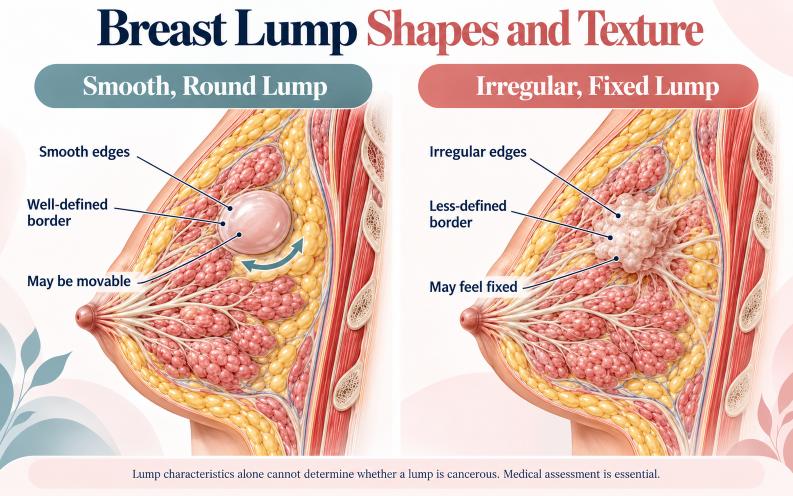
Shape and edges help separate the types of breast lumps, although only imaging can confirm them:
| Shape and feel | More typical of |
|---|---|
| Round or oval, smooth edges, moves easily | Cysts, fibroadenomas, lipomas |
| Rope-like or lumpy area, both breasts | Fibrocystic changes |
| Irregular, hard, poorly defined edges, fixed in place | Needs urgent assessment to rule out cancer |
| Hot, swollen, tender area | Infection or abscess |
How Types of Breast Lumps Look on Ultrasound and Mammogram
Imaging tells doctors far more about the types of breast lumps than touch can. Ultrasound is usually the first test for women under about 40, while a mammogram is added for older women.
Types of breast cysts on ultrasound
| Ultrasound type | What it shows | What it usually means |
|---|---|---|
| Simple cyst | Round, thin wall, completely clear fluid | Benign; no treatment unless painful |
| Complicated cyst | Fluid with debris or thicker contents, no solid part | Almost always benign; often a follow-up scan or drainage |
| Complex cyst | Thick wall, internal divisions or a solid component | Needs a biopsy to rule out cancer |
What type of breast cyst is cancerous?
A simple cyst is not cancerous and does not turn into cancer. Concern arises only with a complex cyst that contains a solid area, or a cyst that refills quickly after drainage or contains bloody fluid. These are biopsied, and most still turn out to be benign.
Types of breast masses on mammogram
Radiologists describe a mass by its shape, its edges (margins) and any calcium specks (calcifications):
- Shape: Round or oval masses are more often benign; irregular masses are more suspicious.
- Margins: Smooth, well-defined (“circumscribed”) edges suggest a benign lump; blurred or spiky (“spiculated”) edges raise concern.
- Calcifications: Large, coarse “popcorn” calcifications are typical of an old fibroadenoma; tiny, clustered or branching specks need closer review.
Results are often given as a BI-RADS score from 0 to 6. Scores of 1 and 2 mean normal or benign, 3 means probably benign with a short-interval follow-up, 4 and 5 mean a biopsy is advised, and 6 means cancer has already been confirmed. A score of 0 means more imaging is needed.
Benign vs Cancerous Types of Breast Lumps
According to the American Cancer Society, a painless, hard, fixed lump with irregular edges is more likely to be cancer. However, breast cancer can also be soft, round, tender or even painful, so no lump should be judged by feel alone.
Normal breast lumps vs cancer
| Feature | Usually benign | More concerning |
|---|---|---|
| Feel | Soft, rubbery or fluid-filled | Hard, like a stone |
| Edges | Smooth and well-defined | Irregular or hard to define |
| Movement | Moves easily under the skin | Fixed to skin or chest wall |
| Pain | Often tender, especially before a period | Often painless |
| Change over time | Changes with the cycle or settles | Stays or slowly grows |
| Skin and nipple | Normal | Dimpling, redness, nipple pulling in, bloody discharge |
| Armpit | Normal | Hard, swollen lymph node |
What type of breast lump is cancerous?
The types of breast lumps that turn out to be cancer are usually invasive ductal carcinoma or invasive lobular carcinoma. Invasive ductal cancer often forms a hard, irregular lump. Lobular cancer may feel more like a thickened area than a distinct lump. Rarer forms, such as inflammatory breast cancer, may not form a lump at all and instead cause redness, swelling and skin that looks like orange peel.
What kind of breast lump to worry about?
See a doctor promptly if a lump:
- Is new and feels different from the rest of your breast
- Is hard, fixed or has irregular edges
- Stays after your next period
- Grows over weeks
- Comes with skin dimpling, nipple changes or bloody discharge
- Appears after menopause
- Comes with a hard lump in the armpit
These features do not mean you have cancer, but they do mean you need a proper assessment. Our guides to breast cancer symptoms and breast pain red flags explain more warning signs.
How Doctors Find Out What Type of Lump You Have
Doctors usually use “triple assessment” to identify the different types of breast lumps:
- Clinical examination. A breast specialist examines both breasts and armpits and asks about your cycle, symptoms and family history.
- Imaging. A breast ultrasound for younger women, with a mammogram added for women around 40 and older.
- Biopsy when needed. If imaging is not clearly benign, a core needle biopsy takes a small tissue sample for laboratory testing.
Most women with a simple cyst or a typical fibroadenoma need only reassurance and, sometimes, a follow-up scan. Treatment for different types of breast lumps ranges from cyst drainage to minor surgery.
Seeing a breast surgeon in Dhaka
Many women delay a breast check because they feel uncomfortable being examined by a male doctor. Seeing a female surgeon in Dhaka can make it easier to speak openly and be examined early.
Dr. Reshma Aziz is a female breast and colorectal surgeon who has provided medical and surgical care since 1996. Her qualifications and surgical training include breast surgery training at IPGMR (1998) and a Diploma in Clinical Ultrasonography (2000). She is registered with the Bangladesh Medical and Dental Council under number A-24611, which you can check through her official BMDC registration record.
During a breast surgery consultation in Dhaka, she examines you, arranges the right scan and explains what the lump is likely to be and what, if anything, it needs. She sees patients at Dhaka Lab in Mohammadpur (Saturday, Tuesday and Thursday, 11:30 AM to 1:30 PM) and Cure Medical Center & Hospital in Gulshan-2 (Saturday and Tuesday, 4:00 PM to 6:00 PM). Confirm your serial on the appointment and visiting hours page before travelling.
Key Takeaways
- Most types of breast lumps are benign, led by fibrocystic changes, cysts and fibroadenomas.
- Smooth, round, movable lumps that change with your cycle are usually harmless.
- Hard, fixed, irregular and painless lumps need prompt assessment.
- Ultrasound, mammogram and biopsy, not touch alone, confirm what a lump is.
Frequently Asked Questions
What are the most common types of breast lumps?
The most common types of breast lumps are fibrocystic changes, breast cysts and fibroadenomas. All three are benign.
Can a benign breast lump turn into cancer?
Simple cysts, typical fibroadenomas and lipomas do not turn into cancer. A few benign findings, such as complex fibroadenomas or atypical hyperplasia, slightly raise future risk, which is why your doctor may advise follow-up.
Are cancerous breast lumps painful?
Usually not, but some are. Most painful types of breast lumps are benign, yet pain alone cannot rule out cancer, so a lump that stays should be examined.
How quickly should I see a doctor about a new lump?
Book a check within a week or two, or sooner if the lump is hard, growing, or comes with skin or nipple changes.
Get Your Lump Checked With Confidence
Knowing the types of breast lumps helps you stay calm, but only an examination and scan can tell you what yours is. Because most lumps are benign, a check often brings reassurance, and if treatment is needed, it can start early.
Dr. Reshma Aziz | Breast, Colorectal & Family Medicine Specialist offers private breast consultations in Mohammadpur and Gulshan, Dhaka. Book an appointment or call +88-01948-444999, or message +88-01775-731935 on WhatsApp.
This article is for general education and does not replace a personal medical assessment.