
Fibroadenoma treatment does not always involve surgery. Once tests confirm that a breast lump is a fibroadenoma, many patients can safely monitor it. Removal may be considered when the lump grows rapidly, becomes large or painful, changes breast shape, causes significant anxiety, or produces uncertain imaging or biopsy findings.
This guide explains diagnosis, nonsurgical care, surgery, recovery, pregnancy-related changes, costs in Bangladesh, and when to consult a breast specialist.
The best treatment for fibroadenoma depends on the patient’s age, symptoms, lump size, growth pattern, imaging findings, biopsy result, pregnancy plans, and personal preference. A new breast lump should be medically assessed before observation or removal is chosen.
What Is a Fibroadenoma?
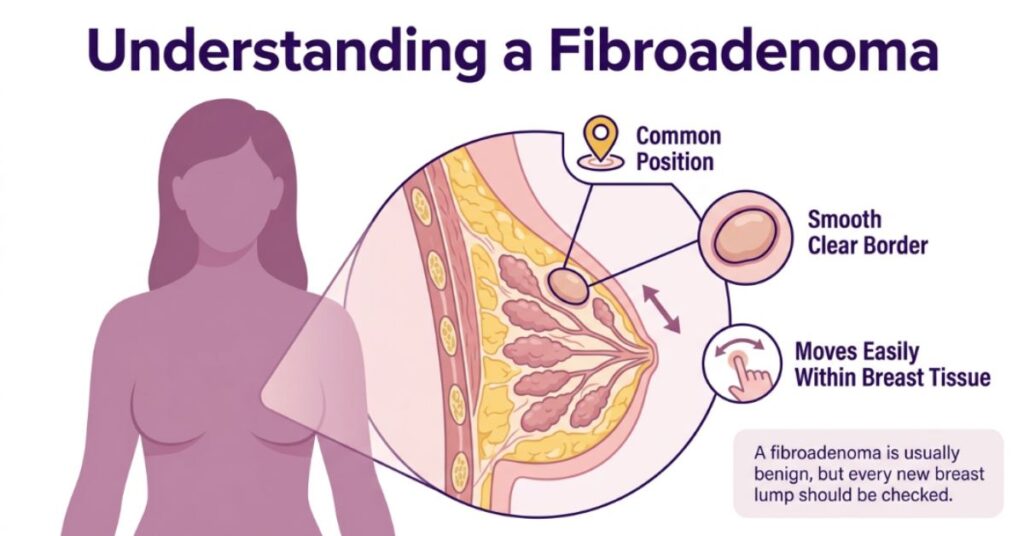
A fibroadenoma is a solid, benign breast tumour made of glandular and fibrous tissue. Benign means it is not cancer. It commonly occurs in younger women but can develop at almost any age.
According to the National Cancer Institute, fibroadenomas often feel round, smooth, firm or rubbery and may move easily beneath the skin. They are commonly painless, although some become tender around menstruation.
Typical fibroadenoma symptoms include:
- A smooth, clearly defined breast lump
- A lump that moves when gently pressed
- A firm or rubbery texture
- One or several lumps in one or both breasts
- Tenderness before menstruation
- Gradual enlargement, especially during pregnancy
- Breast asymmetry when a lump becomes large
These characteristics offer useful clues, but touch alone cannot confirm the diagnosis. Breast cysts, lipomas, phyllodes tumours and some cancers can also present as lumps.
Anyone noticing a new lump should arrange a clinical assessment. Read more about evaluating a breast mass in this guide to finding a doctor for a breast lump in Dhaka.
Fibroadenoma Causes and Treatment Decisions
The exact cause is not completely understood. Fibroadenomas appear to be sensitive to reproductive hormones, particularly oestrogen. This may explain why they are more common during reproductive years, can enlarge during pregnancy or breastfeeding, and often shrink after menopause.
A fibroadenoma is not caused by touching the breast, wearing a particular type of bra, eating a specific food or experiencing a minor everyday injury.
Is a fibroadenoma cancer?
No. A simple fibroadenoma is a benign breast tumour, and most do not increase breast cancer risk. However, a doctor must first establish that the lump really is a fibroadenoma.
Complex fibroadenomas contain additional tissue changes that may be associated with a slightly increased future risk. A rapidly enlarging fibroepithelial lump may also require further assessment to distinguish a fibroadenoma from a phyllodes tumour. This is why self-diagnosis is unsafe.
Learn the warning signs that deserve prompt assessment in this breast cancer symptoms guide.
Can a fibroadenoma turn into cancer?
A typical fibroadenoma does not usually turn into cancer. The practical concern is not transformation but whether an untested lump has been correctly identified. Imaging and, when indicated, tissue sampling help establish a reliable diagnosis.
Seek prompt medical advice if a lump:
- Grows noticeably over weeks or months
- Becomes hard, fixed or irregular
- Causes skin dimpling or nipple inversion
- Is accompanied by bloody nipple discharge
- Appears with an underarm lump
- Develops after menopause
- Produces persistent focal pain or breast distortion
How Is a Fibroadenoma Diagnosed in Dhaka?
Safe fibroadenoma treatment begins with diagnosis. The assessment is tailored to age, medical history, family history, pregnancy status and the physical characteristics of the lump.
Step 1: Medical history
The doctor may ask:
- When did you first notice the lump?
- Has its size changed?
- Does it become tender around your period?
- Are you pregnant or breastfeeding?
- Do you take hormonal medicine?
- Is there a family history of breast or ovarian cancer?
- Have you had previous breast lumps, imaging or biopsy?
Step 2: Clinical breast examination
The doctor examines both breasts and underarms. Important features include size, location, surface, mobility, tenderness, skin changes and nipple changes.
Step 3: Breast imaging
Ultrasound is frequently used to evaluate a breast lump in younger women. It can show whether the lump is solid or fluid-filled and assess its shape, margins and dimensions.
A diagnostic mammogram may be recommended according to age, symptoms and risk profile. Some patients need both ultrasound and mammography. The appropriate test should be selected individually rather than by a universal age rule.
Step 4: Biopsy when indicated
A core needle biopsy removes small tissue samples for examination by a pathologist. It may be recommended when the imaging appearance is not clearly benign, the lump is enlarging, the patient is older, clinical and imaging findings do not agree, or confirmation would change treatment.
The Mayo Clinic notes that biopsy can help distinguish a fibroadenoma from a phyllodes tumour when the nature of a lump is uncertain.
Not every suspected fibroadenoma requires biopsy. The decision depends on the patient’s age, examination, imaging classification, growth pattern and level of diagnostic certainty.
Breast Fibroadenoma Treatment Options
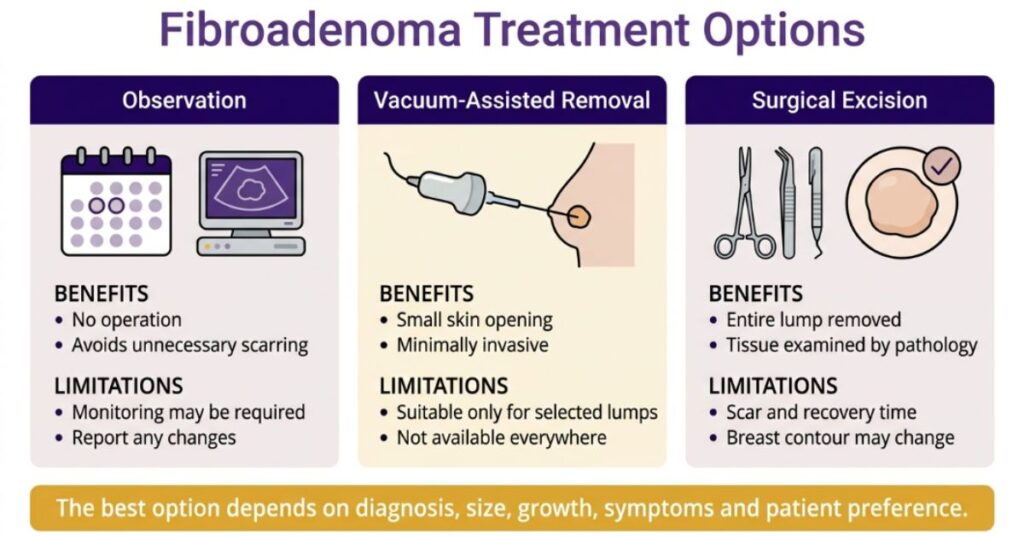
There is no single approach that suits every patient. The main choices are monitoring, minimally invasive removal where available, and surgical excision.
| Treatment option | When it may be appropriate | Main benefit | Important limitation |
|---|---|---|---|
| Clinical monitoring | Imaging and examination are reassuring | Avoids unnecessary surgery | Requires attention to changes |
| Follow-up ultrasound | The specialist wants to document stability | Measures size and appearance | Timing varies by individual risk |
| Vacuum-assisted excision | Selected small, confirmed fibroadenomas | Smaller skin opening | Not suitable or available for every case |
| Cryoablation | Selected confirmed lesions at equipped centres | Minimally invasive | Limited availability in Bangladesh |
| Surgical excision | Large, growing, painful or uncertain lump | Removes the entire mass | Scar, anaesthesia and contour changes are possible |
Fibroadenoma treatment without surgery
Observation is often the best treatment for a small, stable, properly assessed fibroadenoma that is not causing troublesome symptoms.
A monitoring plan may involve:
- Recording the lump’s size and imaging features
- Following the specialist’s recommended review schedule
- Checking for a clear change rather than repeatedly pressing the lump
- Returning sooner if it grows or new symptoms appear
- Maintaining routine breast screening appropriate for age and risk
Some fibroadenomas remain unchanged for years. Others shrink or disappear. Monitoring does not mean ignoring the lump; it means following a documented clinical plan.
The patient should not use herbal products, supplements or massage as substitutes for assessment. No food, cream or home remedy has been established as a reliable way to dissolve a fibroadenoma.
When does fibroadenoma need surgery?
Surgery may be discussed when:
- Imaging or biopsy findings are uncertain or discordant
- The lump grows quickly
- It is large or distorts the breast
- Pain or pressure affects daily life
- A giant or juvenile fibroadenoma is suspected
- A phyllodes tumour cannot be excluded
- The patient wants removal after understanding the benefits and risks
Size alone should not be the only consideration. Age, rate of growth, symptoms, breast size and pathology findings matter. Shared decision-making is essential.
During excision, the surgeon removes the lump through an incision planned with breast shape and scar position in mind. The tissue is then sent for histopathology.
Special Fibroadenoma Treatment Situations
Giant fibroadenoma treatment options
A giant fibroadenoma is unusually large and may grow rapidly, stretch the skin or cause visible asymmetry. Surgical removal is commonly considered because of its size, symptoms and the need to confirm the diagnosis.
Careful operative planning aims to remove the mass while preserving healthy breast tissue and achieving the best practical cosmetic result.
Multiple fibroadenoma treatment options
Having several fibroadenomas does not automatically mean every lump needs removal. Each lesion should be mapped and assessed. Stable, typical lumps may be monitored, while a changing or uncertain lesion may need biopsy or excision.
Removing many lumps can produce multiple scars or alter breast contour, so the potential benefit should be weighed against the cosmetic effect.
Juvenile fibroadenoma treatment options
Juvenile fibroadenomas occur in adolescents and can sometimes grow quickly. Evaluation should consider normal breast development, emotional wellbeing and preservation of developing breast tissue.
The NCI reports that fibroadenomas are the most common benign breast tumours in people aged 18 or younger. Observation may be suitable for a stable lesion, while a rapidly growing or giant mass may require surgery.
Fibroadenoma treatment during pregnancy
Hormonal changes can make a known fibroadenoma enlarge during pregnancy or breastfeeding. Growth does not automatically mean cancer, but any change still deserves medical evaluation.
Ultrasound is commonly used during pregnancy. If tissue diagnosis is needed, the treating team selects an appropriate method. Surgery is usually reserved for concerning, rapidly growing or significantly symptomatic lesions and is planned with the obstetric team when necessary.
Fibroadenoma Removal Recovery Time and Cost
Recovery varies with the procedure, lump size, incision, anaesthesia and individual health.
After surgical removal, many patients can go home on the same day. Temporary soreness, swelling and bruising are common. A supportive bra and prescribed pain relief may improve comfort.
Patients should follow their surgeon’s instructions regarding bathing, dressings, driving, lifting, exercise and returning to work. Desk-based activities may resume sooner than physically demanding work. The final pathology report should be reviewed even when the preoperative diagnosis was reassuring.
Contact the surgical team if you develop:
- Increasing redness, heat or swelling
- Fever or chills
- Worsening pain despite medicine
- Persistent bleeding or discharge
- Sudden breast swelling
- Separation of the wound edges
Fibroadenoma treatment cost in Bangladesh
There is no dependable single price for fibroadenoma treatment in Bangladesh. The total depends on the consultation, ultrasound or mammogram, biopsy, pathology, hospital, anaesthesia, procedure type, lump size, number of lumps and follow-up care.
Before scheduling removal in Dhaka, request a written breakdown covering:
- Surgeon and anaesthesia fees
- Operating-room or procedure-room charges
- Medicines and consumables
- Histopathology
- Day-care or hospital charges
- Postoperative reviews
Choosing treatment only by the lowest advertised price can overlook diagnostic quality, pathology and follow-up support.
Choosing a Fibroadenoma Specialist in Mohammadpur
A useful consultation should provide a clear diagnosis, explain whether biopsy is required, compare observation with removal, discuss scarring and recovery, and answer questions without pressuring the patient.
Dr. Reshma Aziz provides breast and surgical consultations in Dhaka. Her professional profile records breast-surgery training, extensive clinical experience and patient care involving breast assessment and surgery. Her Bangladesh Medical and Dental Council registration is A-24611, which can be checked through the BMDC registration record.
Patients can learn more about the breast surgeon specialist in Dhaka, explore available breast and family medicine services, or read about common breast pain causes.
Frequently Asked Questions
How long does it take for a fibroadenoma to go away?
There is no fixed timeline. Some shrink over months or years, particularly in adolescents, while others remain stable. A confirmed fibroadenoma does not need to disappear for monitoring to be successful.
What is the best treatment for fibroadenoma?
Observation is often best for a small, stable and confidently diagnosed lump. Removal may be preferable for rapid growth, significant size, persistent symptoms, uncertain findings or strong patient preference.
Can medicine dissolve a fibroadenoma?
No standard medicine has been proven to dissolve fibroadenomas reliably. Treatment usually involves observation or removal when clinically indicated.
Can fibroadenoma return after removal?
The removed lump does not grow back after complete excision, but another fibroadenoma can develop elsewhere. Any new breast lump should be assessed rather than assumed to be the same condition.
Does fibroadenoma affect breastfeeding?
Most fibroadenomas do not prevent breastfeeding. A lump may enlarge during pregnancy or lactation, and previous surgery can occasionally affect nearby ducts depending on its location.
Is fibroadenoma removal painful?
Anaesthesia is used during the procedure. Temporary discomfort, bruising or tightness may occur afterward and is generally managed according to the surgeon’s postoperative plan.
Key Takeaways
- A fibroadenoma is usually benign, but every new breast lump needs assessment.
- Many confirmed fibroadenomas can be monitored without surgery.
- Rapid growth, large size, symptoms or uncertain findings may justify removal.
- Ultrasound, mammography and core biopsy are selected according to the individual case.
- Pregnancy can temporarily increase fibroadenoma size.
- Treatment decisions should balance safety, symptoms, scarring, breast shape and patient preference.
If you have noticed a new, growing or uncomfortable breast lump, arrange a private assessment rather than waiting for it to disappear. Contact Dr. Reshma Aziz to discuss diagnosis and suitable fibroadenoma treatment in Dhaka.