
Most people want one number before agreeing to a procedure: will it work? The honest laser piles surgery success rate depends on your piles grade, the technique used and how long you are followed up.
Quick answer: Most published studies report that laser haemorrhoidoplasty relieves symptoms in roughly 70% to 100% of carefully selected patients with grade 2 or 3 internal piles in the short term. Recurrence rates vary widely, from under 5% in some reports to about one in three patients over five years in another. Laser works well for many people, but it is not a guaranteed permanent cure.
Below, you will learn what “success” means, what the research shows and how to improve your own outcome.
What Does “Success” Mean After Laser Piles Surgery?
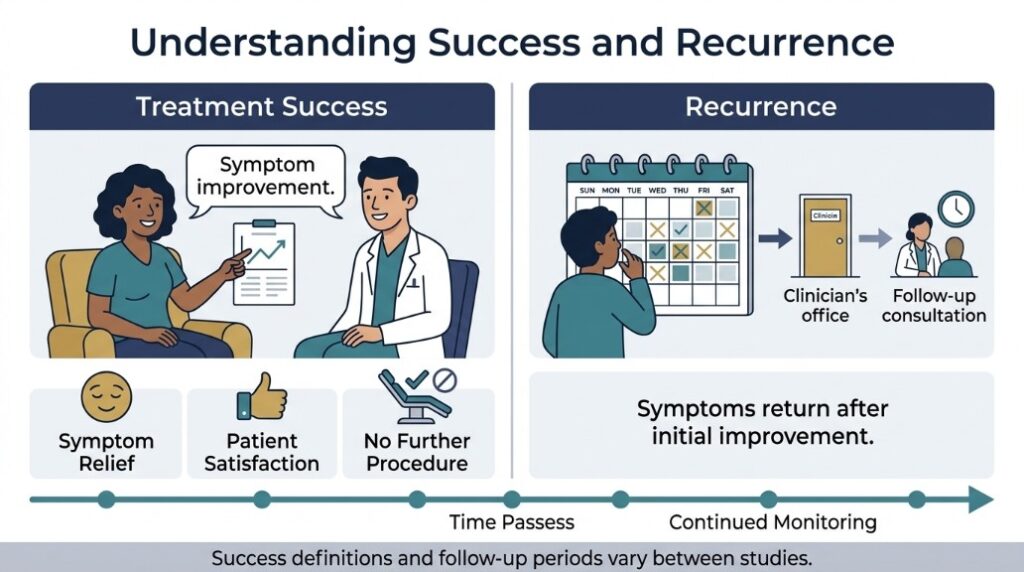
Studies do not all measure success the same way, which is why figures online can look confusing. A procedure may be called successful if:
- bleeding stops or becomes rare
- the piles no longer prolapse (come out of the anus)
- the grade of piles goes down after treatment
- the patient needs no further procedure
- the patient reports being satisfied
Recurrence usually means symptoms come back after initially improving. Some studies count any returning symptom, while others only count recurrence that needs another treatment. A study using the stricter definition will naturally report a higher laser piles surgery success rate.
Definition: Laser haemorrhoidoplasty (LHP) is a procedure in which a thin laser fibre is placed inside an internal pile, and controlled heat shrinks the tissue from within. It differs from open haemorrhoidectomy, where the piles are cut out. Learn how the procedure is done on our laser piles treatment in Dhaka page.
Does Laser Hemorrhoid Surgery Work? What the Research Shows
Yes, for suitable patients, laser hemorrhoid surgery works well in the short to medium term. The laser piles surgery success rate in published research looks like this:
| Study | Patients | Follow-up | Key result |
|---|---|---|---|
| Longchamp et al., Lasers in Medical Science (systematic review, 2021) | 1,570 across 14 studies | 1 to 12 months for LHP | Symptom resolution 70% to 100%; recurrence 0% to 11.3% |
| Poskus et al., International Journal of Colorectal Disease (randomised trial, 2020) | 121, grade 2 to 3 | 1 year | Recurrence needing treatment: 10% after laser, 0% after excision |
| Faes et al., Colorectal Disease (2019) | 50, grade 2 to 3 | Mean 5.4 years | Recurrence in 34% of patients followed up |
| Seymen et al., Polish Journal of Surgery (retrospective, 2024) | 138, grade 2 to 4 | Up to 5 years | Recurrence about 5%; 95% reported symptom relief |
| Rahman et al., Faridpur Medical College Journal, Bangladesh (2025) | 100, grade 2 to 4 | 3 years | Recurrence in 2% |
Why Do the Numbers Vary So Much?
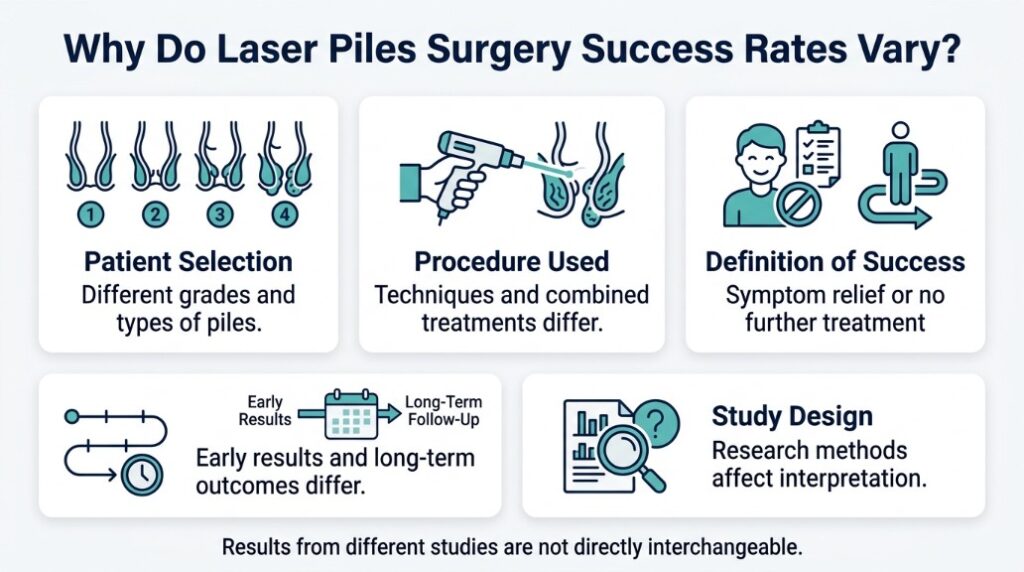
Several reasons explain the gap between a 2% and a 34% recurrence figure:
- Follow-up length: Many studies stop after one year. Piles can return later, so short studies tend to look better.
- Definition of recurrence: Some count any symptom; others only count cases that need another procedure.
- Patient selection: Studies that include more grade 3 or 4 piles may see more recurrence.
- Study design: Randomised trials are usually more reliable than retrospective reviews of a single clinic’s records.
- Technique: Laser settings and whether stitches are added differ between surgeons.
So when you read a single laser piles surgery success rate online, ask how long patients were followed and how recurrence was defined.
Laser Piles Surgery Long Term Results
The Swiss study by Faes and colleagues is one of the longer ones. Nearly all patients improved at first, but by an average of 5.4 years, about one in three of those followed up had recurrent symptoms. The median time to recurrence was 21 months. In contrast, the Turkish and Bangladeshi studies reported much lower recurrence over three to five years.
The fair conclusion is this: laser piles surgery long term results are encouraging for many patients, but reliable long-term data is limited. Any clinic that promises a permanent cure is going beyond the evidence.
Can Piles Return After Laser Surgery?
Yes. Laser shrinks the existing piles but does not remove the pressures that caused them, which is the main reason the long-term laser piles surgery success rate is lower than short-term figures. Piles can return if:
- constipation or hard stools continue
- you strain or sit on the toilet for long periods
- you have long-term diarrhoea
- you lift heavy weights regularly
- pregnancy or weight gain increases pressure in the pelvis
The NHS notes that hospital treatment does not always prevent piles from coming back, which applies to laser as well as other procedures. If symptoms return, options include medicines, rubber band ligation, a repeat laser procedure or surgery, depending on the findings.
Piles Recurrence Rate After Laser Haemorrhoidoplasty: The Short Version
Across published studies, the piles recurrence rate after laser haemorrhoidoplasty ranges from about 0% to 11% in short follow-up (up to one year) and from about 2% to 34% in longer follow-up of three to five years.
Laser Piles Surgery Success Rate for Grade 2, Grade 3 and Grade 4
Piles are graded by how far they prolapse. You can read a full explanation in our guide to the grades of piles from stage 1 to 4.
| Grade | What it means | How laser tends to perform |
|---|---|---|
| Grade 1 | Bleed but do not prolapse | Usually managed without surgery |
| Grade 2 | Prolapse and go back on their own | Good candidates; laser piles surgery success rate for grade 2 is generally favourable |
| Grade 3 | Prolapse and must be pushed back | Often suitable; recurrence risk is higher than grade 2, and stitches may be added |
| Grade 4 | Stay outside and cannot be pushed back | Limited evidence; excision or a combined approach is often preferred |
Laser Piles Surgery Success Rate for Grade 3
Most trials combine grade 2 and grade 3 piles, so a separate laser piles surgery success rate for grade 3 is hard to state. In practice, larger grade 3 piles with a lot of loose tissue are more likely to recur. Surgeons sometimes combine laser with mucopexy (stitches that lift the tissue back into place) to improve results.
Is Laser Surgery Effective for Grade 4 Piles?
It can help in selected cases, but evidence is weaker. Grade 4 piles often have large external components or skin tags that laser alone cannot correct. The 2024 American Society of Colon and Rectal Surgeons (ASCRS) guideline generally supports excisional haemorrhoidectomy for large, combined internal and external piles. Your surgeon should explain why a particular approach suits your anatomy.
Laser vs Open Piles Surgery Success Rate
Open haemorrhoidectomy remains the most durable option for many advanced piles. Laser offers an easier recovery but may carry a higher chance of recurrence.
| Factor | Laser haemorrhoidoplasty | Open haemorrhoidectomy |
|---|---|---|
| Early pain | Usually lower | Usually higher |
| Return to normal activity | Faster (about 15 days in one trial) | Slower (about 30 days in the same trial) |
| Recurrence | Possibly higher in some studies | Lowest recurrence in most comparisons |
| Long-term evidence | Still limited | Well established |
| Best suited to | Selected grade 2 and 3 internal piles | Large, external or grade 4 piles |
In the Poskus trial, 10% of laser patients needed further treatment within a year, compared with none after excision. However, laser patients returned to normal activity in about half the time and rated their satisfaction highest. A 2022 meta-analysis by Tan and colleagues found recurrence was statistically similar between the two approaches, though the included studies were small. See our detailed laser vs open piles surgery comparison.
Pros and Cons of Laser Treatment
Pros: less early pain, small or no external wound, shorter hospital stay, quicker return to work, often day-care.
Cons: recurrence possible, less long-term data, higher equipment cost, not suitable for every grade or type of piles.
Why Does Laser Piles Surgery Fail?
When the laser piles surgery success rate falls short for an individual, common reasons include:
- Wrong case selection: Large grade 4 piles or big external skin tags may not respond fully to laser alone.
- Ongoing constipation or straining: Continued pressure can cause new piles to form. Ongoing bowel problems may need chronic constipation treatment.
- Another condition causing symptoms: Bleeding or pain from a fissure, polyp or other condition will not improve with piles treatment.
- Insufficient treatment: If not all affected piles are treated, symptoms may persist.
- Missed follow-up: Early problems that could have been managed may be overlooked.
Factors Affecting Laser Piles Surgery Success Rate
You cannot control every factor, but several are in your hands. To support a good result:
- Get a proper examination to confirm the diagnosis and grade before treatment.
- Ask your surgeon whether laser alone, laser with mucopexy or open surgery suits your piles.
- Keep stools soft with fibre, water and any prescribed softener. Our list of foods to avoid with piles helps with daily meals.
- Avoid straining and limit time on the toilet.
- Follow the recovery plan in our guide to laser piles surgery recovery time.
- Attend follow-up appointments, even if you feel well.
If bleeding continues after treatment, arrange a rectal bleeding evaluation.
Laser Piles Surgery Success Rate in Dhaka and Bangladesh
There is limited published data on the laser piles surgery success rate in Bangladesh. One prospective study from Bangladesh, published in the Faridpur Medical College Journal in 2025, followed 100 patients with grade 2 to 4 piles for three years and reported recurrence in 2%. This is encouraging, but it is a single-centre observational study, so results may not apply to every patient.
The laser piles surgery success rate in Dhaka will depend on the same factors seen worldwide: correct diagnosis, suitable grade, surgical technique and aftercare. For pricing, see our guide to laser piles surgery cost in Bangladesh.
Consult Dr. Reshma Aziz About Laser Piles Treatment
Dr. Reshma Aziz is a BMDC-registered doctor (Registration No. A-24611). You can verify her BMDC registration record online. She holds an MS in Paediatric Surgery and a Postgraduate Diploma in Colorectal Surgery (2023), completed LASER training in Proctology in 2023 and has provided medical and surgical care since 1996. Read more about her qualifications and surgical training.
At consultation, she examines you privately, confirms the grade of piles and explains whether laser, banding, medicine or open surgery offers you the best balance of recovery and long-term results. She sees patients at Dhaka Lab in Mohammadpur and Cure Medical Center & Hospital in Gulshan.
Key Takeaways
- The short-term laser piles surgery success rate for selected grade 2 and 3 piles is generally high, with symptom relief in most patients.
- Recurrence rates range widely, from about 2% to 34% in studies with three to five years of follow-up.
- Open haemorrhoidectomy usually has lower recurrence but a harder recovery.
- Grade 4 piles often need excision or a combined approach.
- Soft stools, no straining and follow-up care improve your chances of lasting relief.
Frequently Asked Questions
What is the success rate of laser piles surgery?
In short-term studies, laser haemorrhoidoplasty relieves symptoms in about 70% to 100% of selected patients. Long-term recurrence ranges from about 2% to 34%, depending on the study.
Is laser piles surgery a permanent cure?
No procedure guarantees a permanent cure. Laser treats existing piles, but new piles can form if constipation, straining or other risk factors continue.
Can laser surgery be repeated if piles come back?
In some cases, yes. Depending on the findings, recurrent piles may be treated with medicine, banding, repeat laser or surgery.
How soon will I know if laser treatment has worked?
Bleeding often improves within weeks. One study found symptom improvement and shrinkage reached a plateau around six months after the procedure.
Make an Informed Decision
The laser piles surgery success rate is high for many patients with grade 2 and 3 piles, but results depend on choosing the right procedure for the right person. Honest advice about recurrence matters as much as a quick recovery.
If you have bleeding, swelling or prolapsing piles, book an appointment with Dr. Reshma Aziz for an individual assessment and a clear discussion of your treatment options. You can also call +88-019-48-444-999 or message on WhatsApp at +88-017-75-73-19-35.