
If your doctor has said your piles need a procedure, you have probably heard two options: laser treatment or the traditional “open” operation. Friends may say laser is painless. Others may say open surgery is the only permanent fix. Neither statement is fully true.
Quick answer: In the laser vs open piles surgery decision, laser usually means less pain and a faster return to normal life, but it works best for grade 2 and 3 internal piles. Open surgery (haemorrhoidectomy) is more painful and takes longer to heal, yet it remains the stronger choice for large grade 4 piles and many external piles. Neither option is right for everyone, and an examination decides which suits you.
This guide on laser vs open piles surgery explains how each operation works, how they compare on pain, recovery, recurrence and cost in Bangladesh, and which questions to ask before you decide.
What Is Laser Hemorrhoid Surgery?
Definition: Laser hemorrhoid surgery, usually called laser haemorrhoidoplasty (LHP), uses a thin laser fibre placed inside an internal pile. Controlled heat shrinks the swollen blood vessels from within, without cutting away the surrounding skin.
The procedure usually takes 15 to 30 minutes under anaesthesia and is commonly done as day-care surgery. Because the lining of the anal canal is mostly preserved, there is no large open wound. This tissue-sparing approach is the main reason the laser vs open piles surgery comparison favours laser on pain.
You can see how this treatment is planned at our laser piles treatment in Dhaka page.
What Is Open Piles Surgery?
Definition: Open piles surgery, or conventional haemorrhoidectomy, removes the piles with a scalpel, scissors, or an energy device. The best-known version is the Milligan-Morgan operation, where the wounds are left open to heal naturally.
Open surgery has been used for decades. It removes the diseased tissue directly, which is why surgeons still rely on it for advanced or external disease. The trade-off is that healing wounds in this sensitive area are painful, especially during bowel movements. Understanding this difference is the starting point for any laser vs open piles surgery discussion.
Laser vs Open Piles Surgery: Side-by-Side Comparison
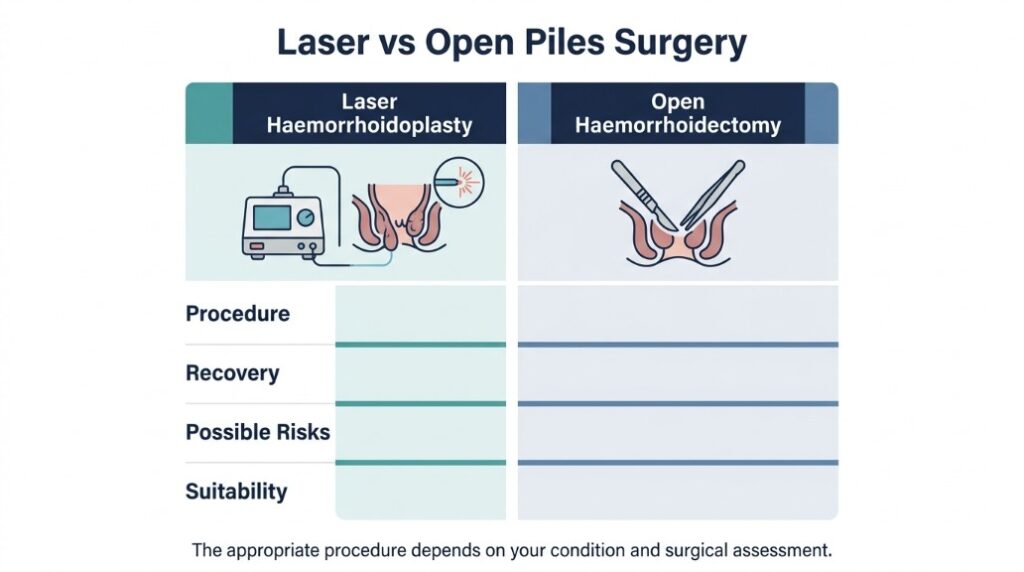
Short answer box: Laser wins on pain and recovery speed. Open surgery wins on handling large, external, or grade 4 piles. Medium-term recurrence for grade 2 and 3 piles appears similar in pooled research.
| Factor | Laser haemorrhoidoplasty | Open haemorrhoidectomy |
|---|---|---|
| How it works | Shrinks piles from inside with laser heat | Cuts and removes the piles |
| Wound | Tiny entry point | Open wounds that heal over weeks |
| Pain after surgery | Usually mild to moderate | Usually moderate to severe |
| Hospital stay | Usually day-care | Day-care or a short stay |
| Return to normal activity | Often within a few days to a week | Often 2 to 3 weeks |
| Best suited for | Grade 2 and 3 internal piles | Grade 4, large external, or mixed piles |
| External piles and skin tags | Not routinely treated | Removed in the same operation |
| Cost in Bangladesh | Higher, because of laser equipment | Often lower |
Is Laser Piles Surgery Painful?
Short answer box: You should not feel pain during laser surgery because it is done under anaesthesia. Afterwards, most people have mild to moderate soreness for a few days. It is not painless, but it is usually much less painful than open surgery.
Pain is the biggest difference in the laser vs open piles surgery debate. A 2023 meta-analysis in Annals of Coloproctology, covering nine studies and 661 patients with grade 2 and 3 piles, found that laser patients needed less pain relief, had fewer complications, and returned to work or daily activities sooner than those who had conventional surgery.
After open surgery, the first few bowel movements are often the hardest part. Many patients need stronger painkillers, stool softeners, and warm water soaks for one to two weeks.
Be cautious if any clinic promises “zero pain.” Some discomfort, pressure, or a burning sensation after laser is normal. For a day-by-day guide, read our article on laser piles surgery recovery time.
Which Surgery Is Better for Piles?
There is no single winner in the laser vs open piles surgery choice, and anyone who claims otherwise is oversimplifying. The better operation is the one that matches your piles. These are the main deciding factors.
Grade of Piles
Piles are graded from 1 to 4 by how far they prolapse. Our guide to the grades of piles from stage 1 to 4 explains this in detail.
- Grade 1 and early grade 2: Usually managed with diet, medicines, or office treatments such as banding. Surgery is rarely the first step.
- Grade 2 and 3: International laser recommendations published in Techniques in Coloproctology (2024) list these as the standard indications for laser treatment.
- Grade 4: In laser vs open piles surgery for grade 4, open surgery is usually preferred. Laser may be used by experienced surgeons in selected cases, often combined with other techniques, but complication risk rises.
Laser Surgery for External Piles
External piles are where laser vs open piles surgery differ most clearly. They sit under the skin at the anal opening. The same 2024 laser recommendations state that treating external piles and skin tags should not be a routine part of laser haemorrhoidoplasty and should only be considered case by case. In practice, large external piles or skin tags often need excision, sometimes combined with laser for the internal part.
A painful, sudden blue lump may be a clot. Our page on thrombosed piles in Dhaka explains how that is managed differently.
Other Conditions in the Area
Laser is not suitable when there is active infection. Abscess, fistula, and inflamed rectal lining are listed as absolute contraindications in the laser recommendations. If you have discharge or recurring swelling, read about anal fistula treatment and get assessed first.
Pros and Cons of Laser Piles Surgery
Short answer box: Laser offers less pain, day-care treatment, and faster recovery. Its limits are higher cost, a narrower range of suitable piles, and a real chance of recurrence.
Pros
- Less pain after surgery than open haemorrhoidectomy
- No large open wound to dress
- Usually day-care, with same-day discharge
- Faster return to work, study, and family duties
- Lower risk of narrowing of the anal opening, because less tissue is removed
Cons
- Best suited to grade 2 and 3 internal piles only
- Does not routinely treat external piles or skin tags
- Higher cost than open surgery or banding
- Piles can come back; published series report recurrence of roughly 9% at one year and up to about 22% at two years
- Complications can still occur, including bleeding and painful clots near the anus
Pros and Cons of Open Piles Surgery
Pros
- Long-established operation with decades of evidence
- Treats grade 4, external, and mixed piles in one procedure
- Removes skin tags at the same time
- Usually lower cost than laser in Bangladesh
Cons
- More pain, especially in the first one to two weeks
- Longer recovery, often 2 to 3 weeks before normal activity
- Open wounds need careful hygiene and follow-up
- Risks include bleeding, difficulty passing urine, and, uncommonly, narrowing of the anal opening
Laser Treatment for Piles in Bangladesh: Cost and Practical Points
Short answer box: In private care, laser piles surgery in Bangladesh is commonly quoted at about BDT 45,000 to BDT 70,000. Open surgery is often cheaper, but the final bill for either depends on the hospital, anaesthesia, tests, and medicines.
The laser equipment and consumables make laser treatment more expensive. However, a shorter recovery can mean fewer days away from work, which matters for many families in Dhaka. When you weigh laser vs open piles surgery on cost, include lost income and travel, not just the hospital bill.
Ask for a written estimate covering surgeon, anaesthesia, theatre, tests, medicines, and follow-up. For a full breakdown, see our guide to laser piles surgery cost in Bangladesh.
Do You Need Surgery at All?
Before weighing laser vs open piles surgery, check whether you need an operation at all. Many people with piles never do. Fibre, water, better toilet habits, and short courses of medicine help a large number of early cases. Our guide to piles home remedies covers safe first steps.
Surgery, whether laser or open, is usually considered when:
- bleeding keeps coming back despite treatment
- piles prolapse and need to be pushed back in, or stay outside
- symptoms affect daily life, work, or sleep
- office treatments such as banding have failed
Rectal bleeding is not always caused by piles. Any new bleeding, especially with weight loss, a change in bowel habit, or a family history of bowel cancer, needs proper examination. Our page on bleeding piles treatment explains what that assessment involves.
Questions to Ask Before Choosing
Use these questions in your consultation to make the laser vs open piles surgery decision with confidence:
- What grade are my piles, and are they internal, external, or both?
- Am I a good candidate for laser, and why?
- Will laser treat everything, or will part of the problem remain?
- What recovery time should I expect for my type of work?
- What are the main risks for me personally?
- What happens if my piles come back?
- What does the written estimate include and exclude?
Key Takeaways
- In laser vs open piles surgery, laser is less painful and usually allows a faster recovery.
- Laser works best for grade 2 and 3 internal piles.
- Open surgery remains the stronger option for grade 4, large external, or mixed piles.
- Recurrence is possible after either operation, especially if constipation continues.
- The right choice depends on an examination, not on the newest technology.
Frequently Asked Questions
Which is better, laser or open surgery for piles?
In the laser vs open piles surgery comparison, laser is usually better for grade 2 and 3 internal piles because it causes less pain and allows faster recovery. Open surgery is usually better for grade 4, large external, or mixed piles.
Is laser piles surgery painful?
The procedure is done under anaesthesia, so you should not feel it. Afterwards, mild to moderate soreness for a few days is common. It is usually much less painful than open surgery.
Can laser treat external piles?
Not routinely. International laser recommendations advise treating external piles and skin tags only in selected cases. Large external piles often need excision.
Do piles come back after laser surgery?
They can. Studies report recurrence of about 9% at one year and up to about 22% at two years. Avoiding constipation and straining lowers the risk.
How does recovery compare in laser vs open piles surgery?
Laser patients often return to normal activity within a few days to a week. After open surgery, recovery often takes 2 to 3 weeks.
How much does laser treatment for piles cost in Bangladesh?
A common private-sector range is BDT 45,000 to BDT 70,000. Ask for an itemised written estimate after examination.
Get the Right Treatment for Your Piles
Choosing between laser vs open piles surgery is a clinical decision, not a marketing one. The best results come from a clear diagnosis, an honest discussion of options, and good aftercare.
Dr. Reshma Aziz is a female colorectal surgeon in Dhaka with a Postgraduate Diploma in Colorectal Surgery and LASER training in proctology. She is registered with the Bangladesh Medical and Dental Council (BMDC Reg. No. A-24611). You can verify her BMDC registration record and review her qualifications and surgical training. She explains both laser and non-laser options and sees patients at Dhaka Lab in Mohammadpur and Cure Medical Center & Hospital in Gulshan.
Book an appointment to discuss your symptoms and find out whether laser vs open piles surgery suits your piles. Visit the contact page to confirm the current chamber schedule, or call 01948-444999.
Medical disclaimer: This article is for general education and does not replace an in-person medical consultation. Treatment decisions should be made with your doctor after examination.