

Effective chronic constipation treatment starts by identifying why bowel movements have become difficult, not by repeatedly changing laxatives. Treatment may involve dietary changes, bowel training, physical activity, carefully selected medicines, or pelvic-floor therapy. Tests are sometimes needed when symptoms persist or warning signs appear.
The best treatment combines an accurate diagnosis with gradual fibre intake, adequate fluids, regular activity, healthy toilet habits and an appropriate medicine when necessary. Severe abdominal pain, vomiting, inability to pass gas, blood in stool or unexplained weight loss requires prompt medical assessment.
This guide covers causes, symptoms, treatment options, medicine safety, costs and when to consult a doctor in Dhaka.
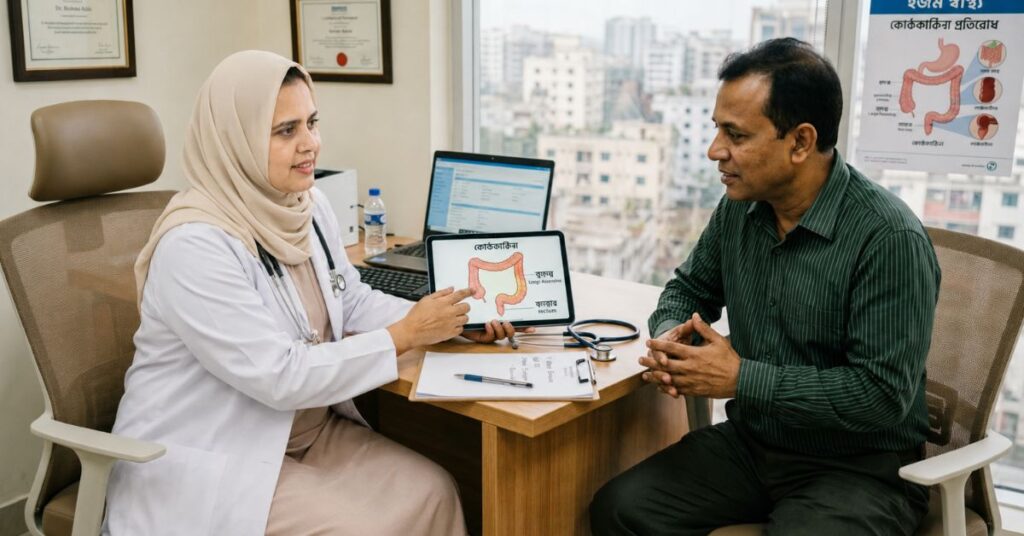
What Is Chronic Constipation?
Constipation does not simply mean failing to pass stool every day. Normal bowel frequency differs between people.
Constipation may involve:
- Fewer than three bowel movements per week
- Hard, dry or pellet-like stool
- Straining during bowel movements
- Pain or difficulty passing stool
- A feeling of incomplete emptying
- A sensation that stool is blocked
- Needing physical assistance to pass stool
The National Institute of Diabetes and Digestive and Kidney Diseases defines constipation using similar symptoms, while recognising that normal bowel patterns vary between individuals. Read the NIDDK definition of constipation.
Constipation is commonly considered chronic when symptoms continue for several months. However, a person should not wait for a specific time threshold if symptoms are severe, worsening or accompanied by warning signs.
Chronic constipation is persistent difficulty passing stool, infrequent bowel movements or repeated incomplete emptying that interferes with comfort or daily life.
Chronic Constipation Causes and Treatment
There is no single cause behind every case. Understanding chronic constipation causes and treatment together helps prevent random or excessive laxative use.
Common Lifestyle and Dietary Causes
Constipation may be associated with:
- Low dietary fibre
- Inadequate fluid intake
- Limited physical activity
- Frequently ignoring the urge to pass stool
- Sudden changes in routine or diet
- Prolonged sitting
- Dependence on heavily processed foods
- Inadequate food intake
Increasing fibre too quickly can worsen bloating or abdominal discomfort. Changes should usually be gradual and supported by appropriate fluid intake.
Medicines and Supplements
Several medicines can contribute to constipation, including some:
- Opioid pain medicines
- Iron supplements
- Calcium supplements
- Antacids containing aluminium or calcium
- Antidepressants
- Antihistamines
- Antispasmodic medicines
- Blood-pressure medicines
- Medicines for Parkinson’s disease
- Diabetes medicines
Do not stop a prescribed medicine without consulting the prescriber. A doctor may adjust the dose, change the medicine or introduce a preventive bowel plan.
Medical and Functional Causes
Persistent constipation may be related to:
- Irritable bowel syndrome with constipation
- Diabetes
- Hypothyroidism
- Neurological conditions
- Slow movement of stool through the colon
- Pelvic-floor dysfunction
- Rectocele or rectal prolapse
- Previous abdominal or pelvic surgery
- Colorectal narrowing or another structural problem
NIDDK identifies slow movement through the colon, pelvic-floor disorders and functional gastrointestinal disorders among the possible causes. Review the recognised symptoms and causes.
Some people have more than one cause. For example, a patient may have low fibre intake, take iron tablets and also struggle to relax the pelvic-floor muscles during defecation.
Chronic Constipation Symptoms and Warning Signs
Understanding chronic constipation symptoms and treatment is important because the presence of warning signs changes the appropriate next step.
Common symptoms include:
- Hard or lumpy stool
- Excessive straining
- Abdominal bloating
- Lower abdominal discomfort
- Infrequent bowel movements
- Incomplete emptying
- Reduced appetite
- Rectal discomfort
- Small amounts of stool despite a strong urge
- Leakage of liquid stool around impacted stool
Repeated straining may aggravate piles, anal fissures or pelvic-floor problems. If bowel movements cause sharp anal pain or bleeding, read the comparison of anal fissure versus piles.
When to See a Doctor for Chronic Constipation
Arrange a medical consultation when constipation:
- Persists despite reasonable self-care
- Keeps returning
- Requires frequent laxative use
- Causes significant pain or bloating
- Begins suddenly without a clear reason
- Alternates with diarrhoea
- Produces a persistent feeling of blockage
- Is accompanied by fatigue or weakness
- Develops after starting a new medicine
- Interferes with work, sleep or daily activities
Seek prompt or emergency medical care for:
- Blood in the stool or rectal bleeding
- Constant or severe abdominal pain
- Repeated vomiting
- Inability to pass stool or gas
- Fever
- Marked abdominal swelling
- Unexplained weight loss
- Black, tar-like stool
- Fainting or severe weakness
These symptoms do not automatically mean cancer or bowel obstruction, but they require appropriate assessment. NIDDK advises prompt care for constipation accompanied by bleeding, constant abdominal pain, inability to pass gas, vomiting, fever or unexplained weight loss. Patients with bleeding can also read this guide to blood in stool treatment in Dhaka.
How Is Chronic Constipation Diagnosed?
A doctor usually begins with a detailed history rather than immediately ordering every available test.
You may be asked about:
- Stool frequency and appearance
- Duration of symptoms
- Straining and incomplete emptying
- Abdominal pain or bloating
- Blood in stool
- Food and fluid intake
- Physical activity
- Current medicines and supplements
- Previous operations
- Pregnancy or childbirth history
- Diabetes, thyroid or neurological disease
- Family history of bowel disease or colorectal cancer
A stool diary and the Bristol Stool Form Scale may help describe the pattern accurately.
Examination and Possible Tests
The assessment may include:
- General examination: Checking hydration, weight and overall health.
- Abdominal examination: Looking for swelling, tenderness or a mass.
- Anorectal examination: Assessing piles, fissures, prolapse, impaction and pelvic-floor function when relevant.
- Blood tests: Considering anaemia, diabetes, thyroid problems or metabolic causes according to the history.
- Colonoscopy or imaging: Used when warning signs, screening needs or other clinical findings justify them.
- Anorectal testing: Anorectal manometry, balloon-expulsion testing or defecography may be considered when an evacuation disorder is suspected.
- Transit testing: Sometimes used to assess how quickly stool moves through the colon.
Not every person needs a colonoscopy. The AGA patient guidance notes that colonoscopy is generally unnecessary solely for constipation when colorectal screening is current, and warning signs such as bleeding, anaemia or weight loss are absent. Read the AGA constipation guidance.
Tests should be selected from the symptoms, age, medical history and examination. A responsible evaluation avoids both unnecessary investigations and missed warning signs.

Chronic Constipation Treatment Options
The most suitable chronic constipation treatment options depend on the underlying cause, symptom severity, previous treatments and other medical conditions.
| Treatment option | May help with | Important consideration |
|---|---|---|
| Gradual fibre increase | Hard stool and low-fibre diets | Can worsen bloating if increased too quickly |
| Adequate fluids | Supporting softer stool | Fluid needs vary with health conditions |
| Physical activity | Reduced bowel movement linked to inactivity | Adapt activity to physical ability |
| Bowel training | Irregular habits or ignored urges | Requires consistency |
| Osmotic laxative | Drawing water into the bowel | Dose and suitability should be reviewed |
| Stimulant laxative | Short-term or rescue treatment | May cause cramping |
| Prescription medicine | Symptoms not controlled by simpler measures | Requires medical assessment |
| Pelvic-floor biofeedback | Defecatory or pelvic-floor dysfunction | Works differently from a laxative |
| Surgery | Rare, carefully selected structural or severe cases | Requires specialist testing first |
Step 1: Improve Bowel Habits
A practical routine may include:
- Eat meals at regular times.
- Gradually add vegetables, fruit, pulses and whole grains.
- Drink suitable amounts of fluid unless medically restricted.
- Stay physically active within your ability.
- Do not repeatedly suppress the urge to pass stool.
- Allow unhurried toilet time.
- Consider sitting on the toilet after breakfast, when the colon is naturally more active.
- Place the feet on a low stool to support a comfortable position.
- Avoid prolonged, forceful straining.
NIDDK advises dietary fibre, suitable fluid intake, activity and bowel training as common first steps. It notes that adults generally require about 22–34 grams of fibre daily, depending on age and sex. See the NIDDK constipation treatment recommendations.
Step 2: Review Medicines and Medical Conditions
A medication review may reveal a preventable cause. Diabetes, thyroid disease, pregnancy and neurological conditions can also change the treatment plan.
Do not assume every case is dietary. Someone already eating sufficient fibre may need assessment for slow-transit constipation or a defecatory disorder.
Step 3: Select a Suitable Laxative
The best treatment for chronic constipation is not always the strongest laxative. Different medicines work in different ways.
| Medicine category | How it generally works | Common limitation |
|---|---|---|
| Bulk-forming fibre | Increases stool bulk and retains water | Gas and bloating |
| Osmotic laxative | Draws water into the bowel | Loose stool or electrolyte concerns |
| Stimulant laxative | Encourages bowel contractions | Cramping or urgency |
| Stool softener | Helps stool retain moisture | May be insufficient for severe chronic symptoms |
| Prescription agent | Increases secretion or bowel movement through specific pathways | Cost, availability and side effects vary |
The joint AGA–ACG guideline evaluates fibre, polyethylene glycol, magnesium oxide, lactulose, bisacodyl, sodium picosulfate, senna and several prescription medicines for chronic idiopathic constipation. Choice depends on the patient rather than a single universal ranking. Read the clinical guideline.
Chronic Constipation Medicine in Bangladesh
Availability and brand names differ between pharmacies. A chronic constipation medicine in Bangladesh should be selected by its active ingredient, evidence, dose and patient suitability—not advertising alone.
Before using a medicine, discuss:
- Pregnancy or breastfeeding
- Kidney, heart or liver disease
- Diabetes
- Other medicines and supplements
- Duration of constipation
- Abdominal pain or vomiting
- Rectal bleeding
- Previous laxative use
- Age and general health
Avoid combining several laxatives without guidance. Frequent self-treatment can mask faecal impaction, pelvic-floor dysfunction or another underlying condition.
Can Chronic Constipation Be Treated Without Surgery?
Yes. Chronic constipation treatment without surgery is appropriate for most patients. It may include diet, fluid intake, exercise, bowel training, medicines, medication review and pelvic-floor biofeedback.
Surgery is uncommon and is not a routine solution for constipation. It may only be considered after:
- A clearly established diagnosis
- Failure of appropriate medical treatment
- Specialist bowel-function testing
- Exclusion of pelvic-floor dysfunction
- Discussion of benefits, complications and long-term effects
Structural problems such as severe rectal prolapse may require a separate surgical assessment. Slow-transit constipation alone does not automatically justify removing part of the colon.
Most patients do not need an operation. Persistent symptoms should lead to a better diagnosis, not simply stronger medicine or premature surgery.
What Does Chronic Constipation Treatment Cost in Dhaka?
The chronic constipation treatment cost in Dhaka depends on what is causing the problem and which services are necessary.
Possible cost components include:
- Initial consultation
- Follow-up visits
- Blood tests
- Prescribed or over-the-counter medicine
- Imaging when indicated
- Colonoscopy when clinically justified
- Anorectal function tests
- Pelvic-floor therapy or biofeedback
- Treatment of piles, fissure or impaction
- Hospital care for severe complications
There is no responsible citywide fixed price. A patient needing only consultation and a bowel plan will have different expenses from someone requiring endoscopy, specialist testing or treatment for faecal impaction.
Ask for an itemised estimate and clarify whether medicines, tests and follow-up are included.
Choosing a Doctor for Chronic Constipation in Dhaka
A qualified doctor for chronic constipation in Dhaka should look beyond bowel frequency. The consultation should assess stool form, incomplete emptying, medicines, medical conditions, warning signs and pelvic-floor symptoms.
Some patients may feel more comfortable discussing sensitive bowel concerns with a female constipation doctor in Dhaka. Privacy preference is valid, although registration, relevant experience and diagnostic judgment remain essential.
Patients seeking a chronic constipation specialist in Mohammadpur should consider:
- Valid medical registration
- Relevant gastrointestinal or colorectal experience
- Willingness to perform a careful history and examination
- Evidence-based medicine use
- Access to appropriate testing or referral
- Clear follow-up arrangements
- Transparent cost information
- Respectful communication and privacy
Dr. Reshma Aziz’s Relevant Credentials
Dr. Reshma Aziz’s documented background includes colorectal, rectal, general and paediatric surgery, family medicine, colonoscopy and diet consultation.
- MBBS: Dow Medical College, 1994
- Master’s in Paediatric Surgery: University of Dhaka, 2003
- Postgraduate Diploma in Colorectal Surgery: TECH Technological University, 2023
- Colorectal Surgery Training: Dhaka Medical College, 2001
- Clinical Experience: More than 20 years across surgical and family-medicine roles
- BMDC Registration: A-24611
Patients can use the linked Bangladesh Medical & Dental Council record to verify her professional registration. Learn more about Dr. Reshma Aziz’s background and her colorectal and family medicine services.
Frequently Asked Questions
1. What is the best laxative for severe constipation?
There is no single best laxative for everyone. Polyethylene glycol is supported for chronic idiopathic constipation, while stimulant laxatives may be used for short-term or rescue therapy in suitable patients. Severe pain, vomiting, marked swelling or inability to pass gas requires medical assessment before taking more laxatives.
2. How can I relieve chronic constipation when nothing helps?
Stop repeating random remedies and arrange an assessment. A doctor may review medicines, check for impaction, investigate slow colonic transit and test for pelvic-floor dysfunction. Biofeedback may help when the muscles do not coordinate correctly during defecation.
3. Is polyethylene glycol better than a stool softener?
They work differently. Polyethylene glycol is an osmotic laxative that increases water in the bowel. Stool softeners mainly help stool retain moisture. Evidence and individual suitability differ, so the choice should reflect symptoms, health conditions and previous response.
4. What is the treatment for long-term constipation?
Treatment for long term constipation may combine gradual fibre intake, adequate fluid, activity, bowel training, medicine review, an appropriate laxative and pelvic-floor therapy. Persistent symptoms may require targeted testing.
5. Can chronic constipation cause piles or fissures?
Repeated hard stool and straining can contribute to piles and anal fissures. Treating constipation may reduce further irritation, but persistent pain, bleeding or a lump should be examined rather than self-diagnosed. Learn more about piles treatment in Bangladesh.
6. Does chronic constipation require a colonoscopy?
Not routinely. Colonoscopy may be considered for warning signs, abnormal findings or age-appropriate colorectal screening. Constipation alone does not automatically require the test.
7. Can constipation become dangerous?
Severe constipation can lead to faecal impaction or bowel obstruction in some cases. Seek urgent care for persistent vomiting, severe abdominal pain, marked swelling or inability to pass stool or gas.
8. How quickly should treatment work?
The timeline varies by cause and treatment. Some laxatives work relatively quickly, while fibre, bowel training and pelvic-floor therapy require consistency. Do not repeatedly increase doses without advice when symptoms continue.
Key Takeaways
- Chronic constipation involves difficult, infrequent or incomplete bowel movements.
- Effective chronic constipation treatment depends on the cause.
- Most patients can be managed without surgery.
- More fibre is not always the complete answer.
- Laxatives have different actions, benefits and limitations.
- Pelvic-floor dysfunction may explain symptoms that do not respond to medicine.
- Colonoscopy is not automatically required.
- Blood in stool, vomiting, weight loss, severe pain or inability to pass gas requires prompt care.
- Treatment cost depends on consultation, tests, medicines and specialist services.
Get a Confidential Constipation Consultation in Dhaka
Do not allow embarrassment or repeated temporary relief from laxatives to delay a proper assessment. Persistent constipation deserves attention, especially when it causes pain, bleeding, incomplete emptying or dependence on medicine.
To discuss chronic constipation treatment in Dhaka, contact Dr. Reshma Aziz’s clinic and request a private consultation. Seek urgent hospital care instead if constipation occurs with severe abdominal pain, vomiting, marked swelling, fever or inability to pass gas.