

Most nipple discharge causes are harmless. Milky discharge during or after breastfeeding, hormone changes around your period, and fluid that appears only when the nipple is squeezed are usually normal. Discharge needs a doctor’s check when it comes out on its own, from one breast, from a single duct, looks bloody or clear like water, or appears with a lump. As the Mayo Clinic notes, nipple discharge is rarely a sign of breast cancer, but these features should never be ignored.
Seeing fluid on your bra or nightdress is unsettling, especially when you are not pregnant. This guide explains nipple discharge causes by colour and situation, the warning signs that matter, the tests doctors use, and how to arrange an assessment in Dhaka.
Nipple discharge from both breasts that appears only with squeezing is usually normal. Spontaneous, one-sided, single-duct, bloody or watery discharge needs a breast examination and imaging.
What Is Nipple Discharge?
Nipple discharge is any fluid that leaks from one or more of the small milk ducts that open on the nipple. It can be milky, clear, yellow, green, brown, grey or bloody, and thin and watery or thick and sticky. Each breast has several ducts, so a doctor will often ask whether fluid comes from one opening or many.
Normal (physiological) vs warning-sign (pathological) discharge
Doctors sort nipple discharge causes into two broad groups. Physiological discharge comes from normal breast function. Pathological discharge has a cause inside the breast, such as a growth in a duct, that needs investigating.
| Feature | Usually normal | Needs a doctor’s check |
|---|---|---|
| How it appears | Only when squeezed or pressed | On its own, staining clothes |
| Breasts involved | Both | One |
| Ducts involved | Several | A single duct |
| Colour | Milky, yellow, green or greyish | Bloody, pink or clear like water |
| Other signs | None | A lump, skin change or nipple turning inward |
| Life stage | Pregnancy, breastfeeding, before a period | After menopause, or in a man |
The Mayo Clinic advises that women who still have periods should see a doctor if discharge has not cleared after their next cycle. Anyone past menopause with spontaneous clear or bloody discharge from one duct should be checked promptly, and any man with nipple discharge needs an examination.
Nipple Discharge Causes by Colour
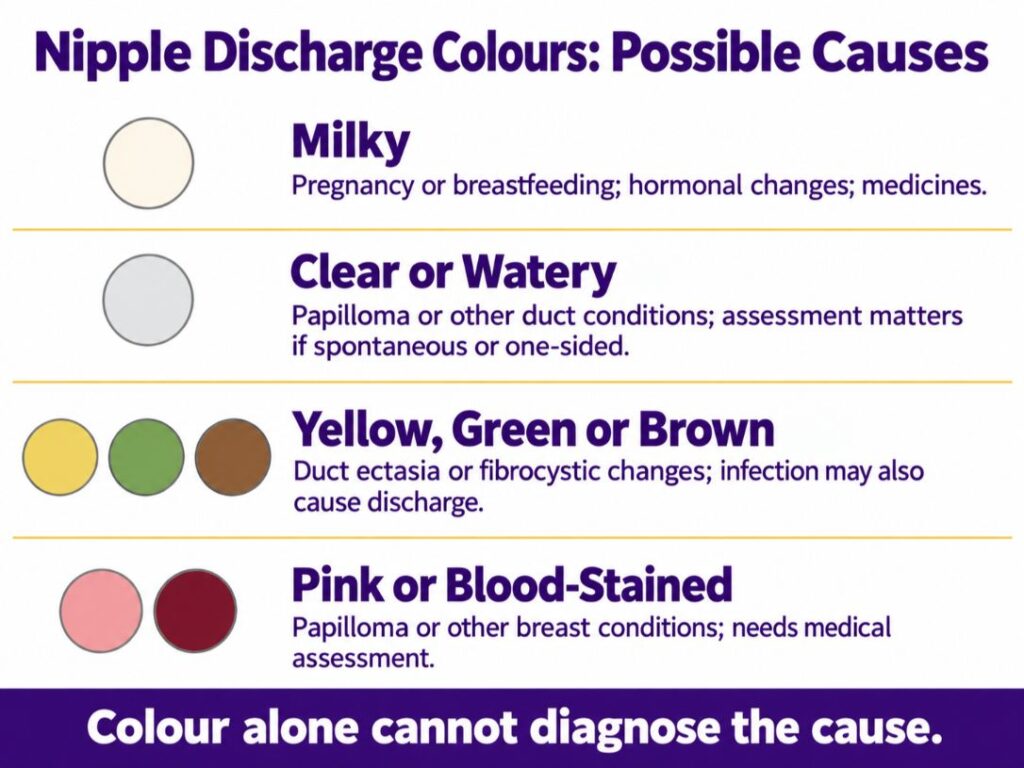
Colour gives useful clues, but it never confirms a diagnosis on its own. Here are the common nipple discharge causes for each type.
Milky nipple discharge causes
Milky fluid from both breasts is usually hormonal. During pregnancy and breastfeeding, it is expected, and the Mayo Clinic notes it can continue for a year or more after nursing stops. When milky discharge appears outside these times, it is called galactorrhoea. According to the Mayo Clinic, common triggers include:
- Medicines such as some antidepressants, antipsychotics, blood pressure tablets, sedatives and opioids
- Birth control pills and herbal supplements such as fennel or fenugreek
- A prolactinoma, a non-cancerous pituitary growth that raises the milk hormone prolactin
- An underactive thyroid (hypothyroidism)
- Long-term kidney disease
- Frequent nipple stimulation or rubbing from clothing
Irregular periods, headaches or changes in vision alongside milky discharge suggest a hormone cause and need blood tests. If you have other symptoms such as tiredness or weight gain, our guide to thyroid symptoms in women may help.
Clear or watery nipple discharge causes
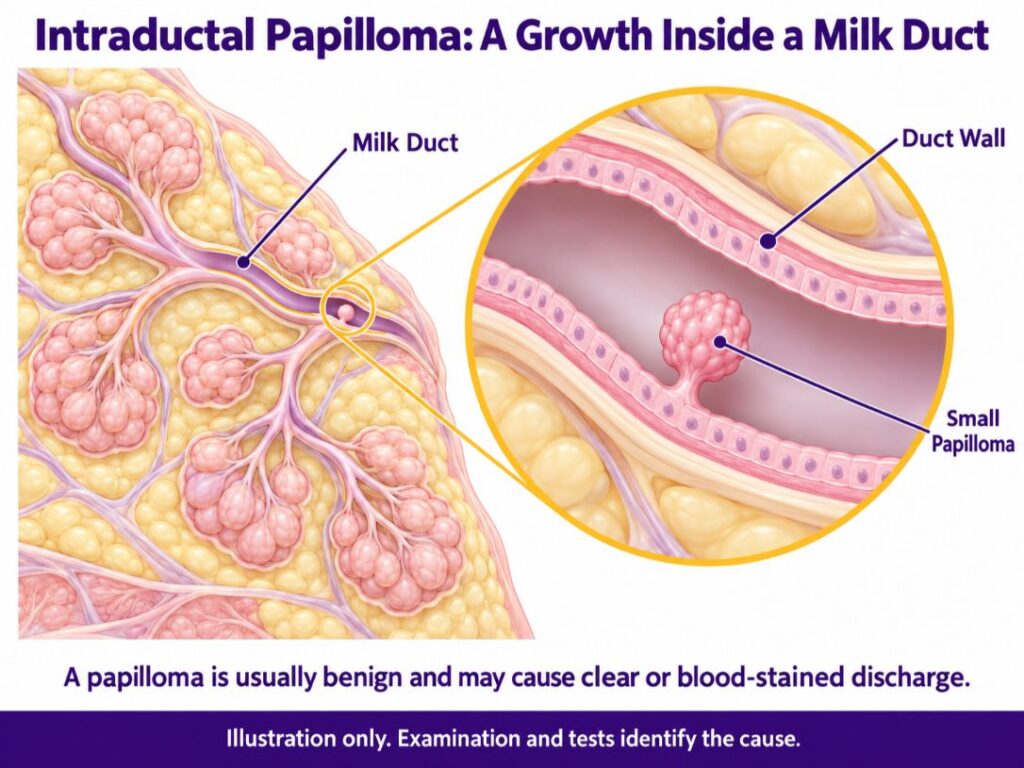
Clear, watery discharge that appears on its own from one duct deserves a check. The most common cause is an intraductal papilloma, a small, non-cancerous wart-like growth inside a milk duct. Less often, clear discharge from one breast is linked to ductal carcinoma in situ (DCIS) or breast cancer, so it should be assessed rather than watched at home.
Yellow, green or brown nipple discharge causes
Thicker yellow, green, brown or greyish discharge, often from both breasts and several ducts, usually points to a benign cause:
- Duct ectasia: Ducts widen and thicken with age, often around menopause, and fill with sticky fluid.
- Fibrocystic breast changes: Lumpy, tender breast tissue that changes with the menstrual cycle.
- Breast infection: Pus-like yellow or green discharge with pain, redness and fever may mean mastitis or a breast abscess.
- Periductal mastitis: Inflammation behind the nipple, more common in smokers.
Bloody nipple discharge causes
Blood-stained discharge is most often caused by an intraductal papilloma, but it can also come from cancer, infection or injury. It always needs a breast examination and imaging. Learn the other warning signs in our guide to breast cancer symptoms.
Nipple Discharge Causes by Situation
What causes nipple discharge when not pregnant?
When you are not pregnant or breastfeeding, the most common nipple discharge causes are hormonal shifts before a period, medicines, a raised prolactin level, an underactive thyroid, duct ectasia, fibrocystic changes and intraductal papilloma. Discharge that persists beyond one menstrual cycle should be checked.
What causes nipple discharge when squeezed?
Many women can express a few drops of fluid if they press the nipple firmly, even when the breast is healthy. Discharge that appears only with squeezing, from both breasts and several ducts, is usually physiological. The Mayo Clinic advises against repeatedly squeezing or checking, because handling the nipple can keep the discharge going.
Nipple discharge from one breast causes
Discharge from a single breast, especially from one duct and without squeezing, is more likely to have a cause inside that breast. Intraductal papilloma is the most frequent reason. Duct ectasia, infection and, less commonly, DCIS or cancer are other possibilities, so imaging is advised.
What causes nipple discharge after menopause?
After menopause, the breast produces little or no fluid, so new discharge deserves attention. Duct ectasia is one of the common benign nipple discharge causes at this age. However, spontaneous clear or bloody discharge from one duct in one breast needs prompt evaluation to rule out a papilloma or cancer.
Nipple discharge causes in men
Men rarely have nipple discharge. Any discharge in a man should be examined, as it can signal a hormone problem, a medicine side effect or, rarely, breast cancer.
How Do Doctors Find Nipple Discharge Causes?
Short answer: A doctor examines both breasts, checks which duct the fluid comes from, and arranges an ultrasound and, depending on age, a mammogram. Blood tests for prolactin and thyroid hormones are added for milky discharge.
A typical assessment follows these steps:
- History. Colour, which breast, whether it appears on its own, your periods, pregnancy and medicines.
- Breast examination. The doctor looks for a lump, skin change or nipple inversion and identifies whether one or several ducts are involved.
- Breast ultrasound. This can show a dilated duct or a small papilloma behind the nipple. It is the first test for younger women.
- Mammogram. Usually added for women around 40 and older.
- Blood tests. Prolactin and thyroid levels for milky discharge, and a pregnancy test where relevant.
- Biopsy. If imaging shows a growth, a needle biopsy confirms what it is.
The NHS notes that several of these tests can often be done in a single clinic visit.
Nipple Discharge Causes and Treatment
Treatment depends entirely on the cause:
| Cause | Usual treatment |
|---|---|
| Physiological discharge | Reassurance; stop squeezing or checking the nipple |
| Medicine side effect | Your doctor may review or change the medicine |
| High prolactin or prolactinoma | Hormone tests and referral for medicine that lowers prolactin |
| Underactive thyroid | Thyroid hormone treatment |
| Duct ectasia | Often settles alone; warm compresses and pain relief help |
| Infection or abscess | Antibiotics and, if needed, drainage |
| Intraductal papilloma | Often removed with a small operation on the affected duct |
| Persistent single-duct discharge | Removal of the duct (microdochectomy) to stop it and confirm the diagnosis |
| DCIS or cancer | Specialist breast cancer treatment |
Duct excision is a short procedure done through a small cut at the edge of the areola. The removed tissue is sent to a laboratory, which gives a definite diagnosis.
Nipple Discharge Evaluation Cost in Dhaka
There is no single fixed nipple discharge evaluation cost in Dhaka, because the tests depend on your age and the type of discharge. The main cost items are:
- Consultation and follow-up visit
- Breast ultrasound and a mammogram if advised
- Blood tests such as prolactin and thyroid function
- Needle biopsy, only if imaging shows a growth
- Duct excision surgery, in the small number of cases that need it
For many women with physiological discharge, the cost is simply a consultation and an ultrasound. Ask for an itemised estimate before any procedure, and contact the chamber directly for current fees.
Seeing a Female Breast Surgeon for Nipple Discharge in Dhaka
Discussing nipple discharge can feel embarrassing, and many women delay a check for that reason. A female surgeon in Dhaka can make it easier to describe symptoms openly and be examined comfortably.
Dr. Reshma Aziz is a female breast and colorectal surgeon who has provided medical and surgical care since 1996. Her qualifications and surgical training include breast surgery training at IPGMR (1998), a Diploma in Clinical Ultrasonography (2000) and an MS in Paediatric Surgery from the University of Dhaka (2003). She is registered with the Bangladesh Medical and Dental Council under number A-24611, which you can check through her official BMDC registration record.
Her services list nipple discharge among the breast concerns she assesses. During a breast surgery consultation in Dhaka, she takes your history, examines both breasts and explains which tests, if any, you need.
- Nipple discharge consultation in Mohammadpur, Dhaka: Dhaka Lab, 1/20 Humayun Road, College Gate. Saturday, Tuesday and Thursday, 11:30 AM to 1:30 PM.
- Nipple discharge specialist in Gulshan, Dhaka: Cure Medical Center & Hospital, House 15, Road 42, Gulshan-2. Saturday and Tuesday, 4:00 PM to 6:00 PM.
Confirm your serial on the appointment and visiting hours page before travelling. Patients outside Dhaka can begin with a telemedicine consultation to review existing reports.
Key Takeaways
- Most nipple discharge causes are benign, including hormones, medicines and duct ectasia.
- Discharge from both breasts that appears only when squeezed is usually normal.
- Spontaneous, one-sided, single-duct, bloody or watery discharge needs a check.
- Intraductal papilloma is the most common cause of bloody discharge from one duct.
- Ultrasound, mammography and blood tests help identify nipple discharge causes.
Frequently Asked Questions
Is nipple discharge a sign of breast cancer?
Rarely. Most nipple discharge causes are harmless. Discharge is more concerning when it is bloody or clear, comes from one duct in one breast, appears on its own, or occurs with a lump.
Is clear nipple discharge normal?
Clear fluid that appears only when squeezed, from both breasts, is often normal. Clear discharge that leaks on its own from one duct should be examined, as it can come from a papilloma.
Can stress cause nipple discharge?
The Mayo Clinic lists stress among possible contributors to milky discharge, but it is rarely the only cause. Persistent milky discharge should still be checked with a hormone blood test.
Should I keep squeezing to see if the discharge has stopped?
No. Repeatedly squeezing or checking the nipple can keep the discharge going. Leave the area alone and let a doctor examine it.
Get a Clear Answer About Your Nipple Discharge
Understanding nipple discharge causes helps you stay calm, but only an examination can tell you what is behind your symptoms. If discharge is new, one-sided, bloody or watery, or comes with a lump, arrange an assessment rather than waiting.
Book an appointment with Dr. Reshma Aziz for a private consultation in Mohammadpur or Gulshan. Call +88-01948-444999 or message +88-01775-731935 on WhatsApp.