

Most stomach aches settle on their own within a few hours. Appendicitis is different. It can turn a dull ache into a surgical emergency within a day, which is why recognising the warning signs early matters.
Quick answer: The most common appendicitis symptoms are pain that starts around the belly button and moves to the lower right side of the abdomen, where it becomes constant and severe within hours. Loss of appetite, nausea, vomiting, mild fever, and constipation or diarrhoea often follow. Pain that worsens when you walk, cough, or press on the lower right abdomen needs same-day medical assessment.
Below, you will learn the early signs, how symptoms progress, and when to go straight to a hospital in Dhaka.
What Is Appendicitis?
Appendicitis is inflammation of the appendix, a small pouch about 5 to 10 cm long attached to the large intestine on the lower right side of the abdomen. Once inflamed, it can fill with pus and eventually burst.
According to the US National Institute of Diabetes and Digestive and Kidney Diseases (NIDDK), appendicitis is the most common cause of sudden abdominal pain requiring surgery. The NHS notes it most often affects people aged 10 to 30, although it can occur at any age.
What Are the Early Signs of Appendicitis?
The early signs of appendicitis are often vague, so many people dismiss them as “gastric” or indigestion. Watch for:
- A dull, crampy ache around or just above the belly button
- Loss of appetite, one of the most consistent early clues
- Nausea, with or without vomiting
- Pain that feels different from your usual stomach upsets
At this stage the pain may come and go. The important change is what happens over the next few hours.
Where Does Appendicitis Pain Start?
Appendicitis pain usually starts in the middle of the abdomen, around the navel. Within hours, it typically moves to the lower right side, where the appendix lies, and becomes sharper, constant, and easier to pinpoint.
The pain often gets worse with:
- Walking, or travelling over bumpy roads in a rickshaw or car
- Coughing, sneezing, or taking a deep breath
- Pressing on the lower right abdomen
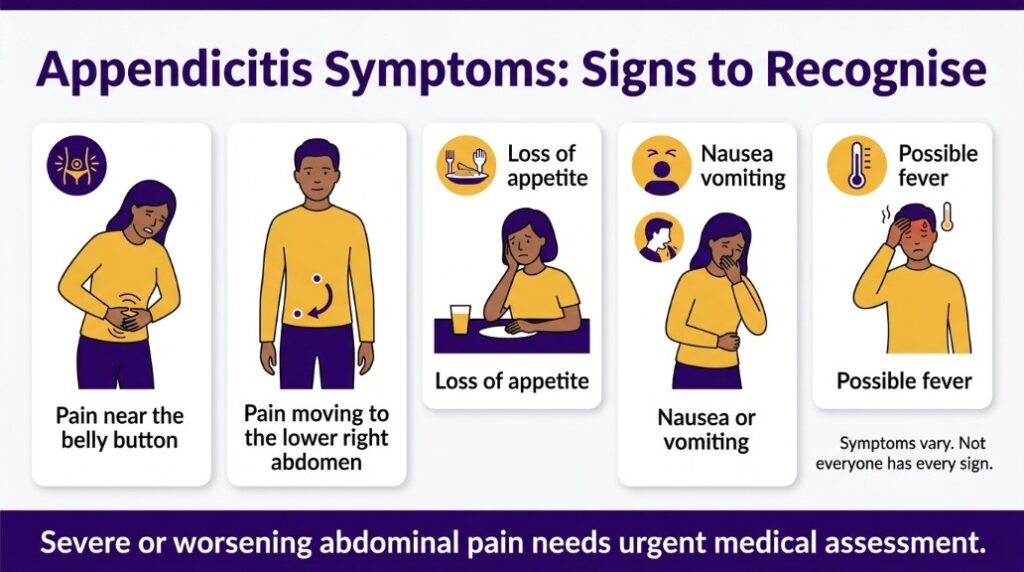
Not everyone follows this pattern. If the appendix sits behind the bowel or low in the pelvis, pain may be felt in the back or above the pubic bone.
Appendicitis Symptoms Timeline: How They Progress
Appendicitis symptoms usually develop quickly, often over one to two days. Every case is different, but a common pattern looks like this:
| Stage | What people commonly notice |
|---|---|
| First few hours | Vague pain around the belly button, poor appetite, nausea |
| Several hours later | Pain moves to the lower right, becomes constant, and worsens with movement; vomiting and low-grade fever may start |
| Day one to two | Pain intensifies; the risk of the appendix bursting grows the longer treatment is delayed |
| If the appendix bursts | Pain may ease briefly, then spread across the whole abdomen with high fever and a hard, tender tummy |
A short period of relief followed by sudden, worse pain is a danger sign, not recovery. The NHS advises emergency help in this situation because the appendix may have burst, which can cause peritonitis, a serious infection of the abdominal lining.
Appendicitis Symptoms in Adults
In adults, the classic appendicitis symptoms include:
- Pain moving from the belly button to the lower right abdomen
- Loss of appetite
- Nausea and vomiting, usually after the pain begins
- Mild fever and a flushed face
- Constipation, diarrhoea, or difficulty passing gas
Older adults may have milder appendicitis symptoms even when inflammation is advanced, so new, persistent abdominal pain in an older person deserves prompt assessment.
Appendicitis Early Symptoms in Women
Women experience the same core pattern, but diagnosis can be harder because some gynaecological conditions cause similar lower right pain. The NHS lists ectopic pregnancy, period pain, and pelvic inflammatory disease among these. Telling your doctor about your last period or a possible pregnancy helps them reach the right diagnosis faster.
Appendicitis Symptoms in Children
Young children often cannot explain where it hurts, and NIDDK notes that some children with appendicitis do not show typical symptoms at all. Parents should watch for:
- Tummy pain with refusal to eat, even favourite foods
- Vomiting along with tummy pain
- Fever
- Walking bent forward or not wanting to move or jump
- Crying when the car goes over bumps or when the tummy is touched
Trust your instincts if your child seems more unwell than usual. Other problems can also cause tummy pain in children, including infections, constipation, and groin swellings (see our guide to hernia symptoms in children).
Appendicitis Symptoms During Pregnancy
Appendicitis is the most common non-obstetric surgical emergency in pregnancy. It can be harder to recognise because the growing uterus pushes the appendix upward. Later in pregnancy, pain may be felt in the middle or upper right abdomen rather than the lower right, and nausea may be mistaken for morning sickness.
Pregnant women with appendicitis symptoms should seek urgent care, especially for persistent or worsening right-sided pain at any height, or abdominal pain with fever or vomiting that feels different from usual pregnancy discomfort. Ultrasound is usually the first imaging test, and MRI may be used when needed because it avoids radiation.
Can Appendicitis Symptoms Come and Go?
Short answer: In acute appendicitis, early pain may come and go for a few hours, but it usually becomes constant and steadily worse. Pain that disappears completely and returns over weeks has many possible causes and should be checked by a doctor.
Repeated, milder episodes of right-sided pain are sometimes called chronic appendicitis, but this is uncommon. Such pain is more often linked to constipation, irritable bowel syndrome, ovarian problems, or urinary issues.
Appendicitis Symptoms Without Fever
Yes, appendicitis can occur without fever. Temperature is often normal or only slightly raised in the early stage and tends to rise as inflammation progresses. A normal thermometer reading is never a reason to delay assessment when other appendicitis symptoms are present.
Appendicitis Symptoms vs Gas Pain: How to Tell the Difference
Gas pain is far more common, but the two can feel similar at first:
| Feature | Appendicitis | Gas pain |
|---|---|---|
| Location | Starts at the navel, settles in the lower right | Moves around, often upper or left abdomen |
| Pattern | Constant and steadily worsening | Comes in waves |
| Relief | Not relieved by passing gas or stool | Eases after passing gas or stool |
| Movement | Worse with walking or coughing | Often improves with walking |
| Appetite | Usually lost | Usually normal |
Use this table as a guide only. Pain under the right ribs after fatty meals may point towards gallbladder stone symptoms, while long-standing bloating and hard stools may need chronic constipation treatment.
How Is Appendicitis Diagnosed?
The NHS points out that no single test can always confirm appendicitis. Doctors usually combine:
- A detailed history of when and where the pain began
- A physical examination of the abdomen
- Blood and urine tests
- A pregnancy test for women of childbearing age
- Imaging, such as ultrasound, CT scan, or MRI
Sometimes doctors observe a patient for a few hours to see how symptoms develop.
Appendicitis Diagnosis Cost in Dhaka
The appendicitis diagnosis cost in Dhaka varies by hospital, the tests required, and whether you are seen in an emergency department. Blood tests and ultrasound usually come first, while a CT scan adds to the cost. Ask the hospital for an estimate, but never let cost delay an emergency assessment.
How Is Appendicitis Treated?
Most cases are treated by removing the appendix, an operation called an appendectomy, done either as laparoscopic (keyhole) surgery through small cuts or as open surgery. NIDDK notes that some mild cases may be treated with antibiotics alone, although this does not suit everyone and appendicitis can return. Most people recover within one to two weeks.
Laparoscopic Appendix Surgery Cost in Dhaka
Laparoscopic appendix surgery cost in Dhaka depends on the hospital, surgeon and anaesthesia fees, whether the appendix has burst, and the length of stay. Ask for an itemised estimate.
When to Seek Emergency Care for Appendicitis Symptoms
Go to the nearest hospital emergency department immediately if you notice:
- Severe, constant pain that keeps getting worse
- Pain spreading across the whole abdomen, or easing and then suddenly worsening
- High fever, chills, or a racing heartbeat
- A hard, swollen, or very tender tummy
- Repeated vomiting or being unable to keep fluids down
- Right-sided abdominal pain during pregnancy
- A child with tummy pain, vomiting, and refusal to eat
While seeking care, avoid laxatives or a hot water bottle on the abdomen, and avoid eating until assessed in case surgery is needed.
Hospitals for Appendicitis Treatment in Dhaka
Suspected appendicitis needs a hospital with a 24-hour emergency department, imaging, and general surgery cover. Many public and private hospitals in Dhaka offer this, so choose the nearest suitable one. For children, paediatric surgery services are ideal.
Finding the Right Surgeon in Dhaka for Abdominal Concerns
If you are looking for an appendicitis surgeon in Dhaka, appendicitis is managed by general surgeons and, in children, by paediatric surgeons. For non-emergency concerns, such as recurring right-sided pain, a planned consultation is a sensible next step.
Dr. Reshma Aziz is a female gastrointestinal surgeon in Dhaka with an MS in Paediatric Surgery, a Postgraduate Diploma in Colorectal Surgery, and more than 20 years of clinical experience. She is registered with the Bangladesh Medical & Dental Council under registration number A-24611; you can view her official BMDC registration record. Read more about her qualifications and surgical training and the conditions Dr. Reshma Aziz treats.
If you suspect acute appendicitis right now, go to an emergency department first rather than waiting for a chamber appointment.
Key Takeaways
- Appendicitis pain usually starts near the belly button and moves to the lower right abdomen within hours.
- Children, older adults, and pregnant women may not show typical appendicitis symptoms.
- Having no fever does not rule out appendicitis.
- Pain that eases and then suddenly worsens may mean the appendix has burst.
Frequently Asked Questions
What are the first appendicitis symptoms?
The first appendicitis symptoms are usually a dull ache around the belly button, loss of appetite, and nausea. Within hours, the pain typically shifts to the lower right abdomen and becomes constant.
How long can you have appendicitis symptoms before it bursts?
There is no safe waiting period. The risk of bursting increases the longer treatment is delayed, particularly after the first day or two. Seek assessment the same day.
Can appendicitis go away on its own?
Appendicitis should not be expected to go away on its own. Some mild cases may be treated with antibiotics, but only under medical supervision after a proper diagnosis.
Can appendicitis be mistaken for period pain?
Yes. Period pain, ovarian problems, and ectopic pregnancy can all cause lower right abdominal pain. Pain that is unusually severe, constant, or comes with fever or vomiting should be checked promptly.
Get Expert Advice About Your Abdominal Symptoms
If you have severe or worsening pain, go to the nearest emergency department. For ongoing or unclear abdominal, bowel, or surgical concerns, consult Dr. Reshma Aziz for an individual medical assessment at Dhaka Lab, Mohammadpur, or Cure Medical Center & Hospital, Gulshan.
Check her appointment schedule and visiting hours, ask about a telemedicine consultation if you live outside Dhaka, or book an appointment to discuss your symptoms and options.
This article provides general health information and does not replace an in-person medical assessment. If you think you or your child may have appendicitis, seek emergency care immediately.