
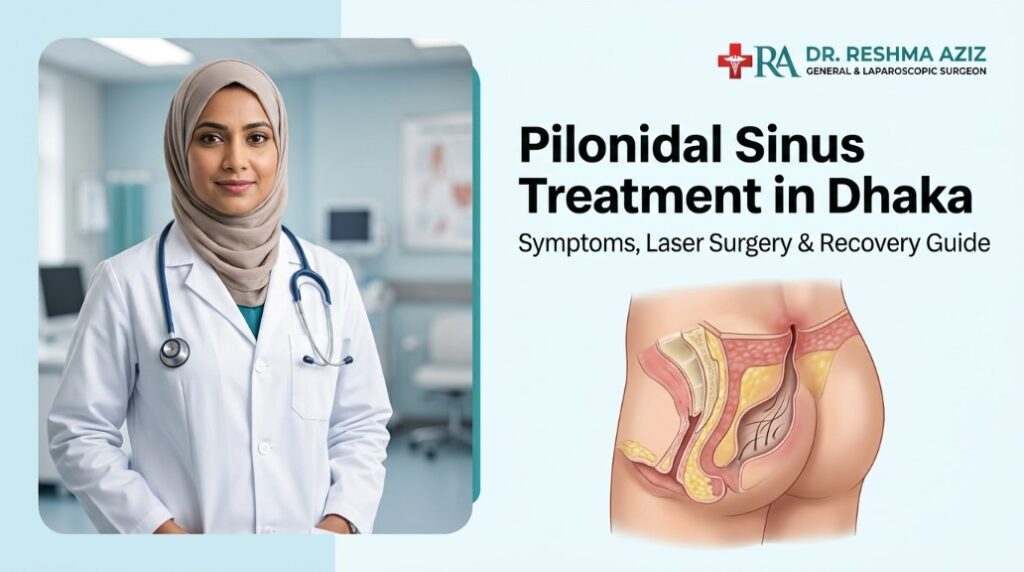
A painful lump near your tailbone can make sitting in traffic, at a desk or on a rickshaw seat miserable. If it keeps swelling, leaking pus or coming back, you are probably dealing with a pilonidal sinus.
Pilonidal sinus treatment in Dhaka depends on the stage of the disease. A quiet sinus with no symptoms may only need hygiene and hair control. A painful abscess usually needs drainage. A sinus that keeps getting infected often needs a planned procedure, such as laser ablation, excision with open healing, or excision with off-midline closure.
In this guide, you will learn how pilonidal sinus treatment in Dhaka works, which option suits which situation, what recovery looks like, and what affects the cost.
Quick Answer
A pilonidal sinus is a small tunnel in the skin at the top of the buttock cleft, usually caused by hair pushing into the skin. Treatment is needed mainly when it becomes infected or keeps recurring. The right pilonidal sinus treatment in Dhaka is chosen after an examination, not by the name of the procedure.
What Is a Pilonidal Sinus?
A pilonidal sinus is a narrow channel under the skin, usually in the cleft between the buttocks just above the tailbone (coccyx). “Pilonidal” means “nest of hair,” which describes the problem well.
The American Society of Colon and Rectal Surgeons (ASCRS) describes pilonidal disease as an acquired condition linked to hair in the buttock cleft. Loose hairs press into the skin, the body reacts to them as a foreign material, and small pits, tunnels or infections develop.
It is more common in:
- Young adults, especially men
- People with thick or coarse body hair
- Those who sit for long hours (office workers, drivers, students)
- People who are overweight
- Anyone with a deep buttock cleft or a family history of the condition
Understanding these risk factors matters because pilonidal sinus treatment in Dhaka works best when it includes steps to stop hair collecting in the cleft again.
Pilonidal Sinus Symptoms and Treatment: What to Watch For
Many people have small pits for years without noticing them. Symptoms usually appear once infection sets in:
- Pain and swelling at the top of the buttock cleft
- A tender lump that makes sitting difficult
- Pus or blood leaking from one or more small openings
- A bad smell or staining on underwear
- Fever or feeling unwell with a severe infection
The NHS notes that these symptoms can develop quickly, often over a few days, and should be treated promptly. If a painful lump appears, seek pilonidal sinus treatment in Dhaka early rather than waiting for it to burst.
Do not squeeze it. Pressing, puncturing or cutting a pilonidal abscess at home can push infection deeper and make later treatment harder.
How Is Pilonidal Sinus Diagnosed?
Diagnosis is usually made by a physical examination. The doctor looks for midline pits, openings, swelling, discharge and old scars. According to ASCRS guidance, the examination should also check the anal area, because an anal fistula can look similar. You can read more about that condition in our guide to anal fistula treatment.
Imaging such as ultrasound is not always needed, but may help in complex or recurrent cases.
Pilonidal Sinus Treatment in Dhaka: What Are the Options?
There is no single best method for everyone. Pilonidal sinus treatment in Dhaka is matched to your stage of disease, the number of tracts and whether it has been treated before.
1. Pilonidal Sinus Treatment Without Surgery
For a sinus with no pain, infection or discharge, doctors usually recommend watchful waiting with:
- Regular washing and keeping the cleft dry
- Hair removal from the cleft (shaving or laser hair removal, as advised)
- Breaking up long periods of sitting
- Loose, breathable cotton underwear
- Weight management where relevant
ASCRS guidance supports hair removal as a key measure for disease without an abscess. However, these steps do not remove an established tunnel.
2. Can Antibiotics Treat Pilonidal Sinus?
Antibiotics can help when infection spreads into the surrounding skin, or for patients with diabetes or weak immunity. They cannot drain a pus collection or remove the sinus tract. Relying on repeated antibiotic courses often delays proper pilonidal sinus treatment in Dhaka and lets the disease become more complex.
3. Pilonidal Sinus Abscess Treatment Options
A painful, swollen abscess usually needs incision and drainage. Under local anaesthetic, a small cut releases the pus, which quickly relieves pressure. Dressings follow for some days. Drainage treats the emergency, but the sinus often returns, so a planned procedure may be discussed once the infection settles.
4. Pilonidal Sinus Laser Treatment in Dhaka
In laser ablation, the surgeon cleans the tract of hair and debris, then passes a thin laser fibre inside to seal it with heat. It is often done under local or spinal anaesthesia as a day-care procedure.
A 2021 systematic review found high primary healing with a low weighted recurrence rate, but its authors noted the results mainly applied to mild chronic disease and called for randomised trials. So, if you are considering this form of pilonidal sinus treatment in Dhaka, ask whether your tract pattern is suitable.
5. Conventional Surgery
- Excision with open healing: the diseased tissue is removed and the wound heals from the inside out. The NHS states this carries the lowest risk of the sinus coming back, but it needs regular dressings.
- Excision with closure: the wound is stitched. Healing is faster, but infection risk is higher. Guidelines advise avoiding closure directly in the midline where possible.
- Flap procedures: used mainly for complex or recurrent disease, where skin is moved to flatten the cleft.
Laser vs Conventional Pilonidal Sinus Surgery: Which Is Better?
| Factor | Laser ablation | Excision, open healing | Excision with closure / flap |
|---|---|---|---|
| Wound | Tiny opening | Large open wound | Stitched wound |
| Anaesthesia | Local or spinal | Local, spinal or general | Spinal or general |
| Dressings | Minimal | Regular for weeks | Until stitches heal |
| Return to routine | Usually quicker | Slower | Moderate |
| Best suited to | Mild, limited tracts | Extensive or infected disease | Complex or recurrent cases |
| Main drawback | Long-term evidence still limited | Long healing time | Wound infection or breakdown |
Pros of laser: less pain, smaller wound, faster return to work.
Cons of laser: not suitable for every case, longer-term data is still growing, and recurrence is still possible.
The best pilonidal sinus treatment in Dhaka is the least invasive option likely to work for your specific disease.
When Does Pilonidal Sinus Need Surgery?
You may need a procedure if you have:
- Two or more infections in the same area
- Persistent discharge or bleeding
- Multiple openings or branching tracts
- A sinus that failed to heal after previous treatment
A single, quiet pit usually does not need an operation.
Recurrent Pilonidal Sinus Treatment Options
Recurrence is a real challenge with every method. For recurrent pilonidal sinus treatment in Dhaka, the surgeon will examine old scars and all openings before choosing between repeat laser treatment, wider excision or a flap procedure. A strict hair-control plan afterwards is equally important.
How to Prepare for Pilonidal Sinus Surgery
Good preparation makes pilonidal sinus treatment in Dhaka smoother:
- Share your history: when symptoms began, past drainages and surgeries.
- List your medicines, especially blood thinners and diabetes medicines.
- Get tests done if advised, such as blood sugar or a blood count.
- Ask about anaesthesia and whether you can go home the same day.
- Arrange leave from work or classes for the recovery period.
- Plan transport home, since sitting may be uncomfortable.
Pilonidal Sinus Surgery Recovery Time and Wound Care
Recovery depends on the procedure:
- After laser ablation: studies report healing over a few weeks, often around a month.
- After closed excision: stitches are usually removed around 10 days, per the NHS.
- After open healing: the wound can take several weeks to heal fully.
The NHS says most people return to work within about two weeks, depending on the job and procedure.
Wound Care After Pilonidal Sinus Surgery
- Keep the wound clean and follow the dressing schedule
- Wear loose cotton underwear
- Eat fibre-rich food to avoid straining (our guide on chronic constipation treatment in Dhaka may help)
- Avoid heavy lifting and strenuous exercise for the first week or so
- Continue hair removal from the area once healed
Contact your doctor if pain suddenly worsens, fever develops, or discharge becomes heavy or foul-smelling. Follow-up is an important part of pilonidal sinus treatment in Dhaka.
Pilonidal Sinus Surgery Cost in Dhaka
There is no fixed price. The pilonidal sinus surgery cost in Dhaka depends on:
- Consultation and examination fees
- Whether urgent abscess drainage is needed first
- The procedure chosen (drainage, laser, excision or flap)
- Type of anaesthesia
- Day-care or hospital charges
- Dressings, medicines and follow-up visits
- Histopathology, if tissue is sent to the lab
The pilonidal sinus surgery cost in Bangladesh also varies between hospitals. Before agreeing to pilonidal sinus treatment in Dhaka, ask for a written estimate that lists each charge, including aftercare. A very cheap package may leave out dressings or follow-up.
Choosing a Doctor for Pilonidal Sinus Treatment in Dhaka
Look for a registered surgeon with colorectal or general surgical experience who examines you privately, explains every option and gives a clear aftercare plan.
Dr. Reshma Aziz is a BMDC-registered doctor (registration number A-24611) who evaluates and manages pilonidal disease as part of her colorectal and general surgical practice. She holds an MBBS, an MS in Paediatric Surgery from the University of Dhaka and a Postgraduate Diploma in Colorectal Surgery, and has completed LASER training in proctology. She has provided medical and surgical care since 1996. You can verify her BMDC registration record and read about her qualifications and surgical training.
For many patients, especially women, a female surgeon in Dhaka makes a sensitive examination more comfortable. See the full list of conditions Dr. Reshma Aziz treats.
Chambers:
- Dhaka Lab, Mohammadpur: Saturday, Tuesday, Thursday, 11:30 AM to 1:30 PM
- Cure Medical Center & Hospital, Gulshan: Saturday, Tuesday, 4:00 PM to 6:00 PM
Please confirm timings on the appointment and visiting hours page.
Key Takeaways
- A pilonidal sinus is a hair-related tunnel at the top of the buttock cleft.
- A quiet sinus often needs only hygiene and hair control.
- An abscess usually needs drainage; antibiotics alone are not enough.
- Laser ablation suits selected mild cases; open or flap surgery suits complex ones.
- Recurrence is possible with any method, so aftercare matters.
- Cost depends on the procedure, anaesthesia, facility and follow-up.
Frequently Asked Questions
What is the best pilonidal sinus treatment in Dhaka?
There is no single best option. Mild tracts may suit laser ablation, while extensive or recurrent disease may need excision or a flap. An examination decides the right choice.
Can a pilonidal sinus heal on its own?
A small, quiet sinus may never cause trouble. An established, repeatedly infected tract rarely disappears without a procedure.
Is laser treatment painful?
It is done under anaesthesia. Most people have mild soreness afterwards, usually less than after open surgery.
Can pilonidal sinus come back after surgery?
Yes. Recurrence can happen after any method. Hair removal, hygiene and follow-up help reduce the risk.
How long do I need off work?
Many people return within about two weeks, but open wounds and physically demanding jobs may need longer.
Should I see a doctor for a painful lump near my tailbone?
Yes. A painful, swollen or leaking lump is a sign of infection and should be checked promptly.
Get the Right Treatment, Not Just Temporary Relief
Repeated antibiotics and home remedies may calm a flare, but they rarely solve the problem. The right pilonidal sinus treatment in Dhaka starts with a careful examination and an honest discussion of your options.
Book an appointment with Dr. Reshma Aziz to discuss your symptoms and treatment options. Visit the contact page or call +88-019-48-444-999 / +88-017-75-73-19-35 (WhatsApp). If you want advice before visiting, a telemedicine consultation can help.
This article is for general education and does not replace personal medical advice. Seek urgent care for severe pain, fever or rapidly spreading redness.