

You eat more vegetables, drink more water, try a laxative from the pharmacy, and still spend too long in the bathroom. If that sounds familiar, you are dealing with something many adults quietly put up with for years.
Quick answer: Chronic constipation treatment usually starts with simple steps: a gradual increase in fibre (such as psyllium or kiwifruit), enough fluids, regular activity and a fixed toilet routine. If these do not help, a doctor may add a laxative such as polyethylene glycol. When laxatives fail, tests can check for pelvic floor problems or slow bowel movement, which need different treatment. Blood in the stool, weight loss or severe pain need prompt medical review.
This guide explains what causes long-term constipation, how chronic constipation treatment works step by step, what to do when laxatives stop working, and which warning signs mean you should see a doctor rather than try another remedy.
What Is Chronic Constipation?
Definition: Chronic constipation means difficult, infrequent or incomplete bowel movements that continue for at least three months. It is not defined by missing a single day. Many healthy people do not pass stool daily.
Doctors commonly use the Rome IV criteria for functional constipation. Symptoms should be present for the last three months, starting at least six months before diagnosis, with two or more of the following in at least a quarter of bowel movements:
- Straining
- Hard or lumpy stool
- A feeling of incomplete emptying
- A feeling of blockage in the back passage
- Needing to use fingers or pressure to help stool pass
- Fewer than three bowel movements a week
It is a common problem. A large review of 41 population studies estimated that about 14% of adults worldwide have chronic idiopathic constipation, which is constipation without an obvious medical cause. The NHS notes it is more common during pregnancy, after childbirth and over the age of 65.
Knowing which pattern you have matters, because the right chronic constipation treatment for hard, infrequent stool is different from the right treatment for difficulty pushing stool out.
What Causes Chronic Constipation?
Most long-term constipation has more than one cause. A person may eat little fibre, take iron tablets and also strain in the wrong way, all at once.
| Cause group | Common examples |
|---|---|
| Daily habits | Low fibre intake, too little fluid, long hours of sitting, ignoring the urge to go |
| Medicines | Iron and calcium supplements, opioid painkillers, some antidepressants, antacids containing aluminium, some blood pressure tablets |
| Medical conditions | Hypothyroidism, diabetes, Parkinson’s disease, irritable bowel syndrome with constipation (IBS-C) |
| Pelvic floor problems | Muscles that tighten instead of relaxing during a bowel movement (dyssynergic defecation) |
| Bowel movement speed | Slow transit, where stool moves through the colon more slowly than normal |
| Structural causes | Rectocele, rectal prolapse, narrowing of the bowel, and rarely bowel cancer |
| Life stages | Pregnancy, the weeks after childbirth, older age |
Stress, anxiety and sudden changes in routine, such as travel or Ramadan fasting hours, can also make symptoms worse.
This is why chronic constipation treatment should follow the cause. Adding more fibre helps someone who eats very little of it, but it may simply cause more bloating in a person whose real problem is pelvic floor coordination. Ongoing straining can also lead to piles and anal fissures. If you notice pain or bleeding during bowel movements, read our guide on anal fissure vs piles.
How to Treat Chronic Constipation: A Step-by-Step Approach
Chronic constipation treatment in adults usually moves in steps. Each step is given a few weeks before moving to the next, unless warning signs appear.
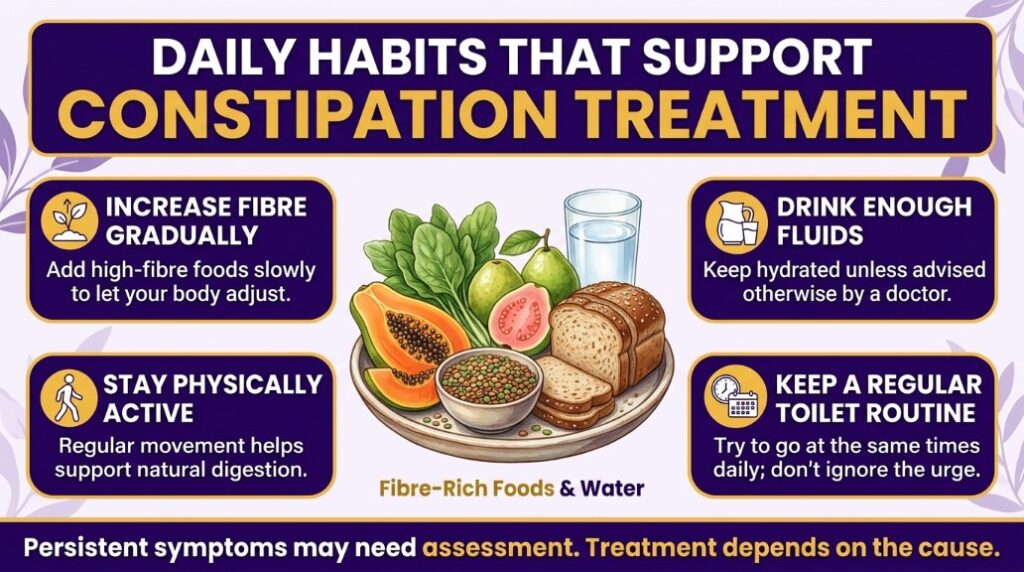
Step 1: Change daily habits
- Add fibre slowly. Increase over two to three weeks to limit gas and bloating. The NIDDK suggests most adults need roughly 22 to 34 grams of fibre a day.
- Drink enough fluid, unless a doctor has told you to restrict it for heart or kidney disease.
- Keep moving. A daily walk helps the bowel as well as the heart.
- Set a toilet routine. Try sitting for a few unhurried minutes after breakfast, when the bowel is naturally more active. Never ignore the urge to go.
- Use a footstool. Raising the knees above the hips straightens the passage and reduces straining.
Step 2: Use diet more precisely
The first evidence-based dietary guidelines for chronic constipation, endorsed by the British Dietetic Association in 2025, found good support for a few specific options rather than a general “eat more fibre” message:
- Psyllium fibre supplements (at least 10 grams a day)
- Kiwifruit, which may cause less bloating than psyllium
- Rye bread
- Mineral water high in magnesium
- Magnesium oxide supplements and certain probiotic strains
Step 3: Add a suitable laxative
The joint AGA and ACG guideline (2023) reviewed the main medicines for chronic idiopathic constipation. Among over-the-counter options, polyethylene glycol (PEG) received a strong recommendation for ongoing use.
| Laxative type | Examples | How it works | Points to know |
|---|---|---|---|
| Bulk-forming | Psyllium (ispaghula) | Adds bulk and holds water in stool | Needs fluid; can cause bloating at first |
| Osmotic | Polyethylene glycol, lactulose, magnesium oxide | Draws water into the bowel | Lactulose often causes gas; magnesium needs caution in kidney disease |
| Stimulant | Bisacodyl, sodium picosulfate, senna | Triggers bowel contractions | Useful short term or as rescue; may cause cramps |
| Prescription | Prucalopride, linaclotide, lubiprostone | Speeds transit or increases bowel fluid | Doctor-prescribed; availability in Bangladesh varies |
The guideline made no recommendation on docusate, a common stool softener, because the evidence was too limited.
Long term treatment for chronic constipation
For many people, long-term chronic constipation treatment means a steady daily routine plus a well-tolerated laxative at the lowest dose that works, reviewed by a doctor from time to time. Taking several laxatives together, or raising doses on your own, can hide a problem that needs a different approach.
Chronic Constipation Treatment When Laxatives Do Not Work
Short answer: If laxatives no longer help, the problem is often not stool hardness but how the bowel or pelvic floor works. A doctor can check for stool impaction, review your medicines and arrange tests for pelvic floor dysfunction or slow transit before changing treatment.
Laxatives fail for a few common reasons:
- Dyssynergic defecation. The pelvic floor muscles squeeze when they should relax. A consensus paper from US and European motility societies reports this affects about 40% of patients with chronic constipation seen in specialist clinics.
- Slow transit. Stool moves through the colon too slowly, even with a good diet.
- Faecal impaction. Hard stool builds up in the rectum. The NHS notes that the main sign can be watery stool leaking around the blockage, which people often mistake for diarrhoea.
- An untreated cause, such as an underactive thyroid or a constipating medicine.
Tests that guide severe chronic constipation treatment
A doctor may recommend anorectal manometry, a balloon expulsion test, defecography or a colonic transit study. Not every patient needs all of them. The choice depends on your symptoms and examination findings.
Pelvic floor biofeedback
For dyssynergic defecation, chronic functional constipation treatment shifts from medicines to retraining. Biofeedback teaches the muscles to relax and push in the right order. The same consensus paper gives it a grade A recommendation for both short- and long-term treatment.
Is surgery ever needed?
Rarely. Surgery is reserved for carefully selected patients with a confirmed structural problem, such as a large rectocele or rectal prolapse, or severe slow transit that has not responded to full medical treatment. A proper constipation evaluation should come long before any discussion of an operation.
Treatment Needs for Women, Older Adults and People With Bloating
Chronic constipation treatment for women
Women are more likely than men to have chronic constipation. Hormonal changes, pregnancy, iron supplements and childbirth can all play a part. A vaginal delivery can stretch the pelvic floor or create a rectocele, a bulge between the rectum and vagina that traps stool.
Practical points for women:
- During pregnancy, diet and routine changes are safe to try first. Ask a doctor before taking any laxative. Our guide to piles during pregnancy covers related problems.
- If you need to press around the vagina or perineum to pass stool, mention it. It is a useful clue, not something to feel embarrassed about.
- Many women delay care because they prefer not to be examined by a male doctor. A women’s rectal health consultation with a female surgeon can make that first visit easier.
Chronic constipation treatment in elderly patients
Older adults often take several medicines, move less and drink less. Treatment starts with a medicine review. Doctors also take extra care with magnesium-based laxatives in people with reduced kidney function. In older people, and those with dementia, the NHS warns that constipation can show up as confusion or a change in behaviour rather than an obvious complaint.
Chronic constipation and bloating treatment
Bloating often improves once bowel movements become regular. Increase fibre slowly, and consider kiwifruit if psyllium makes you gassy. Lactulose commonly causes wind, so PEG may suit better. Bloating that is persistent, getting worse or comes with weight loss should be checked by a doctor.
Red Flags: When to See a Doctor for Chronic Constipation
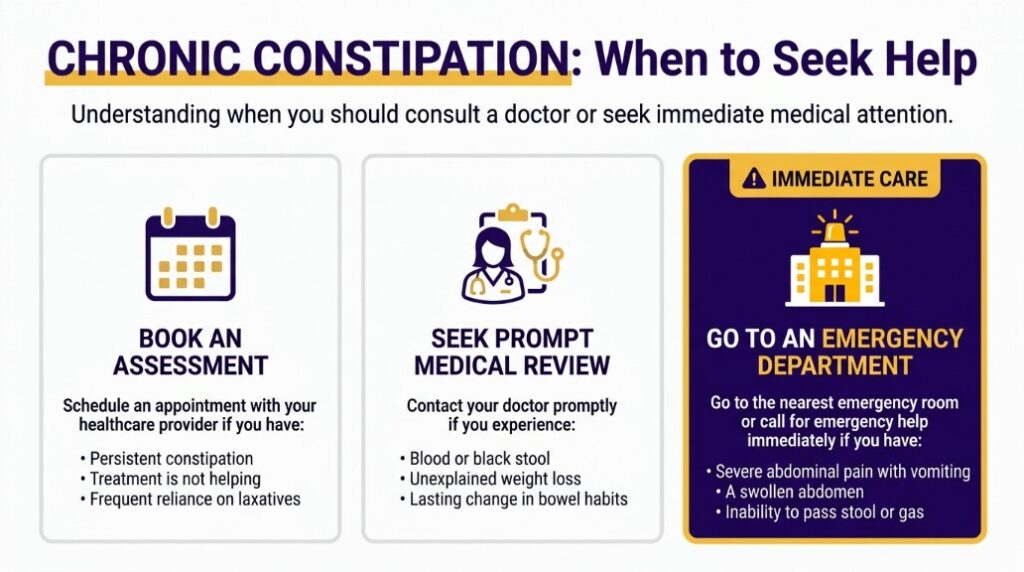
Short answer: See a doctor if constipation keeps coming back, does not improve with treatment, or comes with blood, weight loss, ongoing tiredness, belly pain or a sudden change in bowel habit. Go to an emergency department if you cannot pass stool or gas and have severe pain, vomiting or a swollen abdomen.
Book a routine appointment if you:
- Have constipation that is not improving with treatment
- Are constipated or bloated on a regular basis
- Notice a lasting change in how often or how easily you pass stool
- Feel tired all the time alongside constipation
- Take a medicine that seems to be causing it (do not stop it without advice)
- Rely on laxatives most days
Seek prompt care for:
- Blood in the stool or black, tarry stool
- Weight loss without trying
- A family history of bowel cancer or inflammatory bowel disease
- Anaemia found on a blood test
These signs do not mean cancer. They do mean the cause needs checking before chronic constipation treatment continues. Depending on your age and symptoms, your doctor may suggest a colonoscopy in Dhaka. Constipation alone, without warning signs, does not automatically need one.
Chronic Constipation Treatment in Dhaka: What to Expect
A good first visit for chronic constipation treatment in Dhaka should feel like a conversation, not a rushed prescription. Expect questions about stool pattern, straining, diet, medicines, pregnancies and family history, followed by an abdominal check and, when needed and with your consent, a gentle rectal examination. Keeping a one- or two-week stool diary before the visit helps a lot.
Choosing a chronic constipation specialist in Dhaka
Look for a doctor who:
- Is registered with the Bangladesh Medical and Dental Council (BMDC)
- Has training in colorectal or gastrointestinal conditions
- Asks about pelvic floor symptoms, not just bowel frequency
- Explains when tests are needed and when they are not
Many women also prefer a female doctor for chronic constipation in Dhaka, especially when an examination is likely. That preference is valid and should not delay care.
About Dr. Reshma Aziz
Dr. Reshma Aziz is a female colorectal and breast surgeon who has provided medical and surgical care since 1996. Her documented qualifications include an MBBS from Dow Medical College (1994), an MS in Paediatric Surgery from the University of Dhaka (2003), colorectal surgery training at Dhaka Medical College (2001) and a Postgraduate Diploma in Colorectal Surgery (2023). She is registered with the BMDC under number A-24611, which you can verify on the official BMDC record.
| Chamber | Days | Time |
|---|---|---|
| Dhaka Lab, Mohammadpur | Saturday, Tuesday, Thursday | 11:30 AM to 1:30 PM |
| Cure Medical Center & Hospital, Gulshan | Saturday, Tuesday | 4:00 PM to 6:00 PM |
For a chronic constipation consultation in Mohammadpur or Gulshan, check the appointment and visiting details first, as schedules can change. Patients outside Dhaka can ask about a telemedicine consultation.
Chronic constipation treatment cost in Dhaka
There is no single fixed price, because the total depends on what you actually need. Costs can include:
- The consultation and follow-up visits
- Blood tests, such as thyroid function or a blood count
- Medicines, which range from low-cost fibre to imported prescription drugs
- Specialised tests or colonoscopy, only when indicated
- Biofeedback sessions, where available
Many patients need only a consultation, a few basic tests and a treatment plan. Ask the clinic for current fees and an itemised estimate before any test or procedure.
Frequently Asked Questions
How long does chronic constipation treatment take to work?
Most laxatives work within one to three days. Diet changes and a new toilet routine often take two to four weeks to show their full effect. Pelvic floor biofeedback usually needs several sessions over a few weeks.
Can chronic constipation be cured permanently?
Some causes can be fixed, such as a constipating medicine or an underactive thyroid. For functional constipation, the aim is good long-term control. Many people stay comfortable with steady habits and occasional medicine adjustments.
Is it safe to take laxatives every day?
Osmotic laxatives such as PEG are generally considered suitable for long-term use under medical supervision. Daily stimulant laxatives are better kept for short periods or rescue use. Discuss long-term use with a doctor rather than self-medicating.
Can chronic constipation cause piles?
Yes, it can contribute. Hard stool and repeated straining raise pressure in the anal veins and can also tear the anal lining. Learn to recognise common piles symptoms, and get any bleeding checked.
What should I eat to relieve chronic constipation?
Kiwifruit, rye bread and psyllium have the strongest dietary evidence. Lentils, vegetables and fruit help too. Add fibre gradually and drink enough water, as a sudden jump often causes bloating.
Which doctor should I see for chronic constipation in Bangladesh?
Start with a qualified doctor who can examine you properly. Persistent symptoms, rectal pain, bleeding or suspected pelvic floor problems are reasons to see a colorectal surgeon or gastroenterologist for chronic constipation treatment.
Key Takeaways
- Chronic constipation means difficult, infrequent or incomplete bowel movements lasting three months or more.
- Effective chronic constipation treatment follows the cause: habits, diet, medicines, pelvic floor function or bowel speed.
- Psyllium, kiwifruit and PEG have some of the strongest supporting evidence.
- If laxatives stop working, tests for dyssynergic defecation or slow transit come next, and biofeedback may help.
- Surgery is rare and only follows full assessment.
- Blood in the stool, weight loss, anaemia or severe pain need prompt medical review.
Get a Private Assessment
Living with constipation for months or years is not something you simply have to accept. If home measures and pharmacy laxatives have not worked, a careful assessment can find the reason and point to treatment that fits you.
To discuss your symptoms and chronic constipation treatment options in a private, unhurried setting, book an appointment with Dr. Reshma Aziz at Dhaka Lab, Mohammadpur, or Cure Medical Center & Hospital, Gulshan. You can also call the hotline on 01948-444999.
If you have severe abdominal pain, vomiting, a swollen belly or cannot pass gas, go to the nearest emergency department instead of waiting for a clinic appointment.
This article is for general education and does not replace an individual medical assessment.