

Have you found a small, round lump under your skin that just won’t go away? Maybe it sits on your back, neck, scalp or face, and sometimes it swells or feels sore. It may be a sebaceous cyst.
Sebaceous cyst removal in Dhaka is usually a short day-care procedure done under local anaesthetic. The surgeon removes the whole cyst, including its wall (the sac), which lowers the chance of it coming back. Not every cyst needs surgery. Small, painless cysts can often be watched. Infected cysts are usually calmed down first and removed later.
In this guide, you will learn what a sebaceous cyst is, which symptoms need attention, how sebaceous cyst removal in Dhaka works, what affects the cost, and how to choose the right doctor.
Quick Answer
A sebaceous cyst is a harmless, slow-growing lump under the skin filled with a soft, cheesy material. The most reliable treatment is complete surgical excision with the cyst wall intact. Draining alone often leads to the cyst returning, which is why sebaceous cyst removal in Dhaka focuses on taking out the whole sac.
What Is a Sebaceous Cyst?
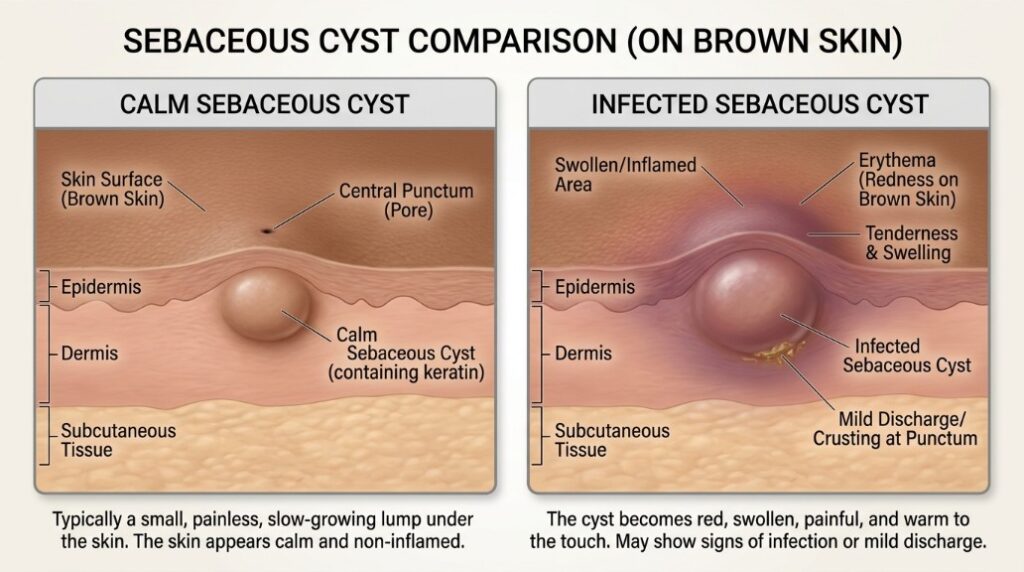
A sebaceous cyst is a closed sac that forms just beneath the skin. Doctors usually call it an epidermoid cyst, because most of these cysts come from the top layer of skin (the epidermis), not from oil glands. The sac fills with keratin, a protein made by skin cells, which gives the contents their soft, whitish, sometimes smelly texture.
According to the NHS, skin cysts are usually harmless, are not cancerous, and cannot be caught from another person. They are most common in adults and often appear on the:
- Face and neck
- Scalp (these are often pilar cysts, a close relative)
- Chest, shoulders and back
- Behind the ears
- Groin and genital area
A typical cyst has a few recognisable features:
- A round, smooth, movable lump under the skin
- A tiny dark dot in the centre (the blocked pore, called a punctum)
- Slow growth, from pea-sized to several centimetres
- No pain, unless it becomes inflamed or infected
If you notice these features, a proper check-up before planning sebaceous cyst removal in Dhaka helps confirm the diagnosis.
Is It a Sebaceous Cyst or Something Else?
Several lumps can look alike. A proper examination matters because treatment differs.
| Lump | How it usually feels | Key difference |
|---|---|---|
| Sebaceous (epidermoid) cyst | Firm, round, just under the skin | Often has a central dot; may discharge cheesy material |
| Lipoma | Soft, rubbery, doughy | Fatty lump with no central pore |
| Skin abscess | Hot, red, very painful | Collection of pus, often develops quickly |
| Pilonidal sinus | Painful lump near the tailbone | Found in the buttock cleft; linked to hair |
| Breast lump | Lump within breast tissue | Needs a dedicated breast assessment |
If your lump is near the tailbone, read about pilonidal sinus treatment in Dhaka. A lump in the breast should always be checked properly; our guide on breast lump assessment explains why.
When Should You See a Doctor About a Sebaceous Cyst?
Many cysts stay quiet for years, and not everyone needs sebaceous cyst removal in Dhaka straight away. Still, the NHS advises seeing a doctor for any skin lump you cannot identify. Book an assessment if your cyst:
- Keeps growing
- Is on your face or another visible area and bothers you
- Catches on clothing, a bra strap or a comb
- Has become painful or tender
- Has come back after previous drainage
Signs of an Infected Sebaceous Cyst
Seek prompt care if you notice:
- Redness or darkening around the lump (redness can be harder to see on brown skin)
- Swelling, warmth and throbbing pain
- Pus or foul-smelling discharge
- Fever or feeling generally unwell
- Redness spreading into the surrounding skin
People with diabetes should not delay, because skin infections can progress faster.
Important: Do not squeeze or try to pop a cyst at home. Squeezing can push the contents deeper, cause infection or spread an existing one, and makes later removal harder.
Sebaceous Cyst Treatment in Dhaka: What Are the Options?
Sebaceous cyst removal in Dhaka is not the only option. The right sebaceous cyst treatment in Dhaka depends on the size, location, symptoms and whether infection is present. Here are the main approaches.
1. Watchful Waiting
Small cysts that cause no pain or cosmetic concern often need no treatment. You simply keep an eye on them and return if anything changes.
2. Infected Sebaceous Cyst Treatment
An inflamed cyst is usually treated before any removal. This may include:
- Antibiotics, when a bacterial infection is suspected
- Incision and drainage if pus has collected
- Warm compresses and pain relief
Medical reviews note that complete removal is usually postponed while infection is active, because the tissue layers are hard to separate and the risk of wound problems and recurrence rises. Once the area has settled, planned excision can follow.
3. Complete Surgical Excision
This is the standard and most reliable approach to sebaceous cyst removal in Dhaka. The surgeon removes the entire sac through a small, usually elliptical cut, then closes the skin with stitches. A 2026 systematic review found that complete excision consistently had lower recurrence than incision and drainage.
4. Minimal Excision Technique
For selected small, non-inflamed cysts, a surgeon may use a tiny incision (a few millimetres), squeeze out the contents and pull the empty sac out. This leaves a smaller scar. It is not suitable for every cyst, especially those scarred from past infection.
Can a Sebaceous Cyst Be Treated Without Surgery?
This is a common question behind searches for sebaceous cyst treatment without surgery in Dhaka. The honest answer: creams, home remedies and antibiotics cannot remove the cyst wall. They may calm inflammation, but the sac remains, and the cyst can refill. Some non-surgical techniques are being studied, but evidence is still limited. If you want the cyst gone for good, sebaceous cyst removal in Dhaka with the full wall taken out is the key.
| Option | Best for | Main limitation |
|---|---|---|
| Observation | Small, painless cysts | Cyst stays and may grow |
| Antibiotics / drainage | Active infection | Sac remains; recurrence is common |
| Complete excision | Most cysts needing removal | Stitches and a linear scar |
| Minimal excision | Small, quiet cysts | Not suitable after repeated infection |
How Is Sebaceous Cyst Removal in Dhaka Performed?
For most patients, sebaceous cyst surgery in Dhaka is a minor procedure. You usually go home the same day. A typical process looks like this:
- Consultation and examination. The doctor confirms the diagnosis, checks for infection and reviews your health, medicines and conditions such as diabetes.
- Cleaning and numbing. The skin is cleaned, and a local anaesthetic is injected. You stay awake but should not feel sharp pain.
- Removal. The surgeon makes a small cut and carefully separates the whole sac from the surrounding tissue.
- Closure. The wound is stitched and covered with a dressing.
- Lab testing when needed. Cancer inside an epidermoid cyst is rare, but the removed tissue may be sent for histopathology if anything looks unusual.
- Follow-up. Stitches are checked or removed at a review visit.
Recovery After Removal
Recovery after sebaceous cyst removal in Dhaka is usually straightforward:
- Mild soreness for a few days, often managed with simple pain relief
- Keep the dressing clean and dry as instructed
- Avoid heavy strain on the area until the doctor advises
- Most people return to office work quickly, depending on the cyst’s location
Risks and Limitations
Every procedure, including sebaceous cyst removal in Dhaka, carries some risk. Possible issues include bleeding, wound infection, a visible scar and, if any part of the wall is left behind, recurrence. Removing one cyst also does not stop new cysts forming elsewhere. A careful surgeon will discuss these points before the procedure.
How Much Does Sebaceous Cyst Removal Cost in Dhaka?
There is no single fixed price. The sebaceous cyst removal cost in Dhaka varies from patient to patient, and any figure quoted without an examination is only a guess. The main cost factors are:
- Consultation fee for the initial assessment
- Size and location of the cyst (face and scalp may need more care)
- Number of cysts removed at one sitting
- Infection status, since an infected cyst may need drainage first and a second procedure later
- Facility type, such as a chamber procedure room or a hospital operation theatre
- Histopathology charges if tissue is sent to the lab
- Dressings, medicines and follow-up visits
The same factors shape the sebaceous cyst surgery cost in Dhaka when a larger or recurrent cyst needs more complex removal. Before agreeing to sebaceous cyst removal in Dhaka, ask for a clear estimate that lists what is included.
Private Clinic vs Hospital Removal: What’s the Difference?
Both settings can deliver safe sebaceous cyst removal in Dhaka. The difference is mostly about case complexity and convenience, not quality alone.
| Factor | Private clinic / chamber | Hospital setting |
|---|---|---|
| Suitable for | Small, uncomplicated cysts | Large, deep, recurrent or multiple cysts |
| Anaesthesia | Local | Local, or other options if needed |
| Waiting time | Often shorter | May vary |
| Cost | Usually lower | Usually higher due to facility charges |
| Backup facilities | Limited | Full support if complications arise |
Your doctor should recommend the setting based on your cyst and your general health, not on convenience alone.
Which Doctor Should You See for a Sebaceous Cyst in Dhaka?
Sebaceous cysts are commonly treated by general surgeons and dermatologists. Before booking sebaceous cyst removal in Dhaka, look for:
- A registered doctor you can verify with the Bangladesh Medical and Dental Council (BMDC)
- Surgical training and experience with minor procedures
- A clear explanation of options, risks and costs
- Willingness to treat infection first rather than rushing into surgery
- Proper follow-up after removal
Dr. Reshma Aziz is a BMDC-registered doctor (registration number A-24611) whose clinical scope includes general surgery, with minor lumps, swellings, skin and soft-tissue conditions, and abscesses. She holds an MBBS, an MS in Paediatric Surgery from the University of Dhaka, and a Postgraduate Diploma in Colorectal Surgery, with General Surgery and Allied training at Apollo Hospital, Hyderabad. She has provided medical and surgical care since 1996. Patients can verify her BMDC registration record and review her full qualifications and surgical training.
As a female surgeon in Dhaka, she also offers a comfortable option for women with cysts in sensitive areas. You can see the full range of conditions Dr. Reshma Aziz treats on her website.
Chambers:
- Dhaka Lab, Mohammadpur: Saturday, Tuesday, Thursday, 11:30 AM to 1:30 PM
- Cure Medical Center & Hospital, Gulshan: Saturday, Tuesday, 4:00 PM to 6:00 PM
Please confirm the current schedule on the appointment and visiting hours page before visiting.
Key Takeaways
- A sebaceous cyst is usually a harmless epidermoid cyst filled with keratin.
- Small, painless cysts may only need monitoring.
- Infected cysts are treated first; planned removal usually follows once the area settles.
- Complete excision of the cyst wall gives sebaceous cyst removal in Dhaka the lowest chance of recurrence.
- Draining or squeezing alone rarely solves the problem.
- Cost depends on size, location, infection, facility and lab tests.
- Choose a verified, registered doctor who explains your options clearly.
Frequently Asked Questions
Is sebaceous cyst removal in Dhaka painful?
The area is numbed with local anaesthetic, so most people feel only pressure and the initial injection. Mild soreness afterwards is common and usually short-lived.
How long does the procedure take?
Removal of a simple cyst is usually quick and done as a day-care procedure. Larger or recurrent cysts may take longer.
Will my sebaceous cyst come back after removal?
Recurrence is uncommon when the entire cyst wall is removed. It is more likely after drainage alone or if part of the sac is left behind. New cysts can still form in other places.
Can I remove an infected cyst straight away?
Usually not. Doctors typically treat the infection first, then remove the cyst once inflammation settles, because operating on an active infection raises the risk of wound problems and recurrence.
Can a sebaceous cyst become cancer?
It is very rare. Epidermoid cysts are benign, but a doctor may send the tissue for testing if the lump looks unusual, grows fast or keeps returning.
Will there be a scar?
Any cut leaves some scar. Good technique, proper wound care and, for suitable cysts, the minimal excision method can help keep it small.
Get Your Cyst Checked With Confidence
A sebaceous cyst is rarely dangerous, but a painful, growing or repeatedly infected lump deserves proper care. The right plan might be simple observation, infection treatment, or a planned, complete removal. Safe sebaceous cyst removal in Dhaka starts with an accurate diagnosis.
Consult Dr. Reshma Aziz for an individual assessment of your lump and a clear explanation of your treatment options. Visit the contact page or call +88-019-48-444-999 / +88-017-75-73-19-35 (WhatsApp) to book an appointment in Mohammadpur or Gulshan. If you cannot visit in person, a telemedicine consultation can help you decide on the next step.
This article provides general health information and is not a substitute for personal medical advice. If you have a hot, rapidly spreading red swelling with fever, seek urgent medical care.