
A breast lump is a new area of swelling, thickening, or firmness in the breast or armpit. Most breast changes are not cancer, but a new or unusual lump should still be checked by a qualified doctor. Do not diagnose it by touch or wait for pain. This guide explains causes, warning signs, breast lump diagnosis in Dhaka, treatment, costs, and pregnancy considerations.
A breast lump is not automatically cancer. The safest next step is a clinical breast examination, followed by suitable imaging and a biopsy only when the findings require it.
What Is a Breast Lump, and What Can Cause It?
A breast lump may feel round or irregular, soft or firm, tender or painless, mobile or fixed. Those features cannot confirm the cause. The National Cancer Institute notes that many benign conditions can produce lumps or lumpiness.
Breast lump causes in women include:
| Possible cause | Common pattern |
|---|---|
| Breast cyst | Fluid-filled and sometimes tender or cycle-related |
| Fibroadenoma | Usually smooth, firm, and mobile; more common in younger women |
| Fibrocystic change | General lumpiness or discomfort that may vary with the cycle |
| Infection or abscess | Pain, warmth, redness, swelling, fever, or feeling unwell |
| Pregnancy or breastfeeding change | Enlarged glands, blocked ducts, cysts, or a milk-filled galactocele |
| Fat necrosis or haematoma | Firm area that may follow injury or surgery |
| Breast cancer | May cause a lump, thickening, skin or nipple change, or an armpit lump |
Hormonal change is common, but it should not be used to dismiss a new focal lump. A doctor considers age, pregnancy history, family history, previous breast problems, medicines, and how the change developed.
Which Breast Lump Symptoms in Women Need Medical Attention?
Arrange an appointment for any new breast or armpit lump, even after a normal screening test. The NCI symptom guidance also highlights breast-shape, nipple, discharge, and skin changes.
Contact a doctor promptly if you notice:
- a new lump or firm area in the breast or armpit;
- a lump that persists, enlarges, or feels different from surrounding tissue;
- dimpling, puckering, thickening, or an orange-peel skin appearance;
- a nipple that has newly turned inward;
- spontaneous nipple discharge, especially bloody or clear discharge from one side;
- a change in breast size or shape that is not normal for you;
- persistent focal breast or armpit pain; or
- redness, warmth, fever, or rapidly increasing swelling.
When to see doctor for breast lump: Book a clinical assessment as soon as reasonably possible after finding a new or unexplained lump. Seek urgent help if redness or swelling is spreading, you have fever, or you feel seriously unwell.
I found a lump in my breast – should I panic?
No. Many causes are benign, but reassurance should come from assessment rather than guesswork. Note where and when you found it and whether it varies with your menstrual cycle. Avoid repeatedly pressing it, and arrange a consultation.
How Does Breast Lump Diagnosis in Dhaka Work?
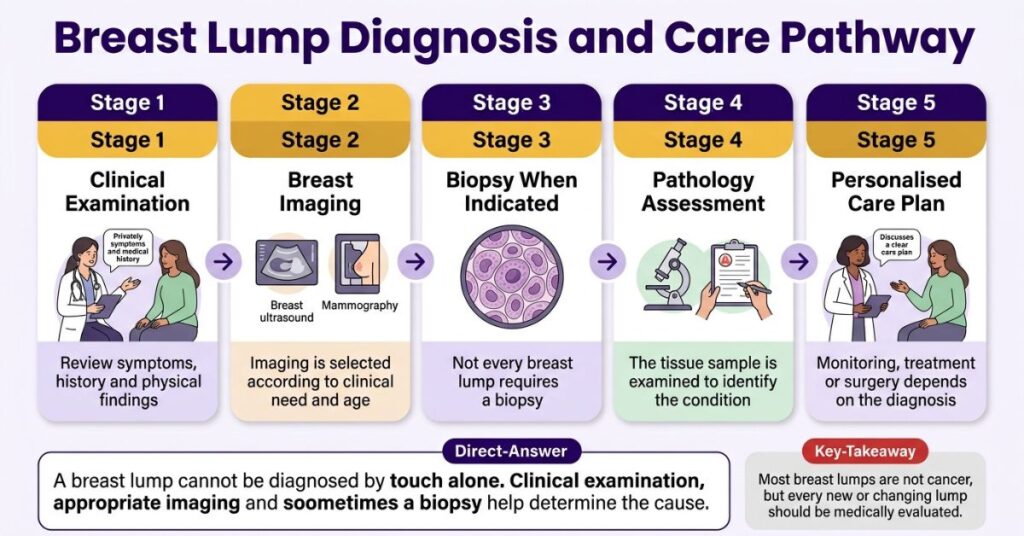
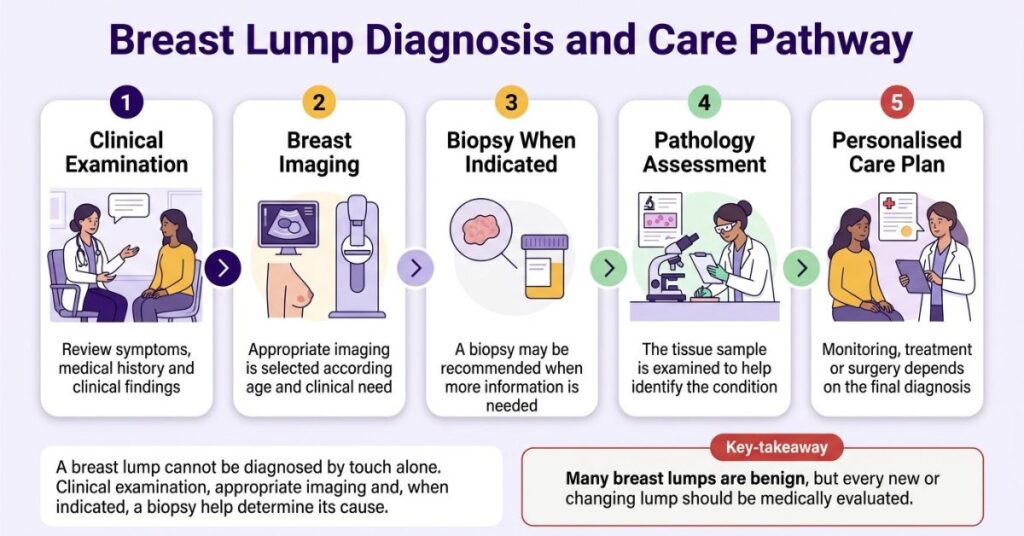
A careful breast lump diagnosis in Dhaka normally begins with history and examination. Further tests depend on age, pregnancy, symptoms, and what the doctor finds. Not every patient needs every test.
1. Clinical history and breast examination
The clinician asks when the change began and about pain, growth, discharge, fever, pregnancy, previous imaging, surgery, and family history. With consent, both breasts, nipples, and armpits may be examined.
2. Ultrasound or diagnostic mammography
Ultrasound can show whether an area is fluid-filled or solid and is often the initial test for younger or pregnant patients. Diagnostic mammography uses breast X-rays to assess a symptom. The American College of Radiology guidance explains that the appropriate first test changes with age and findings.
3. Biopsy when clinically indicated
Imaging cannot confirm every diagnosis. Fine-needle aspiration samples fluid or cells; core-needle biopsy removes small tissue samples. Surgical biopsy is used selectively. According to the NCI diagnosis guide, biopsy is the only sure way to diagnose breast cancer.
The best test is not the most expensive test. It is the test that matches your age, symptoms, examination, and earlier results.
How long does it take to get diagnosed after finding a breast lump?
There is no fixed timeline. Examination occurs at the first visit; imaging may be completed quickly or scheduled separately. Biopsy preparation and pathology take longer. Ask when each result is expected and who will explain it; do not assume silence means a normal result.
Bring previous images and reports, a medicine list, allergy details, and relevant family history.
What Treatment Options and Costs Should You Expect?
Breast lump treatment in Dhaka depends on the confirmed cause, symptoms, imaging, and pathology. There is no single treatment for every lump.
Breast lump treatment without surgery
Non-surgical care may be appropriate when tests support a benign diagnosis. A simple cyst may need observation or aspiration if painful. Some fibroadenomas can be monitored. Infection may need antibiotics, and an abscess may require drainage.
Benefits: avoiding unnecessary surgery, anaesthesia, scars, and recovery.
Limitations: follow-up remains essential; a growing or uncertain lesion may need imaging or biopsy. Do not delay investigation with home remedies.
When is surgery considered?
Breast lump surgery in Dhaka may be discussed when a lesion is suspicious, growing, painful, difficult to diagnose, or when imaging and pathology disagree. If cancer is diagnosed, a breast surgeon, radiologist, pathologist, and oncology team may plan care according to type and stage.
Removal and biopsy cost in Dhaka
There is no reliable citywide fixed price. Breast lump removal cost in Dhaka varies with the procedure, surgeon, hospital, anaesthesia, admission, and pathology. Breast lump biopsy cost in Dhaka changes according to whether it is fine-needle aspiration, core, image-guided, or surgical biopsy.
Request an itemised estimate covering:
- consultation and examination;
- required imaging;
- biopsy and image guidance;
- clinician, radiologist, anaesthetist, theatre, and hospital charges;
- pathology or other laboratory tests if required;
- medicines, dressings, admission, and follow-up; and
- another procedure if the first sample is insufficient.
The lowest quote is not automatically safest. Compare inclusions, pathology, and follow-up. An exact estimate should follow assessment.
Breast Lump During Pregnancy or Breastfeeding
A breast lump during pregnancy may relate to normal breast change, a fibroadenoma, blocked duct, infection, or galactocele, but cancer can also occur. Do not wait until delivery or the end of breastfeeding for assessment.
Ultrasound is usually the first imaging test during pregnancy because it does not use ionising radiation. If needed, the team may recommend other imaging or biopsy with pregnancy-specific planning. Tell them you are pregnant or breastfeeding.
Painful redness with fever can indicate mastitis or an abscess and needs prompt care. For other pregnancy-related anorectal concerns, see the guide to piles during pregnancy; it does not replace assessment of a breast symptom.
How to Choose a Breast Lump Doctor in Dhaka
A qualified breast lump doctor in Dhaka should examine you respectfully, recommend evidence-based tests, and explain the plan. When comparing a breast lump specialist in Dhaka, consider:
- Registration and training: Verify registration and breast-surgery experience.
- Diagnosis first: Be cautious if surgery is offered before examination or imaging.
- Coordinated care: Imaging, pathology, surgery, and referral should connect.
- Privacy: A female breast lump doctor in Dhaka may feel more comfortable for some women, but competence remains essential.
- Follow-up: Ask who will discuss every result.
There is no universal best breast lump doctor in Dhaka. Choose a registered, experienced clinician who explains alternatives and follow-up without guarantees.
Dr. Reshma Aziz’s relevant credentials and experience
Dr. Reshma Aziz is a Dhaka-based consultant surgeon with documented breast, colorectal, general, and paediatric surgical experience. Her breast-care background includes:
- MBBS, Dow Medical College, 1994;
- Breast Surgery training, Institute of Post Graduate Medical Research, 1998;
- Diploma in Clinical Ultrasonography, Jefferson Ultrasound and Research Institute, 2000;
- Master’s in Paediatric Surgery, University of Dhaka, 2003;
- clinical and surgical work since 1996, including breast-surgery responsibilities in Bangladesh and Pakistan; and
- consultant practice covering benign and malignant breast conditions on her official website.
Her BMDC Registration No. A-24611 can be checked through the official Bangladesh Medical and Dental Council record.
What questions should I ask my doctor about a breast lump?
Ask these questions:
- What are the most likely causes in my case?
- Which test should I have first, and why?
- Do I need a biopsy, and which type?
- If the result is benign, do I need follow-up imaging?
- What changes should make me contact you sooner?
- When and how will I receive each result?
A clear plan should state the next test, expected timing, follow-up, and urgent warning signs.
Frequently Asked Questions
Is breast lump always cancer?
No. Cysts, fibroadenomas, hormonal change, infection, and other benign conditions are common. Because cancer can also present as a lump, examination and appropriate tests are needed.
Can a lump disappear without treatment?
Some cysts or hormone-related changes may settle, but a new lump still needs assessment and the advised monitoring plan.
Is a painful lump less likely to be cancer?
Pain is common with benign conditions but does not rule cancer in or out. Persistent focal pain or a painful lump needs evaluation.
Do all breast lumps need a biopsy?
No. The decision follows age, examination, imaging features, and medical history. A biopsy is recommended when tissue is needed to confirm the diagnosis.
Do all breast lumps need removal?
No. Many benign lumps can be observed. Removal may be advised for growth, symptoms, uncertainty, or suspicious findings.
What happens at the first appointment?
Expect a history discussion and consent-based breast and armpit examination. The doctor may recommend ultrasound, mammography, biopsy, or follow-up.
Key Takeaways and Next Step
- A new lump is not automatically cancer, but it should not be self-diagnosed.
- Clinical examination and age-appropriate imaging usually come before treatment.
- A biopsy is used when tissue is needed for a definite diagnosis.
- Non-surgical monitoring may suit some confirmed benign conditions; other lumps need aspiration, drainage, biopsy, or surgery.
- Cost depends on the complete diagnostic and treatment pathway.
- Pregnancy should not delay assessment of a persistent change.
If you have found a new, persistent, or changing breast condition, arrange a confidential consultation with Dr. Reshma Aziz in Dhaka, Bangladesh. Bring earlier reports and images, then discuss the next test, timeline, alternatives, and a written estimate.
Related health guides
Medical review note: Dr. Reshma Aziz should review and approve this article before publication.
Medical disclaimer: This article provides general education and does not replace a medical consultation. Seek urgent care for rapidly increasing swelling, spreading redness, fever, severe illness, or other alarming symptoms.