
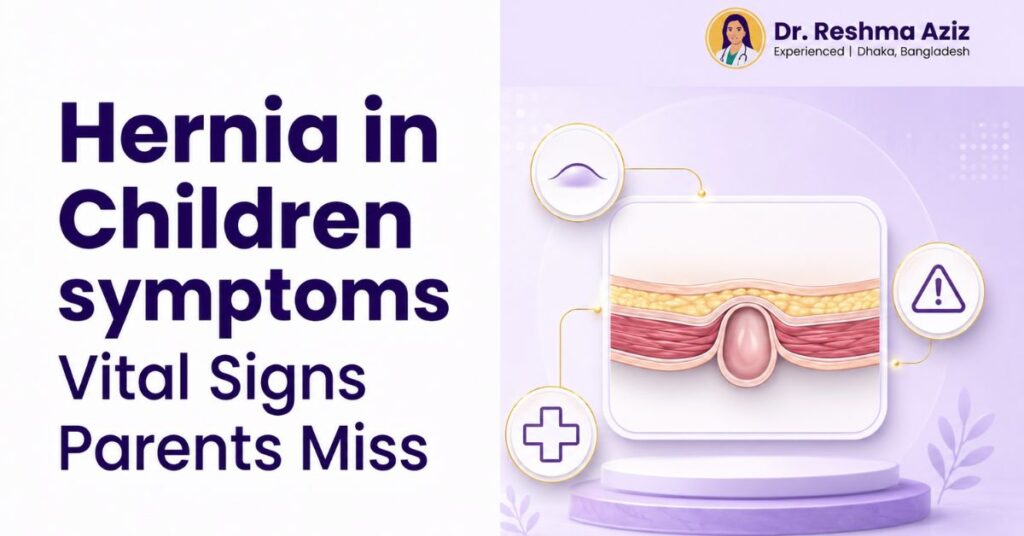
A soft lump in a child’s groin, scrotum, or belly button that becomes clearer during crying may be a hernia. The most important hernia in children symptoms are a changing bulge and – in an emergency – a hard, painful lump, vomiting, abdominal swelling or unusual distress. A suspected hernia needs medical examination. Seek emergency care if the swelling is painful, discoloured, firm or does not settle when the child relaxes.
A hernia happens when tissue pushes through an opening in the abdominal wall. In children, it most often appears in the groin or at the belly button. Only a medical examination can confirm it.
Parents may notice the lump during a nappy change or while the baby cries, yet find that it vanishes before the appointment. This guide explains hernia in children symptoms, common types, warning signs, evaluation, treatment and care in Dhaka.
What Do Hernia in Children Symptoms Mean?
A hernia forms when tissue inside the abdomen moves through an opening in the muscle wall. Many childhood hernias involve an opening that did not fully close during development. Crying does not cause it; pressure simply makes the bulge easier to see.
The two common patterns are:
- Inguinal hernia: A bulge in one or both groins. In boys, it may extend into the scrotum. In girls, it may appear in the groin or labial area.
- Umbilical hernia: A soft bulge at the belly button, often most visible when a baby cries, coughs or strains.
These hernia in children symptoms may be painless. Review is still important because the plan depends on the location, age and whether tissue is trapped.
How Do Hernia in Children Symptoms Begin?
The earliest sign is usually a visible or felt swelling rather than severe pain. Common child hernia symptoms include:
- A soft lump in the groin, scrotum or belly button
- A bulge that becomes larger when the child cries, coughs, stands or strains
- A lump that becomes smaller or disappears when the child relaxes or lies down
- Mild discomfort or pressure around the swelling
- Irritability or feeding difficulty in a baby
- Swelling on one or both sides
A child hernia lump when crying can be intermittent. A clear photo or short video may help if it disappears before the visit. Never delay urgent care to take a picture.
Not every result for baby groin swelling hernia symptoms describes a hernia. Hydroceles, lymph nodes and testicular conditions may look similar, so examination matters.
Comparing Hernia in Children Symptoms by Type
The bulge’s location and behaviour help a clinician narrow the possibilities but do not confirm a diagnosis at home.
| Feature | Inguinal hernia | Umbilical hernia |
|---|---|---|
| Typical location | Groin, scrotum or labial area | Belly button |
| Common appearance | Soft, smooth swelling that may come and go | Rounded navel bulge, clearer with crying or straining |
| Pain | Often painless; discomfort can occur | Usually painless |
| Natural course | Does not reliably close by itself | Many small cases close as the child grows |
| Usual plan | Surgical assessment and repair | Observation may be suitable until age 4-5; surgery for persistence, symptoms or complications |
| Emergency clues | Hard, tender, discoloured or fixed groin lump; vomiting or distress | Sudden pain, vomiting, tenderness, discolouration or a fixed bulge |
Inguinal hernia symptoms in children
Classic groin hernia symptoms in children include a lump that enlarges with crying and fades at rest. The American Academy of Pediatrics explains that this developmental opening generally requires repair.
Hernia symptoms in baby boys can include swelling into the scrotum. Hernia symptoms in baby girls may appear in the groin or labial area; an ovary can sometimes enter the sac, so prompt assessment matters. Do not force a lump inward.
Umbilical hernia symptoms in children
An umbilical hernia is usually a soft navel bulge, clearer during crying. The American College of Surgeons notes that it is commonly painless and many small defects close by around age four, with observation sometimes continuing until age five.
Do not tape a coin or tight wrap over the navel. It will not close the opening and may irritate the skin.
Can Hernia in Children Symptoms Differ by Age or Sex?
The signs of hernia in newborn baby may be subtle: a bulge during crying, distress or poor feeding. Younger and premature babies need prompt assessment because complication risk is higher.
In boys, a groin hernia can reach the scrotum and resemble a hydrocele. In girls, reproductive tissue may occasionally enter the sac. Neither pattern can be diagnosed safely from a photo.
Bulge size alone does not show danger. Consider comfort, skin colour, whether it softens at rest and digestive symptoms. If unsure about hernia in children symptoms, arrange review instead of waiting for pain.
Which Hernia in Children Symptoms Need Emergency Care?
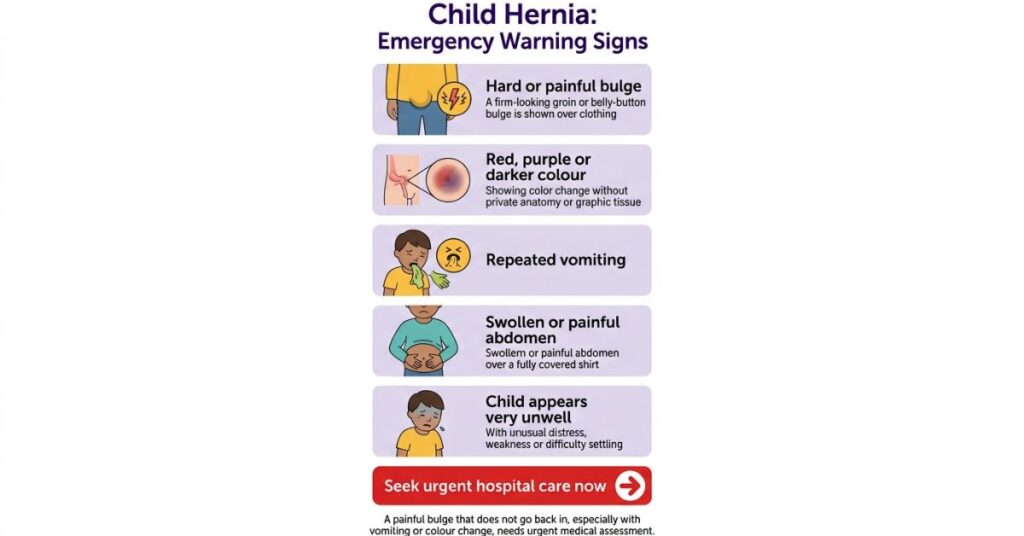
Go to the nearest emergency department now if the lump becomes hard, very tender, red, purple or blue-grey; no longer becomes smaller; or occurs with severe pain, repeated vomiting, a swollen abdomen, fever, poor feeding, unusual sleepiness or inconsolable crying.
These may be strangulated hernia symptoms in children. Incarceration means tissue is trapped; strangulation means its blood supply may be compromised. Both need urgent attention, and suspected strangulation is a surgical emergency.
Do not force the lump inward. Follow emergency staff instructions about food and drink because anaesthesia may be needed.
The Royal Children’s Hospital Melbourne advises urgent care for pain, vomiting, bloating, fever or a tender discoloured swelling. When hernia in children symptoms change suddenly, choose emergency assessment.
How Are Hernia in Children Symptoms Diagnosed?
A doctor starts with the parent’s account and an examination, checking the bulge’s location, texture and behaviour and both groins.
Imaging is not always needed. Ultrasound may help when findings are unclear or another condition must be excluded. A photo of intermittent swelling can help but cannot replace examination.
What parents should note
- When the swelling appeared and what makes it larger
- Whether it disappears during sleep or lying down
- Prematurity, pain, vomiting, feeding changes and bowel movements
- Previous reports or scans
This information helps the clinician interpret pediatric hernia symptoms and decide whether observation, imaging, planned repair or emergency referral is appropriate.
How Are Hernia in Children Symptoms Treated in Dhaka?
The best option depends on the hernia type.
Inguinal hernia treatment
A confirmed inguinal hernia is generally repaired because it will not reliably close and can become trapped. Timing and technique depend on age, prematurity, symptoms, sides involved, anaesthesia and hospital resources.
Umbilical hernia treatment
Observation often suits a painless umbilical hernia because many close naturally. Surgery may be considered for persistence, symptoms or trapping. Waiting is inappropriate with emergency signs.
| Option | Potential benefit | Important limitation |
| Observation for a suitable umbilical hernia | May avoid unnecessary surgery | Needs follow-up; unsuitable for a confirmed inguinal hernia |
| Planned repair | Closes the defect and lowers trapping risk | Involves anaesthesia, recovery and procedure risks |
| Emergency surgery | Treats trapped or strangulated tissue | Has added emergency complexity |
Child hernia treatment in Dhaka: cost factors
There is no responsible single price for child hernia treatment in Dhaka without examination and a hospital plan. Cost varies with:
- Consultation and assessment
- Hernia type, sides involved and urgency
- Open versus laparoscopic approach
- Anaesthesia and theatre charges
- Tests, medicines and supplies
- Day care versus overnight stay
- Hospital and follow-up arrangements
Ask for an itemised estimate. Pediatric surgical experience, qualified anaesthesia, emergency backup and follow-up matter more than the lowest quote alone.
When to See Doctor for Child Hernia in Dhaka
Arrange an appointment when hernia in children symptoms repeat, even without pain. Use emergency care when warning signs are present.
When choosing a child hernia doctor in Dhaka, ask about pediatric-surgery training, experience, the operating facility, anaesthesia and emergency support. The consultation should explain the diagnosis, options, timing, risks, recovery and estimated cost.
Dr. Reshma Aziz is an MBBS doctor with a Master’s in Paediatric Surgery from Dhaka University and more than 30 years of medical experience. Her CV records work at Dhaka Shishu (Children) Hospital from 1996 to 2004 and later pediatric surgical care. Her active BM&DC registration, A-24611, appears in the official verification record.
An appointment allows evaluation; it does not mean surgery is automatic or every case suits the same facility. Emergency symptoms belong in an emergency department.
Related health resources for parents and caregivers
- Thyroid symptoms in women
- Piles during pregnancy
- Breast lump evaluation guide
- Breast cancer symptoms guide
Frequently Asked Questions
What are the early signs of a hernia in children?
Early hernia in children symptoms usually include a soft groin, scrotal or belly-button bulge that grows during crying, coughing or straining and becomes smaller at rest. Pain is not always present.
How can I tell if my child has an umbilical hernia?
An umbilical hernia often appears as a soft, rounded bulge at the navel, especially during crying. A clinician should confirm it because other belly-button conditions can look similar.
Is that bulge above my child’s belly button normal?
Not every bulge is a hernia. A swelling at or above the belly button may have several causes. Arrange an examination, particularly if it persists, enlarges, hurts, changes colour or occurs with vomiting.
Does crying cause a hernia in a baby?
No. Crying raises abdominal pressure and can reveal an opening that was already present; it does not usually create the developmental defect.
Can hernia in children symptoms improve without surgery?
Many uncomplicated umbilical hernias close by age four or five. A confirmed inguinal hernia generally requires repair. Examination determines the plan.
Can parents push the lump back in?
Do not force it. Seek emergency care for a hard, painful, discoloured or fixed bulge. A clinician decides whether reduction is safe.
When should a child with a hernia go to emergency?
Go immediately for severe or persistent pain, a hard or discoloured lump, repeated vomiting, abdominal swelling, fever, poor feeding, marked sleepiness or inconsolable crying.
Conclusion: Notice the Pattern and Act Early
The most recognisable hernia in children symptoms are a groin or belly-button bulge that changes with crying and rest. Sudden pain, vomiting, colour change or a fixed swelling can signal an emergency.
For a repeated lump, schedule a pediatric surgical assessment and bring notes, reports or a clear photo. For urgent warning signs, go to the nearest emergency department. Early assessment supports the safest next step.