
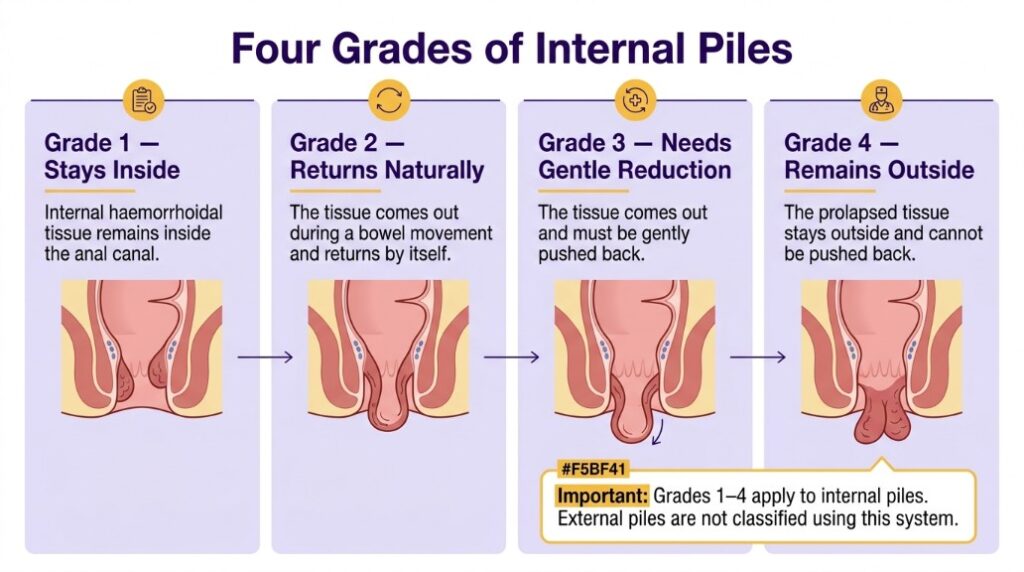
Piles, also called haemorrhoids, are enlarged or displaced vascular cushions in the anal canal. The four grades of piles describe internal haemorrhoids according to how far they prolapse, or come out, during a bowel movement. Grade 1 stays inside; Grade 2 comes out but returns by itself; Grade 3 must be pushed back; and Grade 4 remains outside. The grade helps a doctor discuss treatment, but bleeding, pain, health and examination findings matter too. This guide explains each stage, how diagnosis works and when people in Dhaka should seek care.
Quick answer: How many grades of hemorrhoids are there? There are four grades for internal haemorrhoids. External piles are not classified with this Grade 1–4 system.
What Are the Different Grades of Piles?
The grades of piles are commonly described using the Goligher classification. It focuses on prolapse rather than the amount of bleeding or pain. Someone can therefore have a lower grade with troublesome bleeding, while another person with a higher grade may report surprisingly little pain.
| Grade | What happens | Typical symptoms | Usual starting approach |
|---|---|---|---|
| Grade 1 | Swollen tissue remains inside the anal canal | Bright-red bleeding, itching or discomfort | Fibre, fluids and healthier toilet habits |
| Grade 2 | Tissue prolapses while passing stool, then returns itself | Bleeding, mucus, itching or a temporary lump | Conservative care; an office procedure if persistent |
| Grade 3 | Prolapse must be gently pushed back | Recurrent lump, discharge, irritation or bleeding | Office procedure or surgery, depending on findings |
| Grade 4 | Prolapse stays outside and cannot be reduced | Persistent lump, irritation, bleeding or pain | Specialist assessment; surgery is often considered |
This classification applies to the grades of internal piles. An external haemorrhoid develops beneath the skin around the anus and may become acutely painful if a clot forms. Mixed haemorrhoids contain internal and external components, so their management cannot be decided from an internal grade alone.
Four Grades of Piles: Symptoms and Treatment Options
Grades of piles: understanding Grade 1
Grade 1 haemorrhoids do not prolapse outside. The first clue may be painless, bright-red blood on toilet paper, in the bowl or coating the stool. Some people also notice itching.
Treatment begins by softening stool and reducing strain: eat fibre-rich foods, drink adequate water, stay active, respond to the urge to pass stool and limit toilet time. Persistent bleeding needs assessment because piles are not the only cause. See piles symptoms and warning signs for guidance.
Grade 2: prolapse returns naturally
Grade 2 tissue may appear during straining but moves back inside without assistance. Symptoms can include bleeding, mucus, irritation and an intermittent lump. Many patients ask about grade 2 piles treatment without surgery. Lifestyle changes remain the first step. If symptoms continue, a clinician may discuss an office-based option such as rubber-band ligation, sclerotherapy or infrared coagulation, subject to availability and suitability.
The best option depends on symptoms, examination findings, medicines, pregnancy and previous treatment. People whose constipation keeps triggering symptoms may benefit from a constipation evaluation in Dhaka.
Grade 3 piles: prolapse requiring manual reduction
With Grade 3 disease, prolapsed tissue does not return itself but can usually be pushed back. Bleeding, mucus, itching and cleaning difficulties may affect daily life. Selected cases respond to an office procedure; others need an operation. A clinician should compare likely relief, recovery and recurrence risk.
What is stage 4 piles?
Grade 4, sometimes called stage 4, means the prolapsed internal haemorrhoid stays outside and cannot be pushed back. It can cause swelling, soiling, irritation, bleeding or pain, particularly with strangulation or thrombosis.
Short answer: Grade 4 is the most advanced prolapse category. It does not mean cancer, but it requires specialist assessment because conservative measures usually cannot correct the prolapse itself.
Can Grade 4 piles be cured without surgery? Fibre, fluids and medication may ease constipation, irritation or discomfort, but they do not reliably return fixed prolapsed tissue to its normal position. Surgery is commonly considered after diagnosis. Patients can review piles treatment options in Dhaka and discuss which approach fits their condition.
How to Identify Grades of Piles
Trying to grade a lump at home is unreliable. Anal fissure, fistula, skin tags, rectal prolapse and other conditions can resemble haemorrhoids. Likewise, rectal bleeding should never automatically be blamed on piles.
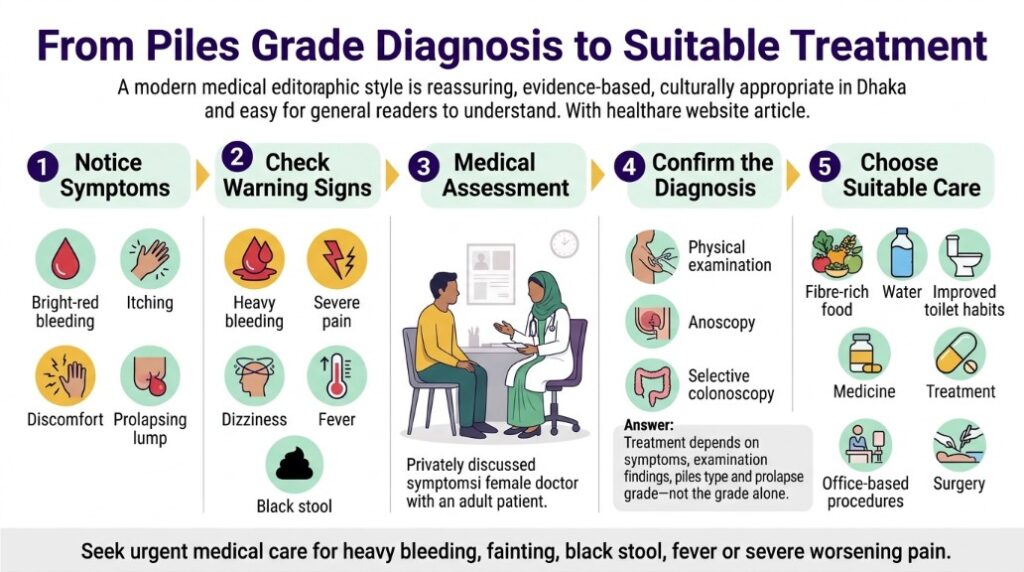
A proper piles grade diagnosis in Mohammadpur or elsewhere usually follows these steps:
- History: The doctor asks about bleeding, pain, prolapse, bowel habits, constipation, medicines, pregnancy and family history.
- External inspection: This can reveal swelling, skin changes, fissures, external thrombosis or visible prolapse.
- Digital rectal examination: When appropriate, a gloved finger checks tenderness, muscle tone, masses and blood.
- Anoscopy or proctoscopy: A short instrument allows the clinician to see the anal canal and internal haemorrhoids.
- Further investigation: Selected patients may need sigmoidoscopy or colonoscopy when bleeding is unexplained, persistent or accompanied by bowel changes.
If you are wondering how to identify grade of piles, notice whether a lump appears only during a bowel movement, returns itself, needs gentle reduction or stays outside. Record this information for the consultation, but do not force a painful lump inward. A clinician must confirm the grades of piles and exclude other causes. Read the comparison of anal fissure versus piles if sharp pain during or after passing stool is the main problem.
Which Grades of Piles Need Surgery?
No grade automatically determines treatment. Most Grade 1 and Grade 2 cases start with dietary and behavioural measures. Office procedures may help persistent lower-grade and selected Grade 3 disease. Surgery is considered more often for symptomatic Grade 3, Grade 4, large external haemorrhoids, mixed disease or failed less-invasive care.
The choice may include haemorrhoidectomy or another procedure suited to the anatomy. Laser is a technique, not a universal answer; benefits, limitations, recovery and cost need discussion before consent. Learn about laser piles treatment in Dhaka without assuming every stage requires it.
Which grade piles is dangerous?
The grades of piles indicate prolapse severity, not danger by themselves. Grade 4 generally needs earlier specialist review, but heavy bleeding or severe pain at any grade can be urgent. Seek prompt medical care for:
- heavy, continuous or recurrent bleeding;
- fainting, marked weakness, dizziness or breathlessness;
- black, tarry stool;
- fever, pus or rapidly increasing swelling;
- severe or worsening anal pain;
- weight loss, abdominal pain or a persistent change in bowel habits.
For ongoing or unexplained bleeding, arrange a rectal bleeding evaluation in Dhaka. Emergency symptoms require urgent care rather than an online appointment.
Grades of Piles Treatment in Dhaka: Choosing Care
The best option is the least invasive treatment likely to control the problem safely. A consultation should confirm the diagnosis, explain the grade, discuss alternatives and set realistic expectations. Cost cannot be calculated from the grades of piles alone; it changes with the procedure, tests, anaesthesia, facility and follow-up. Request a written estimate after examination.
Dr. Reshma Aziz’s professional profile documents more than 20 years of clinical and surgical experience, postgraduate colorectal training and laser proctology training. Her Bangladesh Medical and Dental Council registration is A-24611; patients can view the BMDC credential record. Review her qualifications and surgical training before booking.
Frequently Asked Questions
How many grades of piles are there?
There are four grades of piles for internal haemorrhoids. Grade 1 remains inside, Grade 2 returns naturally, Grade 3 requires manual reduction and Grade 4 remains prolapsed.
How do I know what grade of piles I have?
The pattern offers a clue, but only an examination can confirm the grade and rule out similar conditions. Anoscopy is often used to view internal haemorrhoids.
Can Grade 2 piles improve without surgery?
Yes. Many improve with fibre, adequate fluids, regular activity and less straining. Persistent bleeding or prolapse may need an office-based procedure.
Does Grade 3 always require an operation?
No. Selected cases may be treated with an office procedure, while others benefit from surgery. Symptoms, external disease and previous treatment guide the decision.
Is Grade 4 piles cancer?
No. Grade 4 describes fixed haemorrhoid prolapse, not cancer. However, bleeding and bowel changes still need assessment because different diseases can produce similar symptoms.
What is the best treatment for piles?
The best treatment matches the confirmed diagnosis, prolapse grade, symptoms and patient priorities. It may range from bowel-habit changes to an office procedure or surgery.
Key Takeaway and Next Step
Understanding the grades of piles helps explain prolapse, but it cannot replace a diagnosis. Grade 1 stays inside, Grade 2 returns itself, Grade 3 must be reduced and Grade 4 stays outside. Treatment should address symptoms, bowel habits and the complete examination—not a number alone.
If bleeding, prolapse or pain persists, arrange an evaluation rather than self-treating indefinitely. Patients can book an appointment with Dr. Reshma Aziz for assessment in Dhaka and a personalised discussion of suitable next steps.
Medical note: This educational article is not a diagnosis. Seek urgent care for severe bleeding, fainting, black stool, fever or rapidly worsening pain.